
Leucaena psyllid
Heteropsylla cubana
Description
How to identify
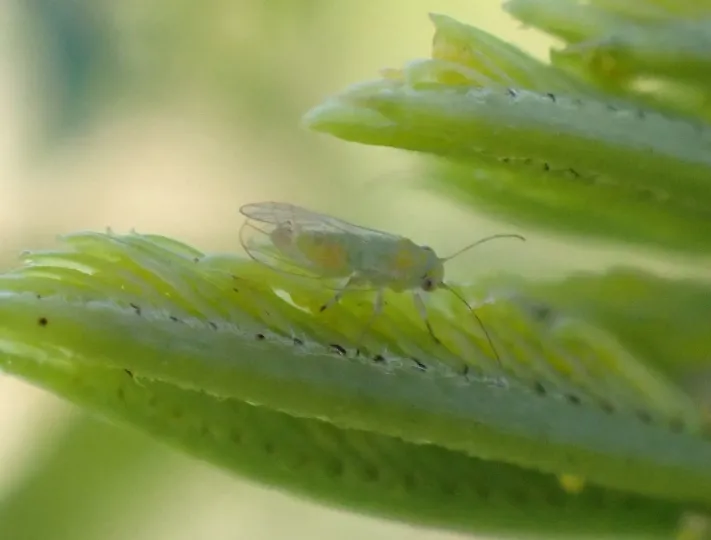
The Leucaena psyllid (Heteropsylla cubana) is a tiny insect belonging to the family Psyllidae, order Hemiptera. Adult specimens typically measure between 1 and 2 millimeters in length.
Adults exhibit a yellow-green to brownish coloration, providing excellent camouflage against the foliage of their primary host, the Leucaena tree.
Females lay their eggs in clusters on newly emerged, succulent leaf buds, where the larvae will find an immediate food source upon hatching.
The nymphs undergo several instar stages, increasing in size and mobility until they reach the adult winged stage, capable of spreading between trees.
Identification in the field is usually achieved by inspecting the apical buds, where nymphs congregate in large, visible numbers to feed on plant sap.
What it damages
The primary host for Heteropsylla cubana is the Leucaena leucocephala tree, which is vital for forage, fodder, and reforestation in many tropical regions.
Feeding by both adults and nymphs causes severe stress to the host, resulting in leaf drop, stunted shoot growth, and a drastic reduction in biomass.
The insects pierce plant tissues to extract phloem sap, which causes the leaves to curl, yellow, and eventually wither away completely.
Ongoing infestations reduce the nutritional quality of the forage, rendering the crop less palatable and less productive for livestock feeding.
In severe cases, the cumulative damage leads to the dieback of entire branches, potentially killing younger trees that cannot recover from the stress.
When it appears
The population dynamics of the Leucaena psyllid are closely tied to the flushing cycle of the host tree, as they require fresh growth to feed and reproduce.
In tropical climates, the psyllid can breed continuously throughout the year, with multiple overlapping generations occurring in a single season.
Outbreaks are frequently observed following periods of rainfall, which trigger abundant new leaf production in the Leucaena trees.
Development from egg to adult is rapid, often taking less than two weeks under warm conditions, allowing the population to explode in a short time.
Monitoring should be constant, especially during the rainy season when the trees produce the tender tissues that these insects prefer.
Signs of infestation
The most distinctive symptom of infestation is the yellowing and downward curling of the newest leaves at the tips of branches.
Heavy infestations are accompanied by the secretion of copious amounts of honeydew, which creates a sticky surface on the foliage and stems.
This honeydew serves as a substrate for the growth of sooty mold, a fungus that covers the leaves in black patches, further reducing photosynthesis.
Presence of numerous yellowish-orange nymphs within the folded leaf buds is a definitive sign of an active infestation.
Progressive dieback of terminal shoots is a common indicator that the colony has reached a critical density level requiring intervention.
Control measures
The most sustainable management approach is the utilization of psyllid-resistant Leucaena cultivars, which have been developed through breeding programs.
Biological control involves the introduction and conservation of natural enemies, such as ladybird beetles, syrphid flies, and specific predatory bugs.
Chemical control, while effective, is generally reserved for nurseries or high-value experimental plots rather than large-scale fodder plantations.
Proper pruning and thinning of stands can help improve air circulation, potentially reducing the suitability of the environment for the psyllids.
- Select and plant resistant Leucaena varieties.
- Maintain diverse ecosystems to support natural predators.
- Monitor bud development frequently during flush periods.
Taxonomy
- Latin name
- Heteropsylla cubana
- Order
- Hemiptera (bugs, aphids, leafhoppers)
- Family
- Psyllidae
- EPPO code
- HETYCU
Discussion
No discussions yet — be the first.