
Hop cyst nematode
Heterodera humuli
Description
How to identify
The hop cyst nematode (Heterodera humuli) belongs to the phylum Nematoda, class Secernentea, order Tylenchida, and family Heteroderidae. This specialized parasite forms cysts that protect eggs from harsh environmental conditions.
Females of this species are lemon-shaped and turn into brown cysts as they mature, which remain in the soil. Males are thread-like and capable of active movement in the soil substrate to search for a mate.
Second-stage larvae are the invasive form; they penetrate the host plant's root system, where they continue their development. Detecting the nematode externally without laboratory analysis is extremely difficult due to its microscopic size.
The parasite's life cycle is closely linked to the seasonal growth period of hops. Cysts can remain viable in the soil for several years, waiting for favorable conditions and the presence of hop root exudates.
To accurately identify the presence of the pest on a site, soil sampling or staining methods for root analysis are used, as infested roots often lack obvious external galls or symptoms.
What it damages
The primary host is common hop (Humulus lupulus). The nematode parasitizes the root system exclusively, depleting the plant's energy reserves.
Certain species of nettle can serve as secondary hosts, maintaining the parasite population even in the absence of the main crop.
Damage to root integrity reduces the plant's ability to absorb water and nutrients from deep soil layers. This makes the hop plant extremely susceptible to drought and micronutrient deficiencies.
Severe infestation by the nematode compromises the roots, creating entry points for secondary fungal and bacterial infections, which significantly accelerates the development of root rots.
In commercial hop yards, the presence of Heterodera humuli leads to reduced stand density, lower cone yields, and degradation of the biochemical quality of the harvest.
Signs of infestation
The first sign of infestation is general plant stunting: shoots grow slowly, and leaves appear smaller than normal. Affected plants look weak and chlorotic compared to their healthy neighbors.
When the root system is damaged, leaf turgor decreases even when soil moisture is adequate. During dry periods, infested plants wilt much faster and take longer to recover.
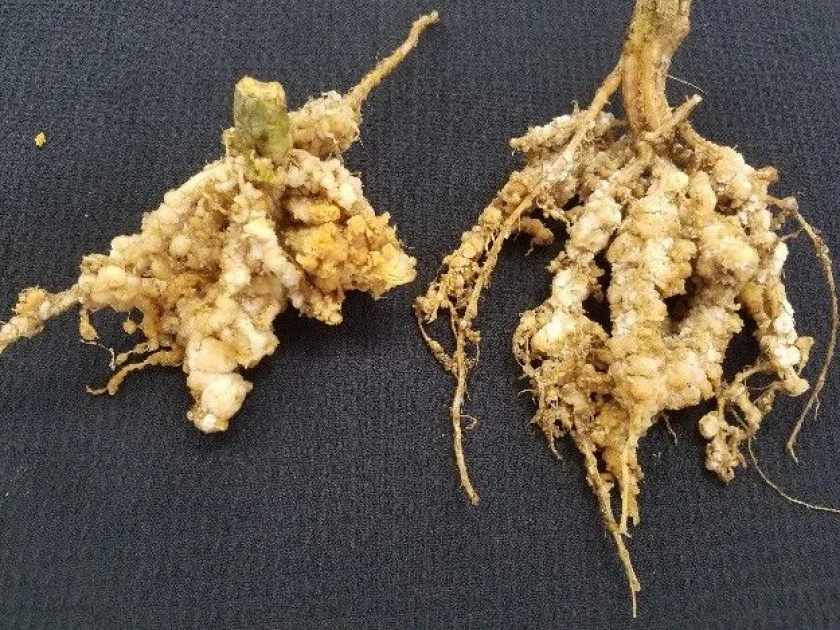
Upon close inspection, small whitish or brown structures — the female cysts — may be visible on the roots. However, they are easily confused with soil particles, so a magnifying glass is essential for detection.
A significant reduction in root mass is observed; roots become brittle and exhibit brown necrotic spots. The development of lateral roots is almost entirely halted, reducing the plant's anchor stability.
Ultimately, infested areas of the plantation are characterized by the appearance of gaps where the hop plants either die or lose all productive capacity.
Control measures
The cornerstone of management is crop rotation, which excludes hops from the same site for 5–7 years. Planting non-host crops helps naturally clear the soil of cysts.
Using disease-free planting material is the primary guarantee of keeping young plantations free from nematodes. It is essential to inspect all nursery stock for hidden infections before planting.
- Applying organic fertilizers to stimulate beneficial soil microflora that suppresses nematode activity.
- Systematic weed control, particularly of nettle, which acts as a reservoir for the pest.
- Using biological products based on antagonistic fungi, such as Pochonia chlamydosporia, to degrade cysts.
Chemical control involves the application of nematicides to the soil before planting or into the root zone, though the use of these chemicals is strictly regulated and limited due to high toxicity.
It is vital to disinfect agricultural tools and machinery when moving from infested fields to clean ones, as nematodes are easily spread through soil debris attached to equipment.
Taxonomy
- Latin name
- Heterodera humuli
- Order
- Nematodes
- Family
- Heteroderidae
- EPPO code
- HETDHU
Discussion
No discussions yet — be the first.