
Heteracris leani
Heteracris leani
Description
How to identify
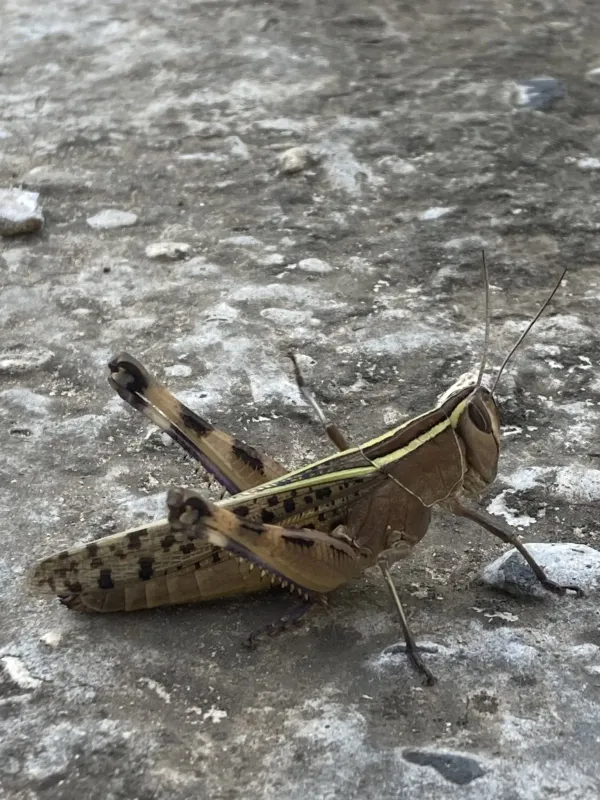
Heteracris leani is a species of grasshopper belonging to the Acrididae family. The adults are medium-to-large insects, reaching lengths of 30–45 mm, characterized by an elongated body shape.
Their coloration is typically greenish-brown or greyish, providing excellent camouflage among grasses and crops. They possess well-developed, translucent wings that allow them to fly significant distances when seeking food.
The head is robust with large compound eyes and strong mandibles, which are adapted for cutting and chewing tough plant tissues. The antennae are filiform and of moderate length, serving as a key diagnostic feature.
The hind legs are thick and muscular, typical of jumpers. A distinguishing feature of this species is often found on the inner surface of the hind femora, which may show specific dark patterns or stripes.
Nymphs resemble the adults but are smaller, wingless, and often display more uniform coloring. Their development occurs through several instars, with each stage showing increased voracity.
What it damages
Heteracris leani is a polyphagous pest, meaning it consumes a wide variety of plants. It poses a significant threat to cereal crops, including wheat, barley, maize, and sorghum, which are staple food sources.
The pest causes damage by feeding on leaves, stems, and sometimes grain heads. When populations are high, they can defoliate entire plants, leaving only the main veins and stems behind.
During drought periods, when natural vegetation dries up, these grasshoppers migrate to cultivated fields, often causing severe damage to borders and spreading inwards as they deplete available resources.
Seedlings are particularly vulnerable; a heavy infestation at the early stages of crop growth can result in significant stand reduction, often necessitating the replanting of large areas.
Beyond cereals, they may feed on vegetables and legumes, making them a generalist pest that requires careful monitoring across different types of agricultural landscapes.
When it appears
The lifecycle of Heteracris leani is closely linked to seasonal changes. They overwinter as eggs buried in the soil, usually in areas with sparse vegetation or along field margins.
Nymphs hatch in the spring as soil temperatures rise. Their emergence typically aligns with the active growth phase of winter and spring cereals, providing them with an immediate food supply.
The nymphal stage lasts for approximately 4 to 6 weeks, during which the insects are gregarious and feed intensely. As they molt through successive instars, their food requirements increase substantially.
Adults typically appear in mid-summer. This period is marked by increased mobility and potential for large-scale movement from breeding sites to more lush, cultivated fields.
The life cycle is generally univoltine, meaning there is one generation per year. Egg-laying occurs in late summer and early autumn, ensuring the species survives until the following spring.
Signs of infestation
The first sign of infestation is often the presence of ragged leaf edges on crops. The grasshoppers feed from the margins inward, leading to a characteristic notched appearance of the leaves.
Visual spotting of the insects themselves is a reliable sign. In sunny weather, they are highly active and will jump or fly when disturbed, making them easy to observe during field scouting.
Heavily infested patches often appear as stripped areas within the field. These patches grow as the population moves and consumes the available vegetation in a particular sector.
The presence of fecal pellets on the soil surface or leaves confirms active feeding. Accumulations of frass can be quite noticeable during peak infestation periods.
In severe cases, you may observe the complete removal of leaf blades, leaving the field looking sparse, brown, and unhealthy, which indicates a critical level of pest pressure.
Control measures
Mechanical control through deep autumn plowing is the most effective preventative measure. This exposes the egg pods to cold weather and predators, significantly reducing the next generation's survival.
Maintaining clean field margins and eliminating weeds in non-cropped areas helps disrupt the pest's breeding cycle by reducing suitable egg-laying sites and early nymph food sources.
When populations reach the economic threshold, chemical control using insecticides is necessary. Effective agents include pyrethroids and organophosphates applied during the nymphal stages.
Targeted border spraying can be a highly efficient strategy to stop the pest from entering the field, saving costs and reducing the overall impact on beneficial insect populations.
- Regular monitoring using sweep nets to estimate population density.
- Integrated Pest Management (IPM) techniques to encourage natural predators.
Taxonomy
- Latin name
- Heteracris leani
- Order
- Orthoptera (locusts)
- Family
- Acrididae
- EPPO code
- HTACLA
Discussion
No discussions yet — be the first.