
Green hesperotettix
Hesperotettix viridis
Description
How to identify
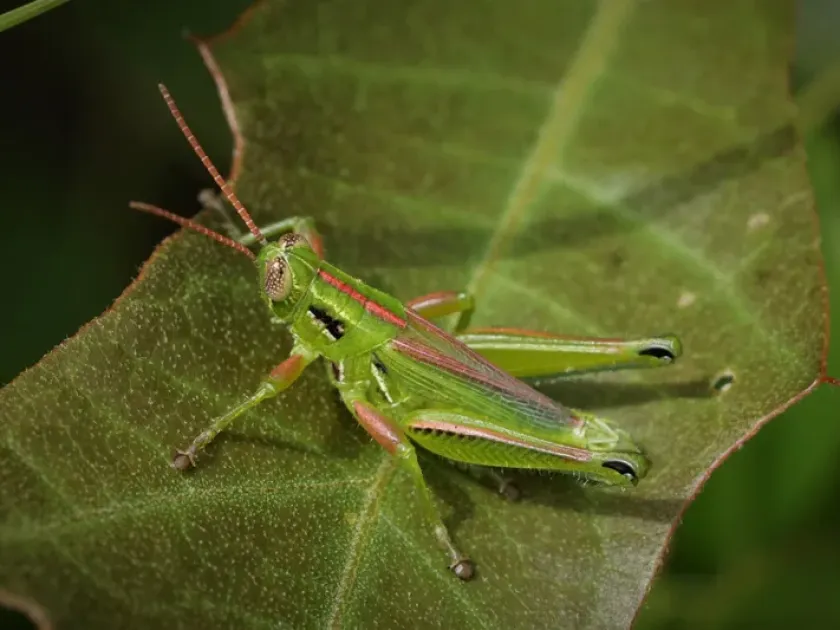
The Green Hesperotettix (Hesperotettix viridis) is a member of the Acrididae family, the true grasshoppers. This insect is well-adapted to its environment, utilizing its coloration as a natural camouflage against various grasses and herbs.
Adult insects typically measure between 15 and 25 millimeters in length. Their bodies display a vibrant green shade, often decorated with distinctive pink or purple stripes that run along the sides of the body and the pronotum.
They possess strong, well-developed hind legs designed for powerful jumping, a common characteristic of the Acrididae family. Their antennae are filiform, providing sensory input as they navigate through dense vegetation.
These grasshoppers are primarily found in open, sunny habitats with plenty of herbaceous vegetation. Their ability to blend into the foliage makes them challenging to spot until their population density becomes noticeably high.
Females are equipped with specialized ovipositor valves, enabling them to deposit egg pods deep into the soil. This reproductive strategy provides protection against desiccation and predation, ensuring the survival of the species.
What it damages
The Green Hesperotettix feeds on a variety of herbaceous plants. While they favor wild flora, they can become significant agricultural pests when their natural food sources are depleted or when their populations surge.
Both nymphs and adults inflict damage by feeding on leaves and stems. They consume leaf tissue, which directly impacts the plant's ability to undergo photosynthesis, leading to reduced vigor and stunted growth.
In cases of severe infestation, the pests can cause substantial defoliation. This is particularly devastating for young crops or high-value plantings that rely on a healthy canopy for proper development and yield.
They are known to target various species within the Asteraceae and Fabaceae families. The consumption of growing points and soft stems can permanently distort plant architecture, making the plants more susceptible to secondary infections.
Economic damage is most pronounced during drought years when natural range vegetation dries out, forcing the grasshoppers to migrate into irrigated fields in search of succulent food sources.
When it appears
The life cycle of Hesperotettix viridis is typically univoltine, meaning there is one generation per year. The timing of their development is closely tied to local temperature and moisture conditions.
The winter is passed in the egg stage, safely tucked away in the soil. As spring temperatures rise, the eggs undergo embryonic development, leading to the hatching of nymphs once the conditions are favorable.
Nymphal development takes several weeks, during which the insects pass through five to six instars. Each stage requires increasingly more food, marking the period of their most aggressive feeding behavior.
Adults emerge in mid-summer, typically around July. This stage is focused on mating and reproduction. Adults remain active throughout the late summer and autumn, often until the first frost occurs.
The number of eggs laid in the autumn and their success in surviving the winter determines the population density for the following year, making late-season monitoring essential for pest management planning.
Signs of infestation
The most common sign of infestation is irregular, ragged feeding damage along the leaf margins. Unlike many other insects, they often leave the tougher veins intact, resulting in a skeletonized leaf appearance.
Increased activity levels are another indicator. When walking through a field, the sudden movement of numerous jumping insects is a clear signal that the population has reached levels requiring attention.
Small, pellet-like frass (excrement) deposited on the leaves and soil surface is a reliable sign of active feeding. A heavy accumulation of frass usually indicates a concentrated and hungry population nearby.
Visual patches of thin or destroyed vegetation are signs of advanced infestation. These areas often appear as bare spots in the field where the plants have been stripped to the stalk.
Scouting for these grasshoppers should focus on field margins and areas adjacent to uncultivated land, as these are the primary entry points for migrating populations invading agricultural plots.
Control measures
Effective control strategies start with cultural practices. Deep autumn plowing can physically damage or displace egg pods, significantly reducing the survival rate of the overwintering generation.
Biological control options, such as the application of entomopathogenic fungi, can be used to manage populations without the need for synthetic chemicals, provided the timing is correct and conditions are favorable.
Chemical intervention is recommended when threshold levels are exceeded. Using contact or stomach-poison insecticides at the early nymphal stages is the most effective approach to limit overall damage.
Sanitation of the surrounding landscape is crucial. Clearing weeds from borders and ditches removes the primary nursery and feeding grounds, keeping the grasshopper populations away from the cash crops.
- Monitor population trends using sweep net sampling.
- Rotate crops to disrupt the grasshopper's habitat and food supply.
- Apply insecticides early when nymphs are young and more susceptible.
- Protect natural predators such as birds and predatory insects that feed on nymphs.
Taxonomy
- Latin name
- Hesperotettix viridis
- Order
- Orthoptera (locusts)
- Family
- Acrididae
- EPPO code
- HESPVI
Discussion
No discussions yet — be the first.