
Palm scale
Hemiberlesia palmae
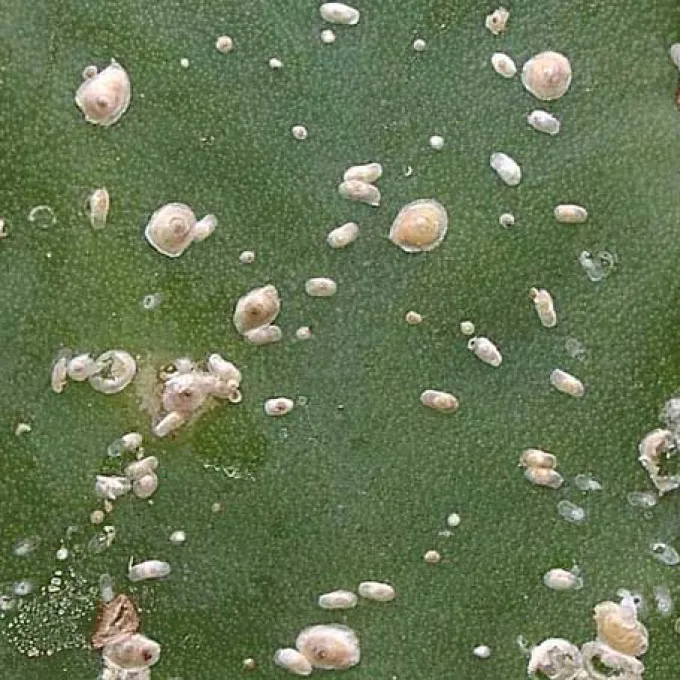
Description
How to identify
Palm scale (Hemiberlesia palmae) belongs to the family Diaspididae (armored scale insects), order Hemiptera. This pest is characterized by the presence of a dense waxy shield that protects the female's body from insecticides and adverse environmental conditions.
Females have a rounded or slightly oval shape, and the color of the shield varies from grayish-brown to brown, allowing them to camouflage effectively on bark or leaf stalks.
Adult males are significantly smaller than females and possess wings, which allows them to actively move in search of mates, whereas females lead a sedentary lifestyle.
First-instar nymphs, known as crawlers, are the only mobile stage capable of spreading across the plant independently or being carried by the wind.
For accurate species identification, microscopic examination of the pygidium — the last abdominal segment of the female — is often required by specialists.
What it damages
Hemiberlesia palmae is a polyphagous insect that causes serious damage to a wide range of crops. Palm species (Arecaceae), including both ornamental and fruit-bearing types, are primarily affected.
The pest is also found on citrus fruits, avocados, various tropical ornamental shrubs, and woody plants grown in indoor environments.
The pest poses a particular threat to botanical garden collections, greenhouses, and private winter gardens, where favorable conditions for its reproduction are maintained.
Damage occurs by sucking plant sap from the tissues of leaves, stalks, and young shoots, which leads to the exhaustion of the plant.
Local necroses form at the feeding sites of the scale, which negatively affects the aesthetic appeal and vitality of the plants.
When it appears
In tropical and subtropical latitudes, as well as in greenhouses, the pest can reproduce year-round without a distinct diapause period.
Optimal conditions for population growth include temperatures ranging from 22 to 28 degrees Celsius and high humidity levels.
The speed of the life cycle directly depends on the temperature; several generations can develop per year in greenhouses, which complicates control efforts.
The spread of new infestation foci most often occurs during the spring-summer period, when crawler activity peaks as they move across the plant.
Migration of the pest between plants in a single room is often accelerated by drafts or close physical contact between infested and healthy plant crowns.
Signs of infestation
The first sign of the pest's presence is the appearance of small bumps or flat spots on the underside of leaves, along the central vein, and on the stalks.
As they multiply, scale insects form noticeable colonies that may look like a dense coating, blending in with the color of the plant's bark or surface.
Severely infested plants begin to yellow, their leaves lose turgor, curl, and drop prematurely, leading to overall stunted growth.
As a result of the damage, sooty mold often settles on the plant, feeding on the scale's honeydew, which gives the leaves an untidy black appearance.
When inspecting for infestations, a magnifying glass should be used to spot the movement of small crawlers or the presence of characteristic shields on young shoots.
Control measures
Controlling scale insects requires a comprehensive approach, as the dense shield reliably protects the insect from most contact-based treatments.
An effective method is the use of systemic insecticides, which penetrate the plant's sap, making it toxic to the pest during feeding.
Mechanical cleaning of plants using a soft brush or a cotton swab dipped in alcohol or soapy water helps to reduce the population numbers.
Regular treatments are recommended, including
- systemic insecticides based on imidacloprid or acetamiprid
- oil emulsions to disrupt insect respiration
- periodic quarantine inspections of all new plants
It is important to carry out follow-up treatments at 7-10 day intervals to eliminate young generations of crawlers that emerge from under the shields after the first procedure.
Taxonomy
- Latin name
- Hemiberlesia palmae
- Order
- Hemiptera (bugs, aphids, leafhoppers)
- Family
- Diaspididae
- EPPO code
- HEBEPA
Discussion
No discussions yet — be the first.