
Western grapeleaf skeletonizer
Harrisina brillians
Description
How to identify
The Western grapeleaf skeletonizer (Harrisina brillians) is a moth belonging to the Zygaenidae family. Adult moths are easily identified by their metallic blue-black color and a wingspan of approximately 25 to 30 millimeters.
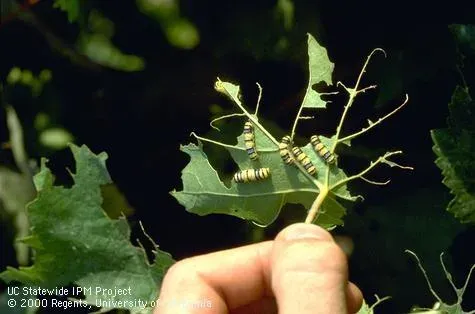
Larvae are quite distinct, featuring a yellow body with two characteristic rows of black spots and transverse bands. They are covered in fine, stinging hairs that can cause significant skin irritation upon contact.
Pupae are found within white, silken cocoons. These are often tucked away in protected areas such as old bark crevices, plant debris on the ground, or within the vineyard trellis system.
The life cycle encompasses a full metamorphosis: egg, larva, pupa, and adult. Depending on local climate, there can be one to multiple overlapping generations per growing season.
Female moths deposit their eggs in clusters on the underside of leaves, which often goes unnoticed until the young larvae begin to emerge and start feeding in groups.
What it damages
The primary host for this pest is the grapevine (Vitis vinifera). The larvae cause damage by feeding on the leaf tissue, leaving only the veins behind, which is why they are called "skeletonizers."
Young larvae feed gregariously, meaning they stay together in groups, concentrating their damage on specific leaves before moving on to fresh foliage as they mature.
Heavy infestations can lead to complete defoliation of the vines. This drastic loss of leaves prevents the grapes from ripening properly and weakens the entire plant structure.
Defoliation also interferes with the vine's ability to store carbohydrates, which negatively impacts its resilience against cold winter temperatures and overall vine vigor for the next season.
In commercial vineyards, this damage significantly reduces yield quality and can lead to lower sugar content, making the fruit unsuitable for high-quality wine production.
When it appears
Adult moths typically emerge in late spring or early summer, depending on the accumulation of degree-days. This marks the beginning of the egg-laying period for the first generation.
The peak feeding period for larvae usually occurs during the warm summer months. This is when the most visible damage appears on the canopy of the grapevines.
In warmer regions, the insect can complete multiple generations in a single season, leading to a prolonged period of potential infestation from early summer through early autumn.
As temperatures begin to drop in autumn, the final generation enters the pupal stage, seeking shelter in the bark or leaf litter to survive the winter dormant period.
Regular monitoring starting from early spring is critical for growers to detect the first signs of egg clusters and manage populations before they expand exponentially.
Signs of infestation
The most prominent sign of infestation is the appearance of skeletonized leaves, where only the leaf venation remains. These leaves often turn brown and crisp as they dry out.
Gardeners and viticulturists should look for yellow or orange egg clusters on the underside of the leaves, which indicate the presence of the next generation of larvae.
The sight of groups of larvae feeding side-by-side on the leaves is an unmistakable indicator of their activity in the vineyard, distinguishing them from solitary defoliators.
Secondary signs include the accumulation of fecal pellets on the leaves and ground beneath the vines, as well as a general thinning of the canopy in affected areas.
Stunted shoot growth and a lack of proper leaf maturity during the peak season serve as important diagnostic clues that a skeletonizer population may be present.
Control measures
Physical removal is a viable control measure for smaller vineyards; hand-picking the larvae or removing infested leaves early in the season can significantly reduce the population.
Biological control agents, particularly the bacterium Bacillus thuringiensis (Bt), are highly effective against larvae while remaining safe for beneficial insects and predators.
Chemical control using systemic or contact insecticides may be necessary during severe outbreaks. Growers must follow label instructions to ensure safety and avoid harvest residues.
Cultural practices, such as vineyard sanitation, are essential. Removing loose, old bark from trunks and clearing fallen leaves helps eliminate the overwintering sites for pupae.
Encouraging native predators and parasitoid wasps through Integrated Pest Management (IPM) can provide long-term stability and reduce the need for chemical intervention.
Taxonomy
- Latin name
- Harrisina brillians
- Order
- Lepidoptera (butterflies)
- Family
- Zygaenidae
- EPPO code
- HARRBR
Discussion
No discussions yet — be the first.