
Harrisina americana
Harrisina americana
Description
How to identify
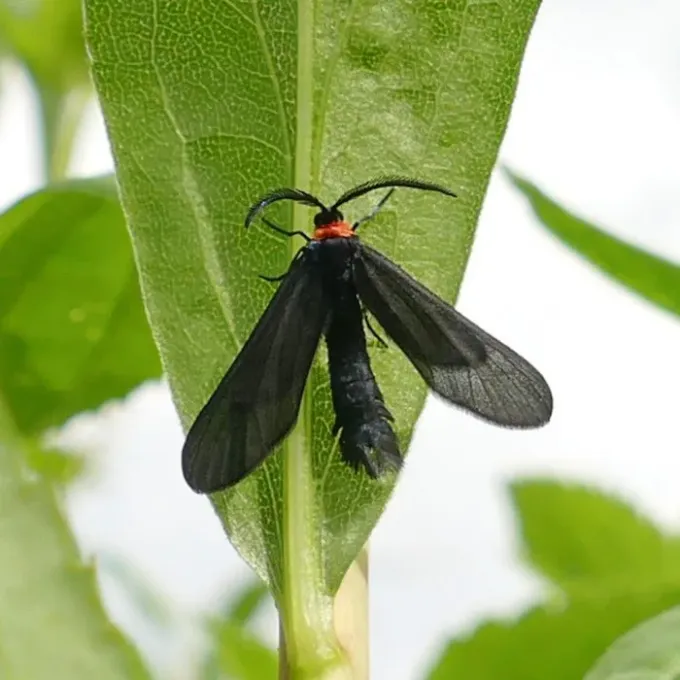
Harrisina americana, commonly known as the grape leaf skeletonizer, belongs to the Zygaenidae family within the order Lepidoptera. The adult moth is small, with a wingspan of approximately 20–25 mm, featuring a uniform metallic dark blue or black coloration.
The insect's body is slender and notable for a distinct bright yellow or orange collar located at the base of the head, which is a key diagnostic characteristic for identification in the field. Males can be distinguished by their more feathered antennae compared to females.
The larvae progress through several instars, changing appearance as they grow. Early-stage larvae are pale yellow, while mature larvae develop a bright yellow body with transverse rows of black spots on each segment, covered by sparse, short hairs.
Pupae develop within tough, silken cocoons, which the pest typically secures in hidden locations such as beneath the bark of older vines or within leaf litter. This protective strategy ensures survival against predators and harsh environmental conditions.
Native to North America, the species primarily targets wild and cultivated grapevines. Due to its resemblance to other related species, accurate identification requires careful examination of wing shape and neck color patterns.
What it damages
The primary host for Harrisina americana is the grapevine (Vitis spp.), affecting both table and wine-producing varieties. Under conditions of high population density, the pest may spread to neighboring host plants within the Vitaceae family.
Larvae are specialized leaf feeders. Young larvae exhibit gregarious behavior, feeding in groups on the underside of leaves, consuming leaf tissue while leaving the central veins intact, which results in the characteristic skeletonized appearance.
As larvae reach maturity, their feeding capacity increases significantly. They can completely strip the vine of its green foliage, leaving only the stalks, which severely hampers photosynthesis and disrupts the plant's ability to accumulate essential sugars.
Extensive defoliation leads to premature leaf drop, weakening the vine before the onset of winter dormancy. Consequently, affected plants exhibit reduced cold hardiness and significantly lower fruit yields in the following season.
While the pest rarely kills an established vine outright, persistent defoliation negatively impacts fruit quality and can lead to the mortality of young nursery stock, which is highly vulnerable to loss of photosynthetic surface area.
When it appears
The life cycle of Harrisina americana can involve up to three generations per year in southern climates, contributing to its status as a significant agricultural pest. Adult emergence begins in the spring once temperatures are sufficient for mating.
Females deposit eggs in clusters on the undersides of leaves, making them difficult to detect during routine scouting. Embryonic development proceeds rapidly, followed by the hatching of larvae that immediately begin active feeding on the foliage.
Peak larval activity generally occurs in mid-to-late summer, when populations reach their maximum. During this period, skeletonization damage is most severe, especially in regions with prolonged, warm summer weather conditions.
Pupation typically occurs by late summer or early autumn, after which the final generation enters diapause. Pupae overwinter within their cocoons in protected vineyard niches, awaiting the return of favorable spring temperatures.
Agrometeorological factors play a crucial role in population dynamics: mild winters increase pupal survival rates, which often results in a significant surge in the pest population at the beginning of the next growing season.
Signs of infestation
The first sign of infestation is the presence of larval colonies arranged in rows along the leaf veins. This organized, gregarious feeding pattern is a tell-tale indicator of their presence during the early stages of establishment.
Skeletonized leaves, appearing as a semi-transparent network of veins, serve as the primary visual indicator of damage. In cases of severe infestation, the foliage may look scorched, as the parenchyma is entirely consumed by the feeding larvae.
The presence of distinct larval frass (droppings) on the surface of leaves beneath feeding sites is another critical sign. As the larvae increase in size, the volume of frass grows, contaminating the canopy and creating a secondary hygiene issue.
Adult moths are often visible during evening hours as they fly above the vineyard canopy. Their unique flight pattern and dark silhouette distinguish them from many other common vineyard insects, aiding in early detection.
Pheromone traps are considered the most effective tool for identifying the onset of adult moth flight. Installing these traps allows vineyard managers to accurately time insecticide applications, preventing mass outbreaks before they cause irreversible damage.
Control measures
Mechanical control, including the hand-picking and destruction of egg clusters during early growth stages, can effectively reduce pest numbers in small-scale or organic vineyards without the use of chemical inputs.
Biological control using Bacillus thuringiensis (Bt) based products is highly recommended. These bio-insecticides specifically target the larvae while remaining safe for beneficial insects, natural predators, and the vineyard workers.
Chemical intervention involves the application of contact or systemic insecticides during the peak of larval emergence. It is essential to strictly adhere to pre-harvest intervals (PHI) and label regulations to ensure consumer safety and efficacy.
Cultural practices play a vital role, specifically the removal of loose vine bark and the sanitation of plant debris where pupae overwinter. Eliminating these overwintering sites significantly suppresses the population for the following year.
Encouraging natural enemies, such as parasitic wasps that target Harrisina americana, provides sustainable long-term control. By maintaining a diverse agroecosystem, vineyard managers can foster natural predatory pressure on the pest population.
Taxonomy
- Latin name
- Harrisina americana
- Order
- Lepidoptera (butterflies)
- Family
- Zygaenidae
- EPPO code
- HARRAM
Discussion
No discussions yet — be the first.