
Brown marmorated stink bug
Halyomorpha halys
Description
How to identify
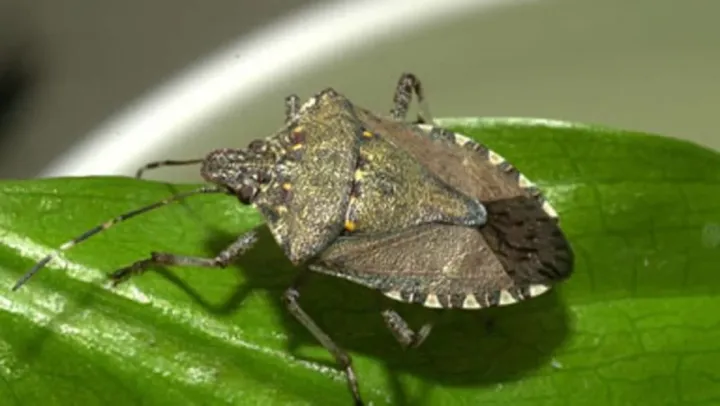
The brown marmorated stink bug (BMSB) belongs to the order Hemiptera and the family Pentatomidae. The adult insect is characterized by a "mottled" or "marmorated" appearance, with a mixture of brown, grey, and black patches covering its body.
Adults typically measure between 12 and 17 millimeters in length. A defining morphological feature of this species is the presence of pale rings on the antennae and alternating light and dark markings along the edges of the abdomen.
The insect undergoes a life cycle consisting of an egg stage and five nymphal instars. Early-stage nymphs are brightly colored with orange and black markings, gradually darkening as they develop into adults.
The head of the bug has a rectangular shape with characteristic indentations on the sides, which distinguishes it from many native stink bug species found in various regions.
BMSBs overwinter as adults in protected locations, often seeking shelter in homes, garages, and agricultural sheds, where they congregate in large numbers to survive the cold season.
What it damages
This species is a highly polyphagous pest capable of feeding on more than 300 plant species. It poses a significant threat to fruit orchards, vegetable fields, legumes, and various ornamental trees.
In orchards, the bug attacks apples, pears, peaches, and nectarines. Vegetable crops such as tomatoes, peppers, cucumbers, and sweet corn are also highly susceptible to its feeding habits.
The bug uses its piercing-sucking mouthparts to feed on various plant parts, particularly fruits. Feeding causes surface depressions, necrotic spots, and significant deformations of the fruit.
Affected tissues often develop "corky" areas, which are hard and tasteless, rendering the fruit commercially unmarketable. This damage is particularly devastating for high-value stone fruits and table vegetables.
In field crops, the bug pierces grain kernels during the milk stage, leading to shriveled seeds, reduced weight, and in severe cases, total loss of seed viability, which is critical for agricultural production.
When it appears
The emergence from overwintering sites typically begins in spring when average temperatures exceed 12–15 degrees Celsius. Adults start appearing in orchards and fields starting in late April.
In warm climates, the bug can produce up to two or three generations per year. The peak population density generally occurs during the summer months, coinciding with the maturation phase of many fruit crops.
BMSBs are highly mobile and fly actively in search of new food sources. As one crop reaches maturity, they frequently migrate to neighboring fields, extending the duration of potential damage.
As autumn approaches and day length decreases, the bugs begin their migration toward protected areas. During this period, massive aggregations often gather on the walls of buildings or inside structures.
The entire developmental cycle is temperature-dependent, meaning that prolonged warm autumns can extend the period of damage and increase the success rate of the next overwintering generation.
Signs of infestation
The first signs of infestation are small puncture marks on the skin of the fruit, often surrounded by pale or necrotic spots. These marks are the direct result of the insect's probing for plant fluids.
Tomatoes often show a "marmorated" or blotchy appearance on their surface due to irregular ripening caused by the bug's saliva. Internally, the flesh may become spongy and discolored.
Egg masses are typically deposited on the underside of leaves. These look like clusters of 20 to 30 tiny, barrel-shaped, pale green or white eggs, which are easy to spot upon close inspection.
The presence of nymphs is a strong indicator of an established colony in the immediate area. They usually remain in close proximity to their feeding sites throughout the early stages of their life cycle.
When disturbed, the bugs release a distinct, pungent odor from their scent glands. This smell is a common sign of their presence and serves as a natural defense mechanism against predators.
Control measures
Effective management of the brown marmorated stink bug relies on an integrated pest management (IPM) approach, including the use of systemic and contact insecticides such as pyrethroids and neonicotinoids.
Pheromone-based monitoring traps are essential for early detection. By tracking population spikes, farmers can time their pesticide applications more precisely to maximize control and minimize chemical usage.
Cultural control methods, such as removing weeds and brush around the borders of fields, are crucial. These areas often serve as primary breeding grounds before the bugs move into the main crop.
Physical barriers, such as specialized netting or bags for individual fruits, can be effective in small-scale or high-value organic farming to prevent the bugs from reaching the harvest.
Post-harvest sanitation, including the removal of debris and securing storage buildings against entry, reduces the available overwintering sites, thereby decreasing the potential population for the following season.
Taxonomy
- Latin name
- Halyomorpha halys
- Order
- Hemiptera (bugs, aphids, leafhoppers)
- Family
- Pentatomidae
- EPPO code
- HALYHA
Discussion
No discussions yet — be the first.