
Striped red-legged bug
Graphosoma semipunctatum
Description
How to identify
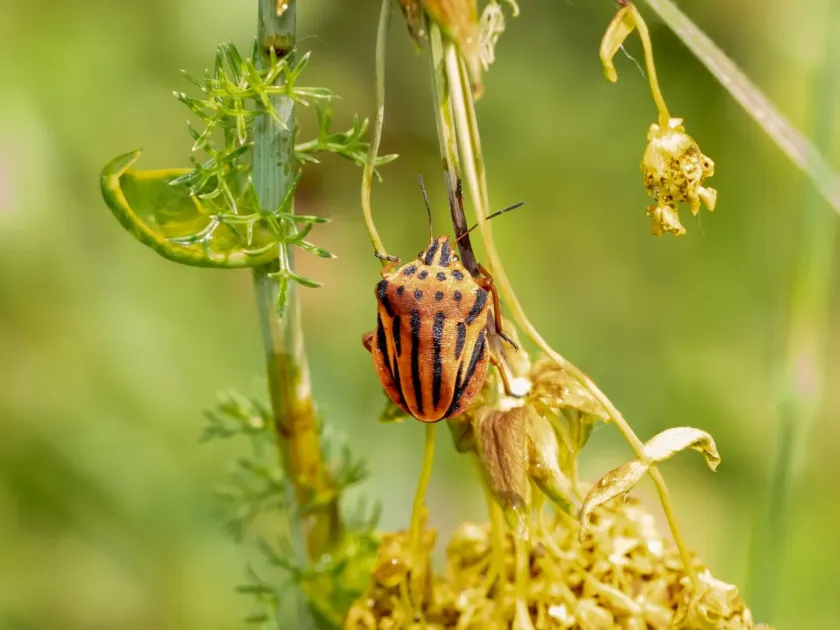
The striped red-legged bug (Graphosoma semipunctatum) is a member of the Pentatomidae family. It is a common pest that closely resembles the more widely known Graphosoma lineatum, but is distinguished by its reddish-colored legs.
Adult insects are shield-shaped, measuring about 8–11 mm in length. Their bodies feature striking longitudinal black and orange or yellow stripes, which serve as warning coloration to potential predators in the wild.
Nymphs go through several molting stages, gradually developing the characteristic striped pattern. During their immature stages, they are highly active and gregarious, often feeding in groups on the same plant.
These bugs hibernate as adults, seeking refuge in leaf litter, debris, or dry vegetation during the winter months. They emerge in the spring when temperatures consistently rise above the threshold for their activity.
They prefer sunny and open habitats, including edges of fields and vegetable gardens, where they can find an abundance of host plants to feed upon and reproduce.
What it damages
This species specializes in feeding on plants of the Apiaceae (umbelliferous) family. Their preferred hosts include carrots, parsnips, dill, parsley, fennel, and coriander.
The bug uses its piercing-sucking mouthparts to penetrate the plant tissues, focusing on leaves, stems, flower heads, and developing seeds. This feeding behavior causes significant physiological stress to the plant.
When feeding, the bug injects saliva containing enzymes that cause necrosis in the surrounding plant tissue. This can lead to the wilting and drying of affected leaves and even entire flower clusters.
Damage to the seed heads is particularly economically significant, as it leads to poorly developed, shriveled, or non-viable seeds, reducing overall crop yield for seed producers.
Infestations typically result in reduced plant vigor, stunted growth, and susceptibility to secondary infections by fungal pathogens introduced through the puncture wounds.
When it appears
The life cycle begins with the emergence of overwintered adults in late spring. Breeding and egg-laying occur during the early summer, coinciding with the rapid growth of host plants.
Eggs are laid in clusters, usually on the underside of leaves. The duration of the nymphal stage is highly dependent on ambient temperature, with warmer summers leading to faster development and higher population densities.
The peak presence of adults and late-stage nymphs usually occurs during the flowering period of carrots and other umbellifers. During this time, they congregate on the umbels to feed on the nutrient-rich sap.
Depending on the climatic conditions, the bug produces one generation per year, although favorable long summers may accelerate their metabolic processes.
As daylight hours decrease and temperatures drop in late August, adults move toward sheltered areas to prepare for the overwintering phase, marking the end of their activity for the season.
Signs of infestation
The most obvious sign of an infestation is the presence of the colorful, striped adults crawling on the flower heads of crops. Their bright appearance makes them relatively easy to spot during daily monitoring.
Early feeding signs include tiny, pale, or yellow pinprick marks on the leaves. As feeding continues, these spots may merge into larger yellow patches, leading to the yellowing and necrosis of the leaf blade.
- Chlorotic spots on leaves and stems;
- Wilting of flower umbels;
- Deformed or undersized seeds;
- Premature drying of vegetative parts;
- Visible aggregations of bugs on stems and flower heads.
Affected plants often appear weak compared to healthy ones. In heavy infestations, the overall development of the plant is stunted, and the yield quality is significantly compromised.
During the early morning, the bugs are generally less active and tend to remain stationary on the plants, which is the best time for visual inspection and control efforts.
Control measures
Integrated pest management starts with cultural practices. Removing weeds from the Apiaceae family (such as wild carrot or hemlock) from field margins reduces the local breeding population.
Maintaining proper crop rotation and ensuring sufficient distance between seed production plots and commercial vegetable areas help prevent the spread of the pest.
In home gardens, manual collection of the bugs during the morning hours can be effective. Using fine mesh covers over carrot umbels can prevent adult bugs from reaching the developing seeds.
Chemical control should be considered only when populations exceed the economic injury level. Selective insecticides should be used to protect beneficial insects, especially pollinators.
Applications should be timed to minimize impact on non-target species, preferably in the late evening, following strict label instructions for dosage and frequency.
Taxonomy
- Latin name
- Graphosoma semipunctatum
- Order
- Hemiptera (bugs, aphids, leafhoppers)
- Family
- Pentatomidae
- EPPO code
- GRASSE
Discussion
No discussions yet — be the first.