
Striped bug
Graphosoma italicum
Description
How to identify
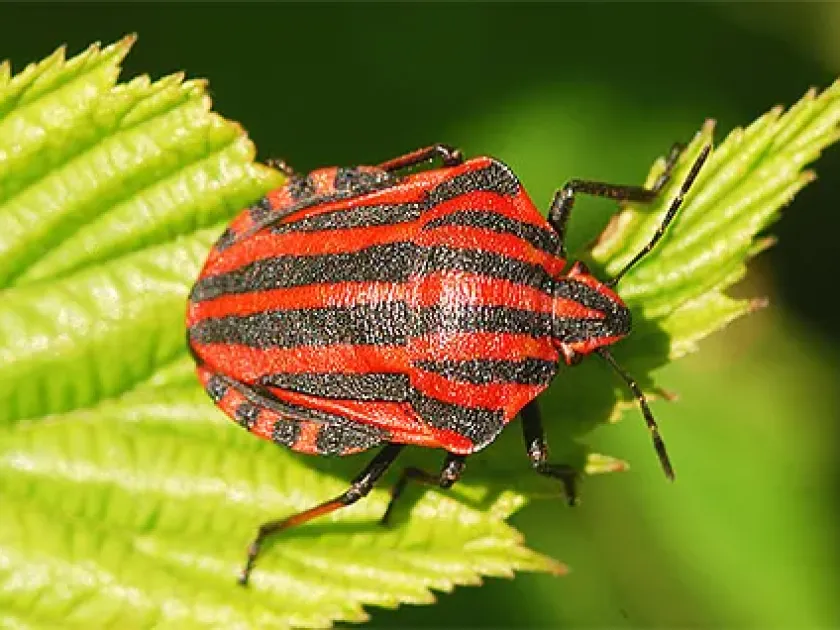
The Striped Bug, known scientifically as Graphosoma italicum, is a member of the Pentatomidae family, commonly recognized by its vivid red and black longitudinal stripes.
Adult insects typically measure between 10 and 12 millimeters in length. Their distinctive warning coloration serves as an aposematic signal, indicating to predators that the bug is toxic or foul-tasting.
Nymphs go through five developmental instars, gradually increasing in size and intensity of color. Unlike adults, they are flightless but highly active and gregarious.
These bugs overwinter as adults, finding shelter in leaf litter, under tree bark, or in dense vegetation. They emerge in the spring once temperatures become sufficiently warm.
Females lay their eggs in clusters on the stems or undersides of leaves. These eggs are usually laid in neat rows, a characteristic behavior of this species during the breeding season.
What it damages
Graphosoma italicum primarily targets plants belonging to the Apiaceae family, including carrots, parsley, dill, fennel, and celery.
Both adults and nymphs cause damage by using their piercing-sucking mouthparts to feed on the plant sap. They prefer to feed on the stems, leaves, and particularly the developing flower heads.
The most significant agricultural impact occurs on seed crops. By draining sap from the developing seeds, they significantly reduce the viability and quantity of the harvest.
Affected plants often show signs of stunted growth, leaf yellowing, and necrotic spots at the points of feeding. This reduces both the yield and the aesthetic quality of herbs.
In high populations, these bugs can cause severe dehydration and weakening of the plant, potentially leading to the death of the inflorescence in susceptible species.
When it appears
The emergence of the Striped Bug starts in late spring as the ambient temperature rises consistently. Adults are the first to reappear from their winter hideouts.
The peak activity and feeding period occurs from June through July. This coincides with the flowering stage of most Apiaceae crops, which is when the bugs are most concentrated.
There is typically one generation per year. However, due to the extended period of oviposition, both nymphs and adults can be observed simultaneously throughout the mid-summer.
By August, the population density remains high, but by late summer and early autumn, the bugs begin searching for suitable hibernation sites to survive the coming winter.
Cold weather initiates the transition to the dormant phase, where the bugs seek protection away from open fields and exposed garden areas.
Signs of infestation
A primary indicator of infestation is the visible presence of large, vibrant red and black clusters of bugs directly on the umbels of carrots or dill.
Plant tissue damage appears as localized yellow or brown spots where the bug has pierced the plant to extract sap. If examined closely, these are often near the seeds or stem nodes.
A distinct, unpleasant odor is often released by the bugs when they are disturbed. This chemical defense serves as a sensory cue for gardeners to detect their presence.
Premature wilting of the seed heads, combined with shriveled or underdeveloped seeds, is a clear sign that the colony has been feeding on that specific plant for some time.
Discovery of egg batches on the undersides of leaves is a definitive sign that a new generation has been established, requiring prompt action.
Control measures
The most effective cultural practice is the removal of wild Apiaceae weeds, such as wild carrot or hemlock, near garden plots, as these serve as the primary host reservoirs.
Manual collection of the bugs in the early morning is highly effective for small-scale gardens. Shaking the plants over a container with soapy water effectively eliminates the infestation.
Chemical control is rarely needed unless the population reaches high economic thresholds. If necessary, choose insecticides that are labeled for use on edible vegetable crops.
Always adhere to pre-harvest intervals if insecticides are applied to ensure that no harmful chemical residues remain on the produce at the time of consumption.
Encouraging biodiversity in the garden by supporting natural predators, including predatory wasps and birds, helps maintain the Striped Bug population at manageable levels.
Taxonomy
- Latin name
- Graphosoma italicum
- Order
- Hemiptera (bugs, aphids, leafhoppers)
- Family
- Pentatomidae
- EPPO code
- GRASIT
Discussion
No discussions yet — be the first.