
Gonometa
Gonometa
Description
How to identify
Gonometa is a genus of large moths belonging to the family Lasiocampidae, commonly known as lappet moths. The most notable species, Gonometa postica, is native to parts of Africa.
Adult moths are robust with hairy bodies and wings that vary in color from yellowish-ochre to dark brown, often featuring distinct transverse lines for camouflage.
The larvae, or caterpillars, are large and densely covered with stiff, irritating hairs. These hairs serve as a defense mechanism and are known to cause severe skin irritation upon contact.
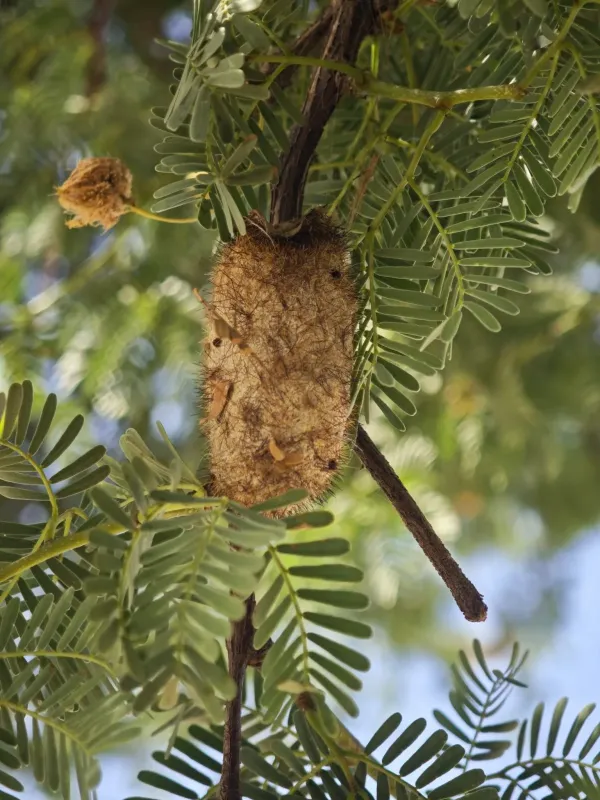
Pupation occurs in very durable, woody-textured cocoons that are securely attached to branches, a trait that has historically made them a source of wild silk.
The life cycle is heavily influenced by environmental conditions, with outbreaks typically occurring in cycles corresponding to seasonal changes in rainfall and host plant vigor.
What it damages
Gonometa is a polyphagous pest known to cause significant damage to forest trees, particularly Acacia species, and various orchard crops within its native range.
The caterpillars are voracious feeders and can strip entire branches of their foliage, leading to rapid and widespread defoliation of the host plant.
Frequent or heavy infestation stresses trees significantly, resulting in stunted growth, reduced photosynthetic capability, and an increased susceptibility to secondary pests and drought.
In cases of severe outbreaks, the entire canopy of a plantation or woodland can be destroyed, leading to substantial ecological and economic consequences.
The presence of the larvae also reduces the overall health of the ecosystem and complicates the maintenance of affected woody plants.
Signs of infestation
The most visible indicator of a Gonometa infestation is the presence of numerous tough, oval-shaped cocoons firmly attached to the tree twigs.
Significant foliage loss is evident, often accompanied by the accumulation of insect frass (droppings) on the ground underneath the infested canopy.
The presence of fine, irritating hairs shed by the caterpillars on leaves and branches is a strong warning sign of their recent activity.
Damage patterns usually start from the leaf edges, proceeding inwards until only the midrib remains, which is typical for large larval feeders.
- Massive and rapid defoliation
- Clusters of durable cocoons on branches
- Presence of large, hairy caterpillars
- Contact-induced dermatitis among workers
Control measures
Manual collection and destruction of cocoons during the dormant season are highly recommended to reduce the localized population of the pest.
The application of biological insecticides, specifically those containing Bacillus thuringiensis, is effective against larvae while minimizing impact on beneficial insects.
Continuous monitoring of plantations using pheromone traps can help estimate population density and trigger timely intervention before larvae reach their most destructive stages.
It is essential for field workers to wear protective clothing, such as long sleeves and gloves, to avoid the painful dermatitis caused by the caterpillar's stinging hairs.
Promoting general tree vigor through proper fertilization and irrigation helps plants better withstand the stress caused by defoliation events.
Taxonomy
- Latin name
- Gonometa
- Order
- Lepidoptera (butterflies)
- Family
- Lasiocampidae
- EPPO code
- GONMSP
Discussion
No discussions yet — be the first.