
Siberian grasshopper
Gomphocerus sibiricus
Description
How to identify
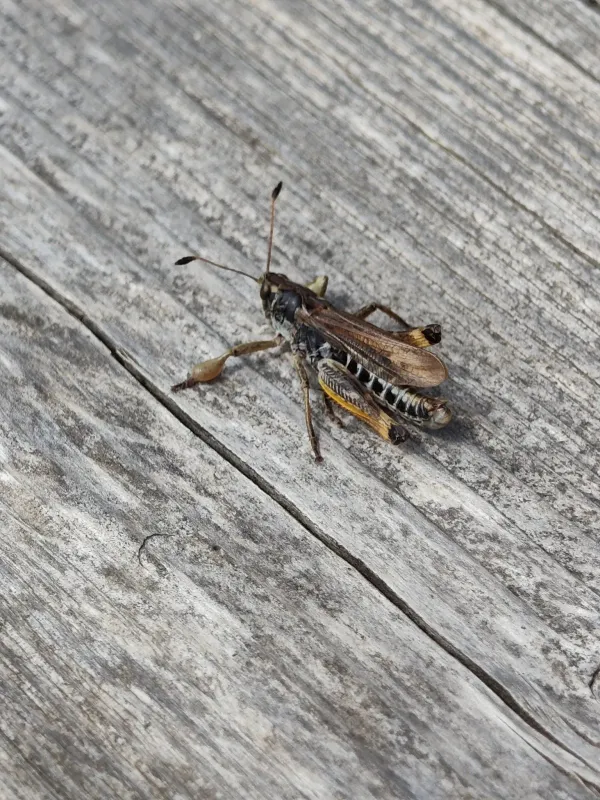
The Siberian grasshopper (Gomphocerus sibiricus) belongs to the Orthoptera order and the Acrididae family. It is a sturdy insect, with a body length ranging from 13 to 25 mm, and a color palette varying from green to brown and even black.
The main distinguishing feature of the males is a club-shaped thickening at the ends of the antennae. The pronotum features a characteristic median keel, interrupted by a transverse groove in the front part.
The wings are well-developed, allowing the insects to migrate over long distances in search of better grazing areas. The hind legs are typically yellowish or reddish, which serves as a key diagnostic trait for the species.
Eggs are laid in the soil within compact egg pods, known as oothecae, covered with a protective layer. Each pod may contain up to 25 eggs, which overwinter in the upper soil layers.
Nymphs go through 4–5 developmental stages. They resemble miniature adults but lack fully developed wings, though they feed aggressively from the moment they emerge.
What it damages
This pest is a polyphage, though it strongly prefers cereal crops and wild grasses. Massive outbreaks can completely destroy wheat, barley, rye, and oat fields across vast areas.
Beyond cereal crops, the grasshopper causes significant damage to hayfields and pastures, leading to critical shortages in livestock feed. It can also attack legumes like alfalfa and clover.
During peak years, the pest may switch to vegetable and industrial crops, including flax, if the primary grass food sources are depleted or scorched by heat.
Damage includes the consumption of leaf blades, stems, and heads. At high population densities, the grasshopper can strip an entire field bare, leaving only tough, inedible parts.
The economic impact is intensified by the fact that the pest often destroys the generative parts of plants, leading to a catastrophic loss in grain yield.
When it appears
The life cycle is closely linked to the temperature regime. Nymphs typically emerge from overwintered eggs in the spring as soil temperatures reach 15–20 degrees Celsius.
The nymphal development phase takes about 30–45 days. This is the period when the pests are most vulnerable to control measures, as they lack the ability to fly.
Adult maturation usually occurs in mid-summer. This is when the insects reach their peak activity and migration capacity, spreading across larger territories.
Reproduction and egg-laying occur in late summer and early autumn, after which adult individuals die off with the onset of the first frosts.
The species completes one generation per year; however, its ability to deposit eggs in protected soil layers ensures high survival rates even in harsh climates.
Signs of infestation
The first sign of an infestation is the appearance of bare patches in the field where vegetation has been heavily depleted. Serrated edges on leaves indicate active feeding.
The presence of fecal matter, appearing as small black granules on the soil or leaves, is a direct indicator of a pest outbreak in the area.
Walking through the field, one may notice mass movement of insects jumping in all directions. The noise generated by their movement in the grass becomes audible in quiet conditions.
Finding egg pods in the soil at a depth of 1–3 cm during fall surveys acts as a reliable predictor of the risk for the next season.
Gatherings of insects along field edges, roadsides, and uncultivated patches are early warnings that they are about to move into crop areas.
Control measures
A core agronomic practice is deep autumn plowing, which destroys the egg pods by bringing them to the surface, where they succumb to frost or predators.
Chemical control using organophosphates, pyrethroids, or neonicotinoids is most effective when applied during the early nymph stages, before the insects develop wings.
Biological control, including the use of entomopathogenic fungi and bacterial formulations, provides an environmentally friendly alternative during moderate infestations.
Implementing consistent population density monitoring allows for localized treatments, reducing pesticide impact on the agroecosystem.
- Regular mowing of weeds along field borders.
- Creation of insecticide-treated barrier zones to protect crops.
- Systematic field inspections to detect early hotspots of activity.
Taxonomy
- Latin name
- Gomphocerus sibiricus
- Order
- Orthoptera (locusts)
- Family
- Acrididae
- EPPO code
- GOMPSI
Discussion
No discussions yet — be the first.