
Desert termite
Gnathamitermes tubiformans
Description
How to identify
The desert termite, Gnathamitermes tubiformans, belongs to the Termitidae family within the Isoptera order. It is a highly social insect adapted to arid environments.
These insects are organized into complex castes, including workers, soldiers, and reproductive individuals, each performing distinct roles to maintain the colony's stability.
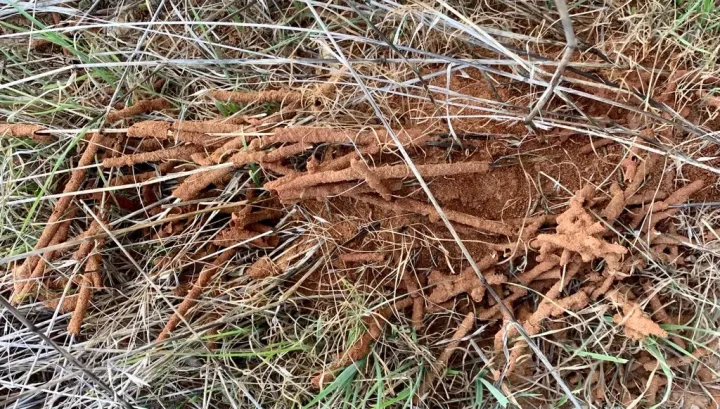
A key identifying feature is their habit of building earthen tubes or galleries over plant surfaces, protecting them from predators and direct desiccation by the sun.
Workers are typically light-colored and soft-bodied, while soldiers possess specialized, dark-colored mandibles used exclusively for colony defense.
They are prolific builders, often creating extensive networks of underground tunnels that connect their nest to food sources across wide areas of the field.
What it damages
Gnathamitermes tubiformans primarily consumes dead plant material, but it acts as a significant agricultural pest when natural food sources become scarce.
They cause damage to the root systems and stems of living crops, such as corn, sorghum, and various grasses, particularly during periods of environmental stress.
By consuming the exterior tissue and cutting off the plant's nutrient uptake, they cause wilting, stunted growth, and eventually the death of the crop.
In pastures, these termites can significantly reduce forage yield by stripping the plant of its protective epidermal layers and creating mud shelters.
The economic impact is most severe in drylands where water-stressed crops are already weakened and therefore more susceptible to termite colonization.
When it appears
The activity of desert termites is highly dependent on soil temperature and humidity, usually peaking during the warmer months of the year.
They remain most active during the summer season, when arid conditions force them to search aggressively for cellulose-rich materials.
Rainfall events often trigger periods of intense activity, as increased soil moisture allows for the expansion of galleries and reproductive flights.
During the cooler or winter months, they retreat deep into the soil profile to avoid freezing temperatures, entering a period of reduced activity.
Agricultural monitoring should be intensified during the spring and early summer as colonies emerge from their dormant state to establish new feeding territories.
Signs of infestation
The presence of Gnathamitermes tubiformans is most easily spotted by observing earthen galleries or mud tubes covering the stalks of plants.
Plants suddenly wilting or dying without apparent signs of water stress or disease should be examined closely for evidence of termite feeding at the base.
When mud tubes are gently brushed away, one can observe active workers moving within the protected passages on the plant surface.
Heavily infested fields often show patches where crop residue or surface organic matter is missing or completely encased in termite-constructed soil crusts.
Exposing the roots of an affected plant often reveals significant scraping or complete removal of the root cortex, a hallmark sign of termite damage.
Control measures
Effective management of desert termites requires a multifaceted approach focused on cultural practices and integrated pest management (IPM).
Maintaining proper soil moisture through irrigation can often deter termite activity, as these insects favor dry and desiccated environments.
Deep tillage is a highly recommended practice, as it disrupts the subterranean tunnel systems and exposes the colonies to environmental extremes.
Systemic insecticides applied during the planting phase can provide a protective buffer around the root zone, preventing initial colonization.
Targeted baiting systems that utilize slow-acting toxicants allow workers to carry the insecticide back to the nest, effectively eliminating the entire colony.
Taxonomy
- Latin name
- Gnathamitermes tubiformans
- Family
- Termitidae
- EPPO code
- GNTTTU
Discussion
No discussions yet — be the first.