
Desert termite
Gnathamitermes
Description
How to identify
The desert termite belongs to the order Blattodea and the family Termitidae. These are highly social insects organized into distinct castes, including workers, soldiers, and reproductives.
Worker termites are soft-bodied and pale, primarily responsible for foraging and nest maintenance. Soldiers possess large, sclerotized mandibles used specifically to defend the colony against predators like ants.
These insects are essential decomposers in arid environments, as they possess specialized intestinal symbionts that enable them to digest cellulose effectively.
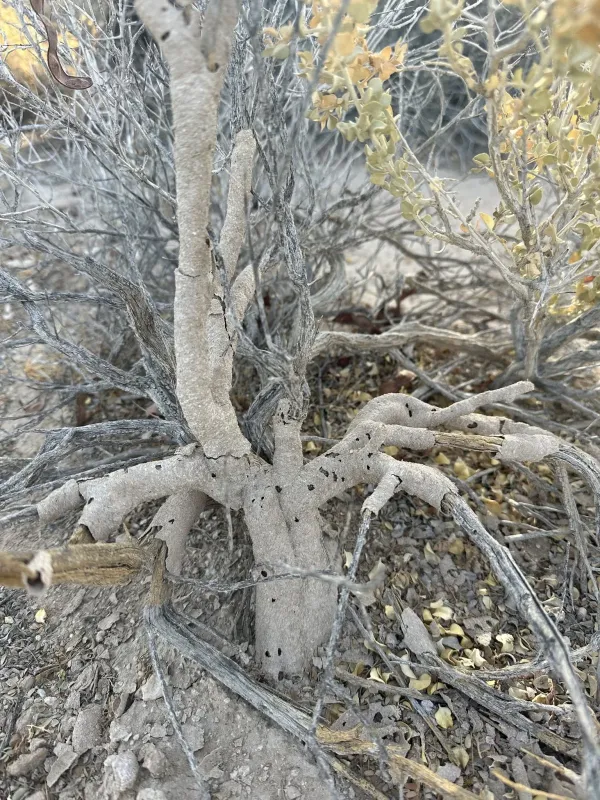
Colonies construct intricate systems of earthen tunnels and galleries on the surface of substrate, which protect them from desiccation and sunlight while they forage.
The reproductive cycle involves nuptial flights of winged adults, which disperse to establish new colonies in moist soil conditions following rainfall.
What it damages
While desert termites primarily function as detritivores, they become significant agricultural pests when natural forage is scarce or when crops are irrigated.
They target the root systems of perennials, shrubs, and field crops. By consuming roots and basal tissues, they disrupt nutrient uptake, leading to plant wilting and death.
Beyond live plants, these termites cause extensive damage to wooden fencing, irrigation tubing, and other composite agricultural infrastructure that contains organic matter.
In irrigated desert agriculture, the increased soil moisture creates an ideal environment for termite populations to expand rapidly, drawing them toward high-value crops.
Damage is often difficult to detect until the plant has already suffered significant root loss, as the destruction occurs entirely beneath the soil surface.
When it appears
The activity level of desert termites is strictly governed by soil temperature and moisture, leading to distinct periods of high and low activity.
Peak foraging occurs after rainfall, when moisture allows termites to operate more freely at or near the soil surface without risk of dehydration.
During extreme summer heat, colonies retreat deeper into the soil profile to find a stable microclimate, drastically reducing their visibility on the surface.
Swarming behavior, where winged reproductives emerge, is synchronized with the onset of the wet season to maximize survival rates for new colonies.
Activity remains minimal during cold winters or prolonged droughts, with colonies entering a state of dormancy to conserve energy and nutritional reserves.
Signs of infestation
The most reliable indicator of a termite presence is the emergence of mud-like tubes or covered tunnels on soil surfaces, tree trunks, or wooden posts.
Unexpected plant death or wilting, despite regular irrigation, is a classic sign that the root system has been compromised by subterranean foraging.
Careful excavation around the base of a plant often reveals soil-filled galleries and a localized presence of white worker termites.
The presence of chewed areas on the lower stalks of crops, covered by protective soil crusts, confirms active feeding by the termite colony.
- Mud tubes on the surface of soil or structures;
- Sudden wilting of crops despite irrigation;
- Subsurface root damage and galleries;
- Observations of winged adults during swarming events.
Control measures
Effective management begins with mechanical disturbance; deep plowing can disrupt the underground nest architecture and sever critical foraging tunnels.
The use of slow-acting bait stations containing growth regulators is highly effective, as foragers carry the insecticide back to the colony to eliminate the queen.
Chemical barriers around the perimeter of agricultural fields can effectively prevent the influx of termites from adjacent desert areas.
Cultural control is vital: removing debris, dead wood, and old stalks from the field eliminates primary food sources and reduces the attractiveness of the plot.
Applying anti-termite treatments to the base of wooden structures and irrigation components provides a physical and chemical barrier against infestation.
Taxonomy
- Latin name
- Gnathamitermes
- Family
- Termitidae
- EPPO code
- GNTTSP
Discussion
No discussions yet — be the first.