
Tobacco cyst nematode
Globodera tabacum
Description
How to identify
The tobacco cyst nematode (Globodera tabacum) belongs to the order Tylenchida and the family Heteroderidae. It is a microscopic roundworm that acts as an obligate parasite of various solanaceous plant roots.
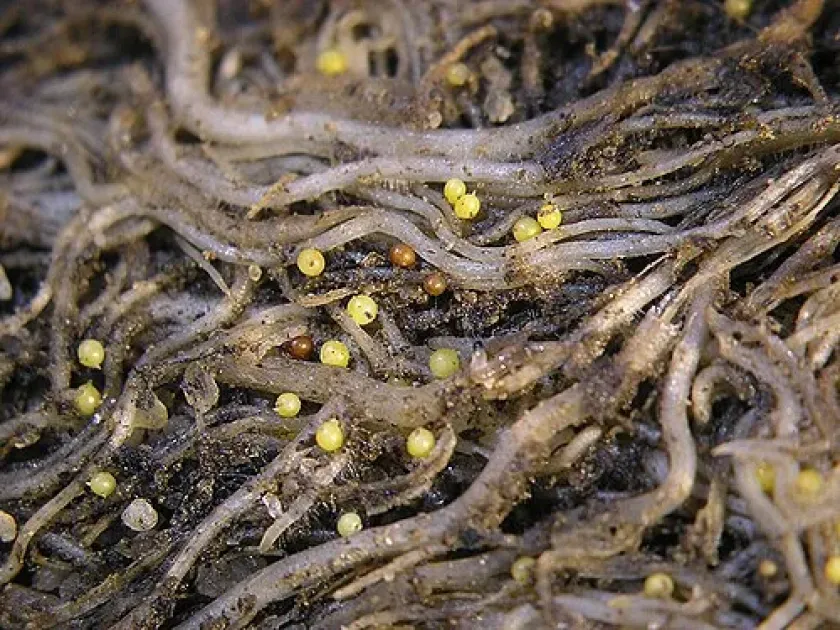
The life cycle features a distinctive stage where females form protective cysts, which are the hardened, dead bodies of the females that contain hundreds of eggs and larvae.
These cysts can persist in the soil for many years, waiting for chemical signals released by the roots of host plants to trigger the hatching of the second-stage juveniles.
Inside the host root, the juvenile undergoes several molts, feeding on the plant's vascular tissue and creating syncytia, which are large multinucleate cells that serve as a nutrient source.
Because these cysts are easily transported by farm equipment, water, or soil movement, the nematode is considered a significant quarantine pest worldwide.
What it damages
The primary hosts of Globodera tabacum are members of the Solanaceae family, including tobacco, potato, tomato, and eggplant, which suffer the greatest damage.
The nematode physically disrupts the root system's ability to take up water and nutrients, leading to stunted growth, wilting, and poor general plant vigor.
Economic damage is most severe in tobacco and potato fields, where significant reductions in yield and marketable quality can lead to substantial financial losses for farmers.
Heavy infestations can lead to a drastic decline in foliage development and, in some cases, the total failure of the crop in severely infested soil patches.
Secondary infections by soil-borne fungi and bacteria are common in damaged root systems, further exacerbating the impact on the plants' health and yield potential.
When it appears
The activity of the nematode is temperature-dependent, with the hatching of juveniles typically occurring in the spring when soil temperatures reach favorable levels.
Throughout the growing season, multiple generations can occur if environmental conditions are suitable and a host crop is present to provide constant sustenance.
As the plant nears maturity or is harvested, the female nematodes on the roots transform into the durable cyst stage to survive the upcoming winter or periods of drought.
The survival mechanism of the cysts ensures that the population can persist through harsh seasons, making short-term crop rotations ineffective against the nematode.
Long-term soil monitoring is essential to track the presence of these cysts, as they can remain dormant for over a decade in the absence of a host.
Signs of infestation
Infestation is often first noticed as patchy growth in fields, where plants appear stunted, chlorotic, and generally smaller than those in non-infested areas.
Wilting symptoms are particularly visible during the heat of the day, as the damaged root system cannot keep up with the plant's transpiration requirements.
A closer inspection of the root system often reveals the presence of tiny white, yellow, or brown cyst-like structures attached to the finer roots of the host plant.
In potatoes, tubers may be smaller and fewer in number, and the overall plant canopy might die back prematurely compared to healthy sections of the field.
Confirming the presence of Globodera tabacum usually requires soil sample analysis in a nematology laboratory to identify the specific species of cyst present.
Control measures
Effective management heavily relies on long-term crop rotation, avoiding the planting of solanaceous crops for 5 to 7 years in fields where infestation has been detected.
Planting nematode-resistant cultivars or hybrids is a critical strategy in areas where the pest is established, as it significantly lowers the nematode population.
Strict sanitation protocols for farm machinery and equipment are necessary to prevent the mechanical transfer of contaminated soil from infested to clean fields.
While chemical nematicides are available, they are often used as a last resort due to costs and potential negative impacts on beneficial soil organisms.
Integrated pest management (IPM) practices, including the use of trap crops and biological control agents like Pochonia chlamydosporia, provide sustainable ways to manage population levels.
Taxonomy
- Latin name
- Globodera tabacum
- Order
- Nematodes
- Family
- Heteroderidae
- EPPO code
- GLOBTS
Discussion
No discussions yet — be the first.