
Wormwood potato cyst nematode
Globodera artemisiae
Description
How to identify
The wormwood potato cyst nematode (Globodera artemisiae) belongs to the order Tylenchida and the family Heteroderidae, representing a specific type of plant-parasitic nematode.
This microscopic organism exhibits a complex life cycle involving distinct stages: eggs, juvenile stages, and the sessile adult stage within a protective cyst.
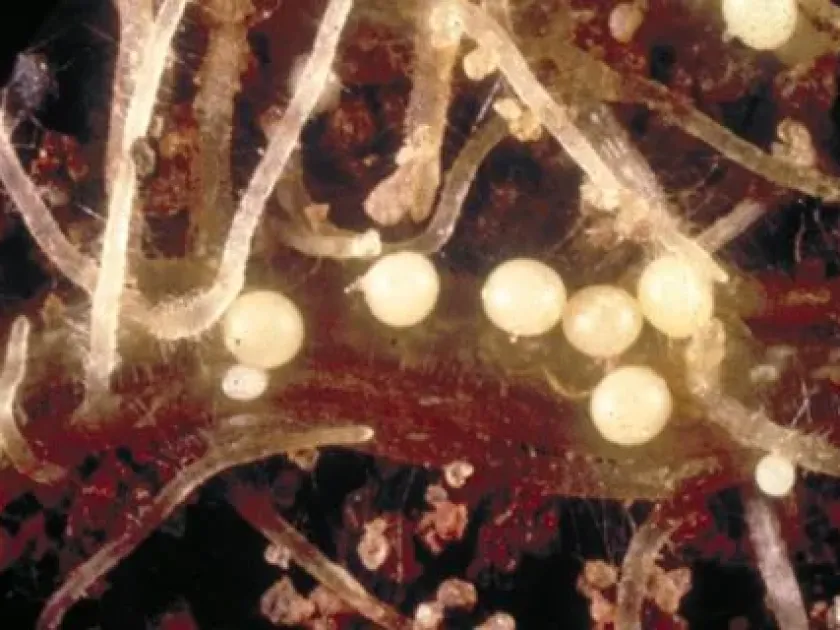
The adult females transform into spherical, leathery cysts that serve as a robust, protective structure for the eggs, allowing them to persist in the soil.
Detection of Globodera artemisiae in the field is challenging due to the minute size of all developmental stages, necessitating professional laboratory diagnostic methods.
Soil sampling and subsequent microscopic morphometric analysis are the standard procedures for correctly identifying this nematode species in agricultural soils.
What it damages
While primarily associated with wormwood (Artemisia), this nematode poses a significant threat to potato and other solanaceous crops in intensive farming systems.
The juvenile nematodes penetrate the root system, where they establish feeding sites, severely disrupting the plant's nutrient and water uptake mechanisms.
This root damage causes systemic physiological stress, leading to stunted growth and reduced capacity for the plant to develop healthy tubers.
Infection often paves the way for secondary soil-borne pathogens, such as fungi and bacteria, leading to root decay and overall plant collapse.
The cumulative impact of these infestations manifests as substantial yield losses and degradation of the crop's market quality.
When it appears
The nematode's activity is tightly synchronized with the growth cycles of its host plants, which provides the necessary stimuli for hatching.
In the spring, rising soil temperatures and chemical root exudates trigger the hatch of juveniles from the protective cysts in the soil.
The life cycle continues throughout the growing season, enabling the parasite to build up large populations of encysted eggs in the soil around the roots.
As the host plant senesces and dies, the females form new cysts that remain dormant in the soil, effectively surviving until the next favorable season.
Their inherent ability to remain in diapause for several years is a key factor in their survival, even in the absence of suitable host crops.
Signs of infestation
The presence of the nematode in a field often becomes apparent through patchy areas of poor growth and visible plant health decline.
Affected plants often show symptoms of severe drought stress, including yellowing leaves, premature wilting, and significant chlorosis.
Roots of infested plants are often stunted and, upon careful examination, may reveal the presence of tiny, pearl-like cysts adhering to the root surface.
The field appearance may be confused with nutrient deficiencies, but typical fertilizers fail to improve the health of infested patches.
- Patchy crop stunting and reduced biomass.
- Premature leaf yellowing and wilting.
- Underdeveloped, sparse root systems.
- Reduced tuber yield and quality.
- Presence of visible cysts on the roots.
Control measures
Implementing a strict crop rotation strategy that excludes susceptible solanaceous hosts for several years is the most effective management tool.
The use of certified, nematode-resistant potato varieties is highly recommended to manage and suppress existing population levels in infested soils.
Rigorous phytosanitary measures, including cleaning machinery to prevent soil transfer between fields, are essential to stop the spread of this pest.
Nematicides can be used for spot treatment in severe cases, though their impact on soil ecology limits their suitability for broad-spectrum application.
Integrated pest management should also focus on eliminating host weeds, such as wormwood, from surrounding areas to minimize infection reservoirs.
Taxonomy
- Latin name
- Globodera artemisiae
- Order
- Nematodes
- Family
- Heteroderidae
- EPPO code
- GLOBAR
Discussion
No discussions yet — be the first.