
Green pine sawfly
Gilpinia virens
Description
How to identify
The green pine sawfly (Gilpinia virens) belongs to the Diprionidae family within the order Hymenoptera. Despite their name, they are not flies but relatives of wasps, and their larvae closely resemble caterpillars.
The larvae are distinctly green, providing excellent camouflage against pine needles. Their heads are usually shiny and dark-colored, which serves as a primary diagnostic feature for distinguishing them from other pine-defoliating insects.
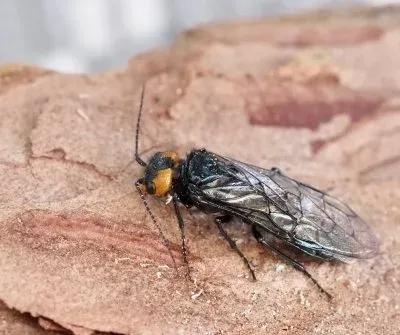
The adults are small, robust insects. Females possess an ovipositor used to saw into pine needles to deposit eggs, which explains the common name given to this entire group of insects.
Pupation occurs within durable cocoons, which are often found attached to pine needles or tucked into the bark crevices of the host tree, providing protection against environmental fluctuations.
The species typically overwinters in the prepupal stage inside the cocoon. This stage is highly resilient, allowing the population to survive harsh winters and emerge during favorable spring conditions.
What it damages
This pest primarily attacks various species of pine trees. The larvae are voracious feeders, capable of consuming significant amounts of needles, which can lead to rapid defoliation of the host tree.
When feeding, larvae usually start from the edges of the needles, leaving them ragged before eventually consuming the entire needle. Excessive defoliation severely impairs the tree's ability to undergo photosynthesis.
Heavily infested trees become severely stressed, making them highly susceptible to secondary attacks by bark beetles and wood-boring insects, which often seal the fate of the tree.
Cumulative damage over several seasons results in reduced annual growth, stunted development, and in extreme cases, the total death of the tree, especially in young plantations.
Large-scale defoliation also creates a significant fire hazard in pine forests. The accumulation of dropped, partially eaten needles provides dry fuel that can easily ignite during dry summer months.
When it appears
The adult emergence begins in late spring when temperatures stabilize. This is the period when mating occurs and females begin the process of egg-laying on suitable host trees.
Larvae typically appear in late spring or early summer, depending on the local climate. This period marks the peak of their activity, as they feed intensely to gather energy for pupation.
The species usually completes one generation per year. However, in regions with particularly long and warm growing seasons, partial second generations may occasionally occur.
By mid-summer, the feeding phase concludes, and larvae migrate to construct their cocoons. This transition period is critical for observing the end of the active infestation cycle.
From late summer through the entire winter, the sawfly remains in a dormant state inside the cocoon, awaiting the arrival of the next spring to restart the development cycle.
Signs of infestation
The most prominent sign of infestation is the appearance of needles with serrated or missing edges. In severe cases, branches look almost bare, with only short, stubby needles remaining.
A telltale sign of an active infestation is the presence of frass, or droppings, which accumulate beneath the infested trees. These small, dark pellets often litter the forest floor under affected branches.
Close inspection of the foliage will reveal rows of small incisions on the needles, where eggs were deposited. Young larvae are often found feeding in clusters on the ends of the branches.
When disturbed, the larvae exhibit a characteristic defensive behavior, raising their front and rear ends to form an S-shape. This motion is a clear indicator that the sawfly is present.
One can also find the tough, brown, oval cocoons attached to the needles or twigs. Finding these indicates that the larvae have successfully completed their feeding stage.
Control measures
Chemical control is effective when using insecticides targeting the younger larval stages, as they are most vulnerable shortly after hatching. Systemic insecticides can also be applied to protect the foliage.
Biological control methods, such as the use of nucleopolyhedrovirus sprays, are highly recommended because they are target-specific and have minimal impact on non-target beneficial insects.
Promoting a healthy ecosystem by protecting natural enemies like parasitic wasps and predatory bugs can help maintain sawfly populations below the economic threshold without chemicals.
Regular monitoring of pine plantations is essential. Early detection allows for localized management, preventing the need for large-scale applications of control agents across an entire forest area.
In smaller landscapes or nurseries, physical removal of larvae and cocoons is a practical solution. If infestation is spotted early, pruning affected branches can also stop the spread.
Taxonomy
- Latin name
- Gilpinia virens
- Order
- Hymenoptera
- Family
- Diprionidae
- EPPO code
- GILPVI
Discussion
No discussions yet — be the first.