
European pine sawfly
Gilpinia verticalis
Description
How to identify
The European pine sawfly (scientific name: Neodiprion sertifer) is a destructive pest of pine trees, belonging to the order Hymenoptera and the family Diprionidae. Despite the name, adult sawflies look more like small wasps, but they lack the characteristic "wasp waist" and possess a saw-like ovipositor.
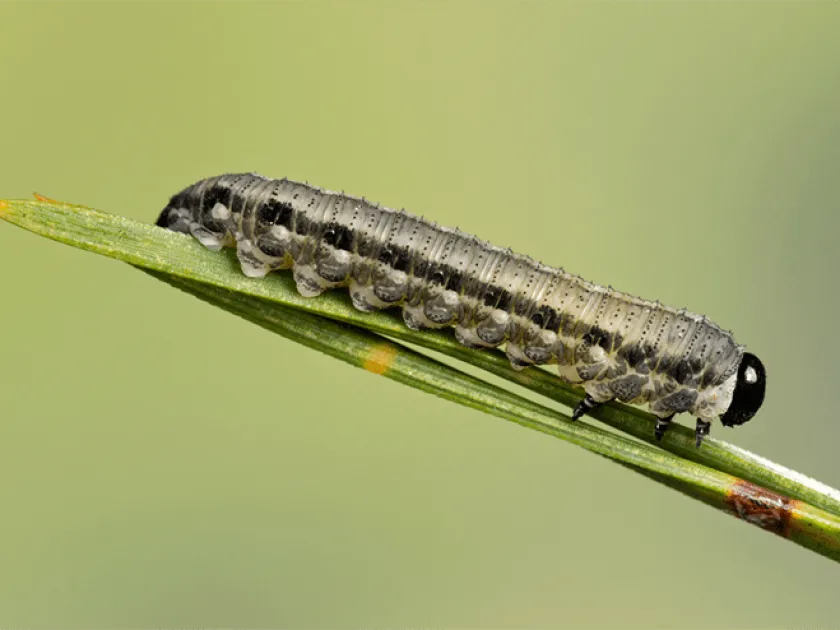
The larvae, which are the main cause of damage, resemble caterpillars. They are typically gregarious, feeding in groups, and have a greyish-green to dark olive coloration with a lighter dorsal stripe, allowing them to blend perfectly with pine needles.
The life cycle begins with eggs overwintering inside the pine needles of the previous year's growth. Hatching occurs in spring, precisely timed with the emergence of new pine buds, which are susceptible to early damage.
This species is univoltine, meaning it produces only one generation per year. However, their high reproductive potential and gregarious behavior can lead to sudden, severe outbreaks in pine stands.
Adults emerge in late summer or autumn to mate and lay eggs. The female uses her saw-like ovipositor to cut into the needle tissues, creating a safe, protected environment for the overwintering eggs.
What it damages
The European pine sawfly primarily infests various species of pine, with a strong preference for Pinus sylvestris. It can be a significant problem in forests, parks, and ornamental plantations.
Larvae consume pine needles, starting with the margins and eventually devouring the entire needle. This feeding pattern creates a very distinct "stubby" appearance on the branches.
Severe defoliation reduces the photosynthetic capacity of the trees, leading to weakened health, reduced growth rates, and, in young trees, possible death after repeated infestations.
Ornamental pines and young plantations are at the highest risk. Damage here is not only biological but also aesthetic, as the tree loses its visual appeal and structural integrity.
Defoliated trees are highly susceptible to secondary attacks from bark beetles and other wood-boring insects, which can finalize the destruction of the weakened host tree.
Signs of infestation
The most obvious sign of infestation is the presence of large clusters of larvae on the branches. They often feed in unison, and when disturbed, they exhibit a synchronized defensive movement.
Brown, dry needle stubs left on the branches are classic evidence of previous feeding. Unlike leaf-eating caterpillars, sawfly larvae leave the central vascular bundle exposed or consume the needle completely.
Small, light-colored slit marks on the needles indicate where females have laid their eggs. These marks are visible before the larvae hatch and serve as an early warning sign for scouting.
Accumulation of larval frass (excrement) on the ground underneath the infested tree branches is a clear indicator of a high population density of larvae feeding above.
In the advanced stages of an outbreak, the upper portion of the tree canopy appears thin and yellowish, which is a stark contrast to healthy, lush green foliage.
Control measures
Integrated Pest Management (IPM) is crucial for controlling Neodiprion sertifer. Early detection and monitoring are the most effective ways to prevent large-scale defoliation.
Biological control includes the use of nucleopolyhedrovirus-based pesticides, which are highly specific to this species and do not harm beneficial insects or local wildlife.
Chemical insecticides, such as systemic or contact-acting pyrethroids, can be applied when the population exceeds the economic injury threshold, typically during the early larval stage.
- Manual removal of infested branches if the tree is small or in a nursery setting.
- Encouraging natural predators such as parasitic wasps and predatory beetles.
- Installing bird nesting boxes to attract insectivorous bird species to the area.
- Maintaining healthy forest conditions to improve the tree's natural resilience.
Avoiding pure pine monocultures in landscape planning can significantly reduce the risk of massive outbreaks, as diversity helps maintain a natural balance of predators and prey.
Taxonomy
- Latin name
- Gilpinia verticalis
- Order
- Hymenoptera
- Family
- Diprionidae
- EPPO code
- GILPVE
Discussion
No discussions yet — be the first.