

Pest · Hemiptera (bugs, aphids, leafhoppers) · affects Onion, Fodder beet, Wild cabbage
Especially harmful
Mealy plum aphid
Brachycaudus helichrysi
Description
How to identify
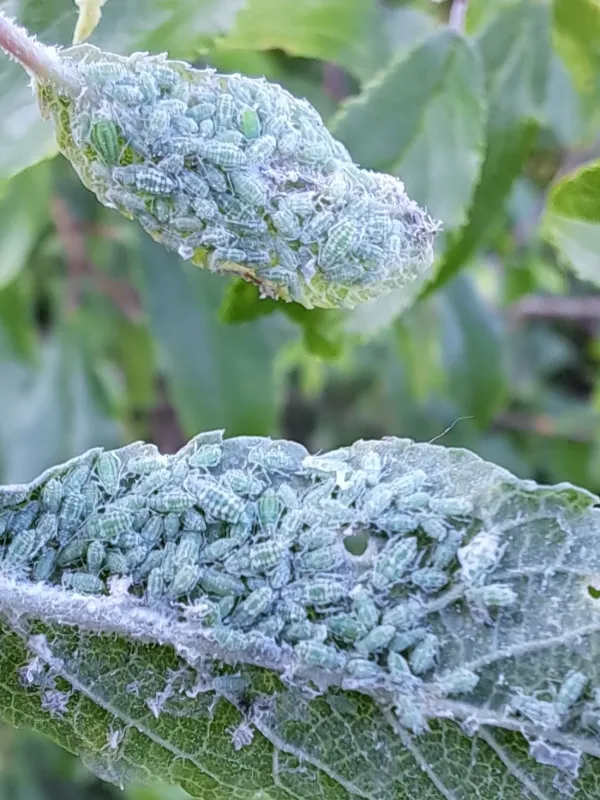
The mealy plum aphid (Brachycaudus helichrysi) is a small sap-sucking insect belonging to the family Aphididae. Adults are approximately 1.5–2 mm long, characterized by a distinct waxy, white, or dusty coating on their bodies.
The color of the aphid ranges from pale green to yellowish-green. Their heads and thoraxes often display darker pigmentation compared to the rest of the body, which aids in field identification.
This species exhibits a heteroecious lifecycle, meaning it alternates between primary woody hosts (primarily Prunus species) and secondary herbaceous hosts, especially members of the Asteraceae family.
The colony consists of wingless forms that reproduce during the spring and winged forms that facilitate migration and dispersal throughout the summer season.
These aphids are generally found in dense clusters on the undersides of leaves, protected by the density of the colony and their waxy secretions, which can make them difficult to spot during the early stages of infestation.
What it damages
Primary hosts for this pest include plum, damson, and sloe trees, though they can also infest peaches, nectarines, and apricots. Secondary hosts are diverse and include various common weeds.
The aphids feed on plant phloem sap, extracting essential nutrients and moisture, which leads to metabolic stress and stunted growth in affected plant tissues.
Infestation causes significant leaf curling and deformation along the midrib, which drastically reduces the surface area available for photosynthesis.
Damage to the foliage and shoots negatively impacts fruit development and can lead to a reduction in the number of flower buds formed for the following year's crop.
Large colonies produce massive amounts of honeydew, which promotes the growth of sooty mold, blocking light and interfering with gas exchange on the leaf surface.
When it appears
The mealy plum aphid appears on fruit trees in early spring, synchronized with the bud burst and the emergence of new, tender foliage that provides optimal nutrition.
By early to mid-summer, most of the population migrates away from the plum trees to their secondary herbaceous hosts, where they continue to breed for several generations.
As autumn approaches, winged sexual forms return to the primary woody hosts to mate and deposit overwintering black eggs in bark crevices.
The period of maximum damage typically occurs between May and June, representing a critical window for orchard monitoring and pest management intervention.
Mild and humid spring conditions are particularly favorable for rapid population growth, potentially leading to outbreaks that can cause severe tree weakening.
Signs of infestation
The most diagnostic sign is the severe rolling or curling of leaves, which often turn yellow or develop chlorotic spots due to aphid feeding.
White, mealy, or waxy deposits are visible on the undersides of leaves, indicating the presence of a thriving aphid colony hidden within the curls.
Sticky honeydew secretions coat the leaves and stems, acting as a substrate for the growth of black, sooty mold fungi that gives the foliage a dark appearance.
Affected shoots often show retarded growth and significant distortion, appearing stunted compared to healthy growth elsewhere on the tree.
An abundance of predatory insects, such as ladybird beetles and lacewing larvae, feeding on the colonies, is often an indicator of a high aphid density.
Control measures
Integrated Pest Management (IPM) is essential for controlling the mealy plum aphid, focusing on preventative measures and targeted chemical intervention.
- Pruning and removing infested shoots early in the season to reduce colony numbers.
- Eliminating secondary herbaceous host plants, such as weeds near the orchard, to disrupt the summer cycle.
- Preserving natural predators like ladybugs, hoverflies, and lacewings by avoiding broad-spectrum insecticides.
- Applying dormant oil sprays in late winter to suffocate overwintering eggs.
- Using systemic or contact insecticides during the spring, strictly adhering to economic threshold levels to prevent resistance.
Biological control agents, including entomopathogenic fungi, are becoming increasingly useful tools for organic and sustainable orchard management practices.
Careful timing of insecticide application is crucial, as the waxy coating of the aphid can sometimes provide a physical barrier to contact-based treatments.
Reference
Connections · Mealy plum aphid
Most often together:
Marketplace
Products · 2

Biology
Taxonomy
- Latin name
- Brachycaudus helichrysi
- Order
- Hemiptera (bugs, aphids, leafhoppers)
- Family
- Aphididae
- EPPO code
- ANURHE
Community
Discussion
No discussions yet — be the first.