
Lappet moth
Gastropacha quercifolia
Description
How to identify
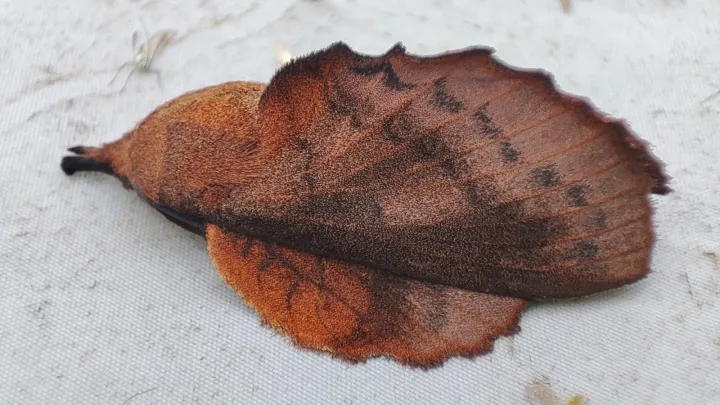
The Lappet moth (Gastropacha quercifolia) is a species of moth in the Lasiocampidae family. It is well-known in entomology for its remarkable camouflage, which makes both the adult and the larva nearly invisible on host trees.
Adult moths have a wingspan ranging from 50 to 90 mm. Their wings have a distinctive reddish-brown or dark-brown color with wavy edges, mimicking the appearance of a withered oak leaf. When at rest, they hold their wings tightly against their bodies.
The larvae, or caterpillars, are large, reaching up to 100 mm in length. They are covered in dense gray-brown hairs and possess distinctive transverse blue and black bands on the second and third thoracic segments, which are visible when they are disturbed.
Pupation occurs within a tough, elongated, grayish-brown cocoon. These cocoons are typically constructed in branch forks or concealed within bark crevices, often camouflaged with small debris and particles of plant tissue.
This species is widely distributed throughout the Palearctic region. Its preferred habitats include mixed deciduous forests, parks, and traditional orchards, where it can easily access its preferred host plants.
What it damages
The Lappet moth is a polyphagous pest that feeds on a wide range of woody plants. Its primary targets in agricultural settings are fruit trees, specifically apples, pears, plums, cherries, and apricots.
Larvae are highly voracious. In spring, they feed on emerging buds, preventing normal foliage development. As they grow, they move on to devour entire leaves, leaving behind only the toughest midribs and veins.
Heavy infestations can lead to significant defoliation of the canopy. This physiological stress reduces the tree's ability to store carbohydrates, which negatively impacts fruit set and overall winter hardiness.
Young trees are particularly susceptible to severe damage. Continuous annual defoliation can lead to stunted growth, dieback of terminal shoots, and increased susceptibility to fungal diseases and boring insects.
While orchards are the main economic concern, the presence of the moth in nearby hedgerows or woodlands ensures a constant source of re-infestation for commercial and private gardens.
When it appears
The Lappet moth follows an annual life cycle. Adult moths emerge in mid-summer, typically between July and August. They are nocturnal and are frequently attracted to artificial lights at night.
Females deposit their eggs in small batches, usually on the underside of leaves of suitable host trees. The eggs hatch after a few weeks, and the young larvae begin feeding during the late summer and early autumn months.
The species overwinters as young larvae. They seek refuge in bark crevices, moss, or the leaf litter near the base of the trunk, where they enter a state of diapause to survive cold winter temperatures.
As spring approaches and temperatures rise, the overwintered larvae emerge to feed on the swelling buds and young foliage. This is the most damaging phase of their life cycle for fruit production.
By late spring or early June, the larvae reach maturity and begin the process of spinning their cocoons. The pupal stage lasts approximately three to four weeks before the new generation of adults emerges.
Signs of infestation
The most obvious sign of infestation is the skeletonization or total consumption of leaves within the canopy. Larvae are master mimics and remain motionless during the day, appearing like part of the woody structure.
- Ragged, eaten leaf edges on various fruit tree species.
- Large, hairy caterpillars found resting on branches during dusk or night.
- Presence of firm, grayish-brown silken cocoons hidden in branch junctions.
- Visible frass (excrement) pellets accumulating on lower branches or the ground underneath the tree.
Checking the trees at night with a flashlight is the most reliable way to detect active larvae, as they initiate their feeding cycle once the sun sets.
Early season damage to buds is a critical indicator of a high population density that may require immediate intervention.
Control measures
Cultural control involves mechanical removal. During dormant winter months, cleaning loose bark from trunks can help expose and eliminate hibernating larvae, reducing the population for the next season.
Hand-picking caterpillars in small orchards or gardens is highly effective. If done early in the season, this manual effort can prevent the need for more intensive chemical treatments later.
Biological control, such as using Bacillus thuringiensis sprays, is highly recommended. This targets the larvae while they are young and feeding, and it minimizes the impact on non-target beneficial insects.
Chemical applications should be timed for the spring when larvae are actively feeding. It is essential to use registered insecticides and rotate chemical classes to avoid the development of pest resistance.
Pheromone traps can be deployed during the summer flight period to monitor population levels and help time interventions, serving as an early warning system for the orchard manager.
Taxonomy
- Latin name
- Gastropacha quercifolia
- Order
- Lepidoptera (butterflies)
- Family
- Lasiocampidae
- EPPO code
- GASPQU
Discussion
No discussions yet — be the first.