
Lappet moth
Gastropacha
Description
How to identify
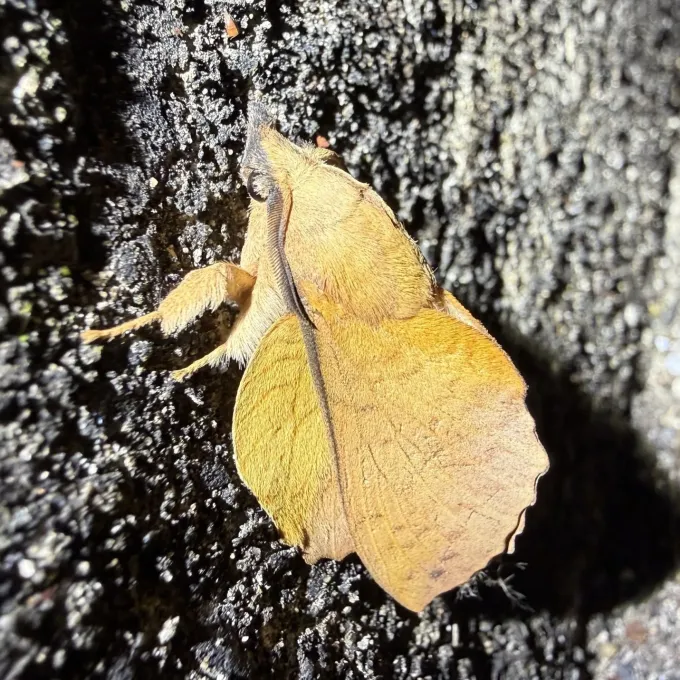
The Lappet moth (Gastropacha quercifolia) is a large moth belonging to the Lasiocampidae family. When resting, it mimics a dried, withered oak leaf with remarkable precision. Its body and wings feature a complex pattern of brown and reddish-brown colors, allowing it to blend perfectly into the bark of trees during the day.
The larvae, or caterpillars, are large, reaching up to 10 centimeters in length. Their coloration is grayish-brown, mimicking a twig or piece of wood. A distinct feature is the presence of bright blue or red transverse bands on the dorsal side, which are revealed only when the caterpillar is disturbed or defensive.
The life cycle is univoltine, meaning there is one generation per year. The species overwinters as young larvae, hiding in bark crevices or at the base of branches. With the onset of spring and the swelling of buds, they emerge from diapause and begin intensive feeding on the foliage.
Adult moths are active in mid-summer, typically between July and August. After mating, females deposit their eggs on the underside of leaves in small groups. The resulting larvae feed throughout the late summer and autumn, accumulating sufficient energy to survive the winter months.
Adults do not feed as their mouthparts are vestigial; their sole biological function is reproduction. A single female can lay up to 800 eggs, which creates the potential for significant outbreaks if natural predators are insufficient to control the population density in a local area.
What it damages
The Lappet moth is a polyphagous insect that targets a wide range of woody plants. It primarily affects fruit trees such as apples, pears, plums, and cherries. Additionally, it frequently infests deciduous trees like oaks, willows, and hawthorns, often causing significant defoliation.
Signs of infestation
The most evident sign of a Lappet moth infestation is the presence of heavily eaten foliage. Older larvae are capable of skeletonizing entire leaves, leaving behind only the main veins. This damage reduces the tree's ability to photosynthesize, which can stunt growth and weaken the plant.
Because they are nocturnal, these caterpillars remain sedentary and camouflaged on twigs during the day. Inspecting the undersides of branches or the trunk during the early morning can often reveal the caterpillars resting, as they are notoriously difficult to spot while inactive.
Reduced vigor in fruit trees, evidenced by sparse foliage, is a key symptom. If a large number of caterpillars are present, the tree may experience severe stress, leading to a reduction in fruit quality and the failure of buds to develop properly for the following season.
Cocoons can also be found attached to twigs or hidden within webbed-together leaves. These cocoons are dense and elongated, typically blending in with the surroundings. Their presence is a clear indicator that the population has completed its larval stage and is preparing for metamorphosis.
Frass (larval droppings) found on the ground beneath the canopy is a telltale sign. A significant accumulation of frass indicates that the infestation is active and that the caterpillars are currently feeding in the upper canopy, where they may be less visible to the naked eye.
Control measures
Mechanical control is highly effective in small orchards and gardens. This involves manually removing caterpillars and egg clusters when spotted. Additionally, scraping away loose or dead bark during the winter can eliminate the overwintering sites for young larvae.
Biological control using formulations based on Bacillus thuringiensis is an environmentally friendly and highly effective method. Treatment is most successful when applied to early-instar larvae, ensuring maximum efficacy and minimal disruption to beneficial predatory insects.
Chemical control should be reserved for cases of severe outbreaks. If insecticides are required, they should be applied with precision, following label instructions to protect pollinators. It is essential to avoid spraying during the blooming period to prevent non-target mortality.
Encouraging natural predators such as birds and parasitic wasps is a sustainable long-term strategy. Providing nesting sites for insectivorous birds can significantly reduce the number of caterpillars by creating a natural balance within the orchard environment.
- Scraping dead bark to remove wintering larvae.
- Manual removal of caterpillars during evening hours.
- Application of bio-insecticides targeting young larvae.
- Using sticky bands on tree trunks to trap caterpillars.
- Enhancing biodiversity to support natural predator populations.
Taxonomy
- Latin name
- Gastropacha
- Order
- Lepidoptera (butterflies)
- Family
- Lasiocampidae
- EPPO code
- GASPSP
Discussion
No discussions yet — be the first.