
African grasshopper
Gastrimargus africanus
Description
How to identify
Gastrimargus africanus is a member of the Acrididae family, commonly known as the African grasshopper. These insects are characterized by their robust bodies, strong hind legs designed for jumping, and functional wings for flight.
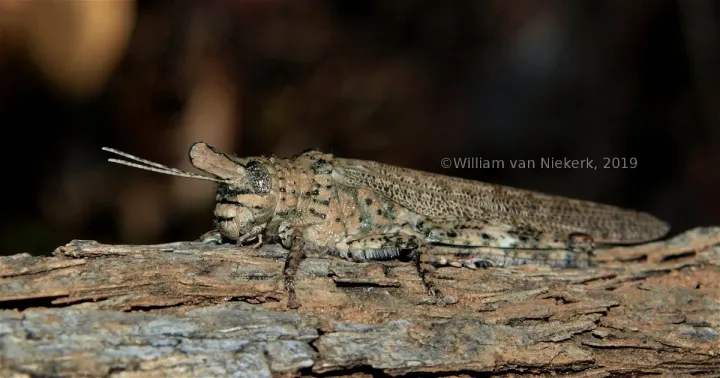
Adults typically exhibit a camouflage coloration ranging from green to brown or mottled grey, which allows them to blend seamlessly into their natural habitat of grasses and field crops. Their forewings often display intricate patterning, while hind wings may show yellowish hues at the base.
The nymphs go through several developmental stages, or instars. Each stage shows a gradual increase in size and the progressive development of wing pads. By the final molt, they reach their adult, sexually mature stage.
This species is widely distributed throughout Africa and surrounding regions, thriving in diverse environments such as grasslands, meadows, and agricultural areas. They are known for their adaptability to various climates, provided there is enough vegetation for sustenance.
Taxonomically, identification relies on the specific morphology of the pronotum and the venation patterns on the tegmina. In field conditions, they are often identified by their size and distinct jumping patterns compared to other orthopteran species.
What it damages
The African grasshopper is a significant polyphagous pest that feeds on a wide range of botanical species. By consuming leaves, stems, and reproductive organs, they pose a serious threat to the productivity of various agricultural systems.
Cereal crops, including maize, sorghum, millet, and wheat, are particularly susceptible. Grasshoppers can defoliate plants rapidly, reducing their ability to photosynthesize and leading to stunted growth or total crop loss.
When populations reach high densities, the damage is severe. The pests can consume entire sections of a field, leaving only the vascular tissues of stems behind. This behavior can result in massive economic losses for local farmers and regional food supplies.
Beyond direct tissue consumption, the feeding damage leaves plants vulnerable to secondary infections. Bacteria and fungi often enter through the wounds caused by grasshopper mandibles, causing further decay and reduction in crop quality.
The extent of the damage is highly dependent on the population density of the locusts. Early intervention is critical, as damage accumulates exponentially as nymphs reach their final, more voracious stages of development.
When it appears
The seasonal activity of Gastrimargus africanus is primarily dictated by rainfall patterns and temperature. Reproduction typically coincides with the arrival of the rainy season, which stimulates the growth of the grass needed for egg-laying and nymphal feeding.
Eggs are deposited in the soil in protective cases. The timing of hatching is often synchronized with the germination of nearby vegetation, ensuring the young nymphs have an immediate food source available upon emergence.
Depending on the region, the species can produce multiple generations per year. The peak activity period usually occurs during the warmest months when conditions are optimal for rapid growth and development of the population.
Migration becomes a significant factor during dry spells or after food depletion in local areas. Grasshoppers will move in search of greener pastures, often migrating from fallow lands into actively growing commercial agricultural fields.
Field scouting should begin at the start of the growing season. Agronomists focus on identifying potential breeding sites near field margins or waste areas to estimate the potential risk of infestation before nymphs spread.
Signs of infestation
The first sign of an infestation is the appearance of ragged holes or notched edges on leaves. In cases of high density, large patches of the leaf canopy may be skeletonized or entirely missing, especially around the edges of the field.
Observing the pests directly is common when walking through fields. Sudden, noisy jumping by large numbers of insects upon disturbance is a hallmark sign of a significant population presence.
Excrement in the form of small, pellet-like droppings on leaves and soil surface is a clear indicator of grasshopper activity. Furthermore, cast-off skins from molting are frequently left behind on the stems of infested plants.
- Ragged, uneven defoliation on crop leaves.
- Visible presence of large, jumping adults or nymphs in the canopy.
- Presence of frass (droppings) on the ground near plant bases.
- Cast skins attached to plant stems following molting cycles.
Scouting protocols often target the boundary rows first, as grasshoppers tend to colonize these areas before advancing into the center of the crop, making early detection possible with focused monitoring.
Control measures
Effective management of Gastrimargus africanus requires an integrated approach. Cultural methods, such as deep tillage of known egg-laying sites, are highly effective because they destroy the egg pods in the soil and prevent hatching.
Chemical control remains the primary strategy during outbreaks. Applying contact or stomach-poison insecticides in the early stages of nymph development is most effective, as the pests are less mobile and more susceptible to control measures.
Biological control agents, such as entomopathogenic fungi or specialized wasps, are increasingly used in integrated pest management programs to reduce chemical dependency and promote long-term population suppression.
Keeping field borders free of tall, dense weeds can reduce the attractiveness of these areas to grasshoppers, limiting their ability to build up populations before invading the commercial crop.
Decision-making for control operations should be based on threshold counts. Agronomists count the number of individuals per square meter and compare this to established economic injury levels to determine if treatment is financially justified.
Taxonomy
- Latin name
- Gastrimargus africanus
- Order
- Orthoptera (locusts)
- Family
- Acrididae
- EPPO code
- GSTMAF
Discussion
No discussions yet — be the first.