
Galgupha
Galgupha
Description
How to identify
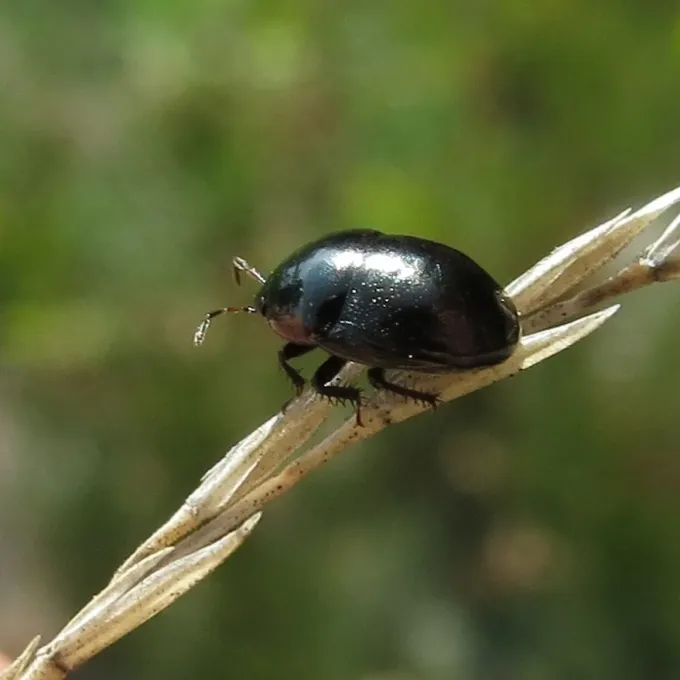
Galgupha is a genus of bugs belonging to the family Thyreocoridae (the negro bugs or burrowing bugs) within the order Hemiptera. These insects are easily recognized by their highly convex, almost hemispherical bodies.
Adults typically exhibit a dark, shiny black or brownish coloration with a metallic sheen. Their scutellum (the shield-like structure) is unusually large, covering the entire abdomen and wings, giving them the appearance of small, compact beetles.
The size of an adult ranges from 3 to 6 millimeters in length. Their heads are small and tightly held against the pronotum, contributing to their streamlined, aerodynamic body shape that aids in moving through vegetation.
Nymphs undergo several developmental stages, gradually resembling adults. They are generally less mobile than mature bugs and often feature paler or mottled colors, which helps them camouflage within the soil and root areas.
Accurate identification to the species level often requires a microscope to examine specific morphological characteristics, such as the punctation of the pronotum or genital structures, which are hidden by the large shield.
What it damages
Galgupha bugs are polyphagous, meaning they feed on a diverse range of host plants, including vegetable crops, grains, and legumes. They pose a significant risk to agricultural productivity.
These bugs use their piercing-sucking mouthparts to extract sap from stems, leaves, and young fruits. This feeding habit weakens the plant's structural integrity and diminishes its overall health.
Young seedlings are particularly vulnerable to infestations. Attacked plants often show signs of stunted growth, leaf curling, and in severe cases, death of the entire plant due to systemic nutrient depletion.
Mechanical damage caused by feeding also creates entry points for secondary infections, including various fungal and bacterial pathogens that further degrade the quality and quantity of the harvest.
In large-scale farming, uncontrolled Galgupha populations can lead to significant economic losses, especially during dry seasons when plants are already stressed by water scarcity.
When it appears
The life cycle of Galgupha is highly dependent on regional climate conditions. Adults typically overwinter under plant debris, leaf litter, or within the top layer of soil.
Adult activity commences in early spring when temperatures consistently rise above 10–12 degrees Celsius. Initially, they feed on wild host plants and weeds before migrating to agricultural fields.
Reproduction typically occurs in late spring and early summer. Females lay eggs on the undersides of leaves or along stems, ensuring that nymphs have immediate access to food sources upon hatching.
The development from egg to adult takes approximately 4 to 8 weeks, depending on ambient temperatures. In warmer southern regions, the pest may complete two full generations within a single season.
As autumn approaches and temperatures drop, the bugs actively seek overwintering sites, often moving from open fields to the shelter of hedgerows, forest edges, or uncultivated margins.
Signs of infestation
The first indicator of an infestation is the appearance of small, pale, or necrotic spots on the leaves, caused by the bug's mouthparts piercing the plant tissues during sap extraction.
During field scouting, you can often find clusters of nymphs on the undersides of leaves or at the base of the plant. They tend to group together and move slowly when disturbed.
- Yellowing of leaf margins (chlorosis).
- Distortion or curling of young shoots and tips.
- Presence of dark waste droplets on leaf surfaces.
- General slow-down in crop development and vigor.
Severe infestations often manifest as premature wilting of specific plant areas, despite sufficient soil moisture, indicating damage to the plant's vascular tissue.
Control measures
Effective management of Galgupha requires an integrated pest management (IPM) approach, combining cultural practices with chemical interventions where necessary.
Deep autumn plowing or soil cultivation is highly effective in disrupting the overwintering sites of these bugs, significantly reducing the population density before the next planting season.
Biological controls, such as encouraging natural enemies or applying biopesticides based on entomopathogenic fungi, can be useful strategies during the early stages of infestation.
When monitoring indicates that the economic injury level has been exceeded, targeted applications of systemic or contact insecticides are recommended.
It is crucial to follow label directions for pesticide usage and rotate chemical classes to minimize the risk of the pest developing resistance to specific active ingredients.
Taxonomy
- Latin name
- Galgupha
- Order
- Hemiptera (bugs, aphids, leafhoppers)
- Family
- Cydnidae
- EPPO code
- GALPSP
Discussion
No discussions yet — be the first.