
Galendromus occidentalis
Galendromus occidentalis
Description
How to identify
Galendromus occidentalis is a predatory mite belonging to the Phytoseiidae family, which is widely recognized in agriculture for its role as a natural enemy.
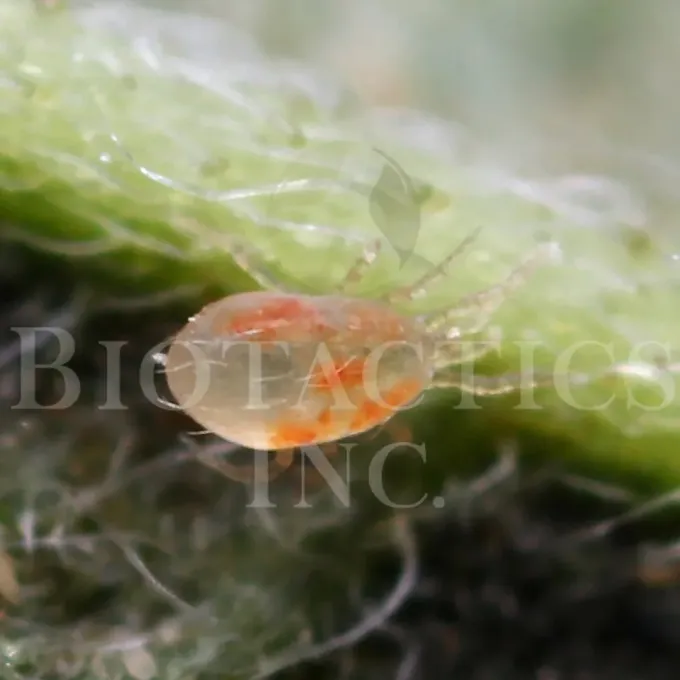
Adult mites are tiny, measuring approximately 0.3 to 0.4 mm in length, and are usually pear-shaped, making them difficult to detect without specialized equipment.
Their coloration is variable, ranging from translucent yellow to pale orange, which often depends on the type and quantity of prey they have recently consumed.
The life cycle encompasses stages from egg to larva, protonymph, deutonymph, and finally the adult stage, allowing for rapid population growth in warm conditions.
They are highly active predators, constantly patrolling plant foliage to locate and feed on herbivorous mites, especially spider mites.
What it damages
In agronomy, Galendromus occidentalis is strictly classified as a beneficial organism rather than a pest, serving as a primary biological control agent.
Its primary food source includes various species of tetranychid mites, such as the two-spotted spider mite, which are notorious for damaging leaves and reducing crop yields.
When chemical interventions eliminate this predatory mite, spider mite populations often experience an explosive increase, leading to severe economic losses in orchards and vineyards.
In scenarios where primary prey is scarce, these mites can subsist on alternative food sources like pollen, nectar, or honeydew, which allows them to persist in the field.
The lack of this predator in an agricultural system is therefore a significant disadvantage, removing a crucial buffer against seasonal pest outbreaks.
When it appears
The seasonal activity of this mite is highly dependent on environmental temperatures, typically beginning when daily temperatures rise above 15 °C in the spring.
Peak activity occurs during the summer months, particularly in July and August, when conditions are ideal for both the predator and its herbivorous prey.
As daylight hours shorten and temperatures drop in the autumn, the mites enter a diapause phase or significantly reduce their metabolic rate to survive the winter.
In controlled environment agriculture, such as greenhouses, they can maintain activity throughout the year, providing constant biological suppression of spider mites.
The high reproduction rate enables multiple generations per season, ensuring that the predator population adapts quickly to the fluctuating density of the prey.
Control measures
To preserve populations of Galendromus occidentalis, farmers should avoid the use of broad-spectrum pesticides that are toxic to beneficial predatory mites.
Adopting an Integrated Pest Management (IPM) approach is essential, where chemical applications are only used as a last resort based on strict economic threshold monitoring.
When chemical control of other pests is necessary, choosing selective pesticides that spare predatory mites is the best strategy to maintain ecological balance.
In cases of severe spider mite outbreaks, augmentative releases of lab-reared Galendromus occidentalis can be an effective way to restore predator populations rapidly.
Maintaining diverse flora around crop areas provides a refuge for these mites during periods of low prey density, enhancing their long-term effectiveness in the field.
Taxonomy
- Latin name
- Galendromus occidentalis
- Order
- Mites
- Family
- Phytoseiidae
- EPPO code
- TYPLOC
Discussion
No discussions yet — be the first.