
Galendromus helveolus
Galendromus helveolus
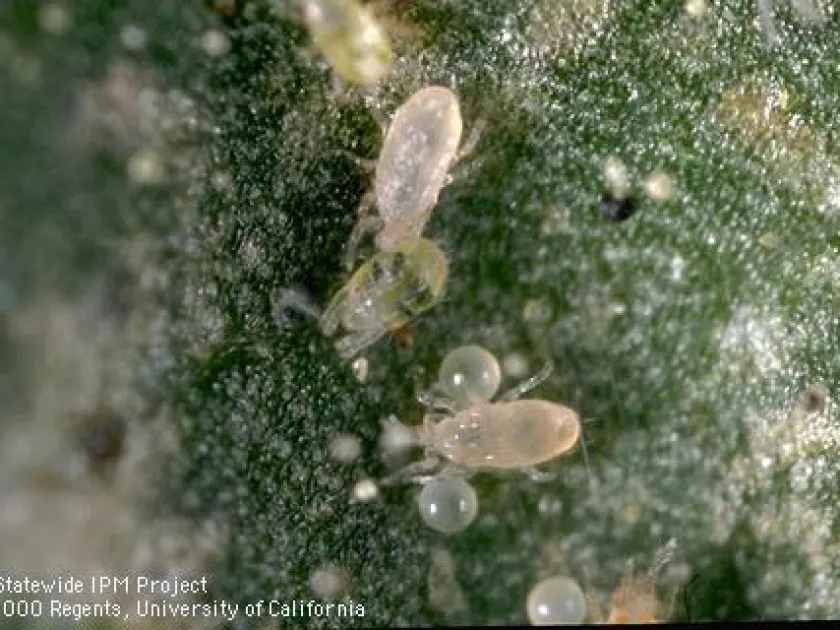
Description
How to identify
Galendromus helveolus is a mite belonging to the family Phytoseiidae. While many species in this family are considered beneficial predators, G. helveolus is often monitored for its impact on specific agricultural crops, where its presence may indicate a shift in the local ecosystem balance.
These mites are microscopic, typically displaying an oval, pale, or yellowish body. They possess a smooth dorsal shield and are highly mobile, allowing them to traverse leaf surfaces rapidly when searching for food or suitable habitats.
Systematically, they are closely related to other predatory mites. Identification in the field requires specialized knowledge or microscopic analysis of the dorsal setae patterns to differentiate them from other closely related species.
The biology of this mite is highly adaptive, allowing it to survive and reproduce across various environments. Its population dynamics are closely linked to the availability of nutrients and the presence of competing organisms in the habitat.
Although they are often beneficial predators in specific systems, in intensive agriculture, they require careful monitoring to ensure that their population levels do not cause secondary damage to the crop.
What it damages
Damage caused by Galendromus helveolus often manifests as tissue impairment on the host plants. While primarily predatory, their feeding habits can lead to direct damage under certain environmental stress conditions.
The host range includes a variety of citrus trees and ornamental species frequently found in greenhouses, where high humidity and stable temperatures favor their rapid colonization.
Feeding activity leads to the extraction of cellular contents from the leaves, which causes chlorosis and the development of necrotic spots, ultimately affecting the plant's photosynthetic efficiency.
Mass infestations can result in significant yield losses, stunted growth, and a reduction in the ornamental quality of affected plants, creating a substantial economic burden for growers.
Furthermore, the physical damage to the leaf epidermis makes the plant more susceptible to secondary pathogens, including various fungal and bacterial infections that enter through the mite's feeding sites.
When it appears
The seasonal activity of Galendromus helveolus is largely governed by environmental variables such as temperature and humidity levels. In indoor settings, populations can remain active and reproductive throughout the year.
In outdoor field conditions, the mite's activity commences as temperatures rise in the spring. Populations typically reach their peak density during mid-summer, when the heat accelerates their life cycle.
As autumn approaches and temperatures drop, the mite’s rate of reproduction significantly decreases, leading the insects to seek shelter in bark crevices or plant debris to overwinter successfully.
Monitoring efforts should be constant throughout the growing season. Their rapid life cycle means that a small initial population can expand to cover a large portion of a crop in a relatively short timeframe.
Detection methods include regular inspection of the underside of leaves and the use of magnifying tools or sticky traps to monitor early-season migration into the crop canopy.
Signs of infestation
The initial signs of an infestation often appear as small, light-colored stippling or bleaching on the leaves. As the infestation progresses, these spots expand, leading to larger discolored patches.
The presence of fine webbing on the foliage is a primary indicator of high infestation density. This webbing is used by the mites for protection and to stabilize their movement across the leaf surface.
Severe infestation causes the leaves to curl, yellow, and eventually drop prematurely. This premature leaf drop significantly reduces the plant's vigor and limits its ability to produce fruit or flowers.
- Chlorosis (yellowing) and marble-like spotting on leaves.
- Visible fine silk webbing on the leaf underside.
- Leaf curling and deformation.
- Stunted shoot development.
Under a magnifying lens, one may observe the mites actively crawling along the veins or congregating near the succulent young growth, which is their preferred feeding area.
Control measures
Integrated Pest Management (IPM) is the most effective approach for controlling Galendromus helveolus, combining biological, cultural, and chemical strategies.
Biological control involves the strategic introduction of specialized predators or entomopathogenic fungi that can keep the mite population in check without disrupting the broader ecosystem.
Cultural practices, such as removing infested plant debris and managing weed reservoirs, are essential for reducing the overall pest pressure on the primary crop.
Chemical intervention should be limited to the use of selective acaricides that specifically target the mites while preserving the populations of beneficial insects and natural predators.
Maintaining optimal irrigation and fertilization schedules helps improve overall plant health, making the crops more resilient to mite attacks and reducing the need for intensive chemical sprays.
Taxonomy
- Latin name
- Galendromus helveolus
- Order
- Mites
- Family
- Phytoseiidae
- EPPO code
- GALNHE
Discussion
No discussions yet — be the first.