
Froggattiella
Froggattiella
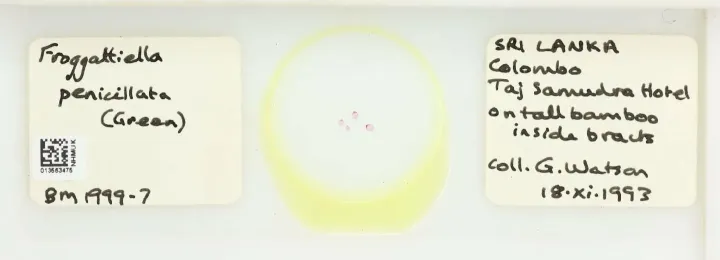
Description
How to identify
Froggattiella is a genus of scale insects belonging to the family Diaspididae within the order Hemiptera. These insects are characterized by their sedentary lifestyle, living protected beneath a hard scale or "armor" formed from their own wax secretions and larval exuviae.
Adult females of this genus are typically wingless and lack functional eyes, having evolved to remain in one position on the host plant throughout their lifespan. Their bodies are completely concealed by a protective cover, which can vary in color and texture depending on the species.
The life cycle of males is quite different; they undergo metamorphosis, developing into winged, short-lived adults capable of flight. Their sole biological purpose is to locate and fertilize the sedentary females to ensure the continuation of the population.
Identifying specific species within the Froggattiella genus is a complex task usually requiring microscopic examination of the pygidium, the terminal segment of the female's body. Specific patterns of pores and lobes on this section are essential diagnostic markers.
The spread of the infestation occurs mainly during the crawler stage. These newly hatched, active larvae are capable of moving across the plant surface or being passively dispersed by wind, insects, or human activities to colonize new, healthy plant hosts.
What it damages
Froggattiella primarily infests woody plants, with a strong affinity for the Myrtaceae family. They are particularly recognized as significant pests in eucalyptus plantations and ornamental plantings where they can form dense, damaging populations.
These insects are piercing-sucking feeders. They insert their stylets into the plant tissue, specifically the phloem or parenchyma, to drain nutrients. This systematic sap extraction deprives the plant of vital resources needed for growth and metabolic maintenance.
Heavy infestations lead to significant tissue damage. As the population grows, the scales cover stems and leaves, often causing chlorosis (yellowing), foliage desiccation, and premature leaf drop, which dramatically reduces the tree's photosynthetic capacity.
Furthermore, the physical damage caused by the stylets can serve as an entry point for secondary infections. Fungal pathogens and bacteria often exploit these wounds, leading to bark necrosis or the decay of internal plant tissues.
In nursery settings, high populations of this pest can render young saplings non-marketable. Continuous feeding weakens the plant structure, leading to stunted growth and potentially irreversible damage to the tree's architecture if not managed promptly.
Signs of infestation
The first observable signs of a Froggattiella infestation are small, immobile bumps or crust-like scales appearing on the bark and leaf undersides. Often, these are mistaken for natural plant textures, delaying the start of necessary control measures.
As the insect colony grows, the host plant begins to exhibit signs of stress, such as patchy yellowing of leaves and overall leaf thinning. In severe cases, the tree will lose its vibrancy, showing a lack of new shoot production.
The presence of honeydew is sometimes observed, which may attract ants or promote the growth of sooty mold, an unsightly black fungal layer that coats the leaves and further inhibits the tree’s ability to photosynthesize effectively.
Upon closer inspection with a magnifying lens, the scales are clearly visible. Removing a scale often reveals the soft-bodied insect underneath. During the crawler phase, tiny, speck-like moving organisms might be seen on the foliage.
Long-term infestation effects include branch dieback and an overall thinning of the canopy. The tree may eventually exhibit "stag-headedness," where the terminal branches die due to a lack of sufficient nutrient transport to the upper parts of the crown.
Control measures
Controlling Froggattiella is challenging because the hard, waxy scale provides excellent protection against many standard contact pesticides. Effective management requires targeting the most vulnerable life stage: the crawler.
Systemic insecticides, particularly those containing neonicotinoids, are highly effective as they are taken up by the plant's vascular system, ensuring that the insect ingests the toxicant during its continuous feeding process.
Horticultural oils can be used to manage populations by physically smothering the insects. When applied thoroughly, these oils create a film that blocks the respiration of the scale insects, leading to their suffocation without harming the plant.
- Conducting regular scouting to identify infestations early.
- Pruning and destroying heavily infested branches to reduce the pest load.
- Timing insecticide applications to coincide with the peak crawler emergence.
- Enhancing plant health through proper irrigation and balanced fertilization programs.
Integrated Pest Management (IPM) also encourages the preservation of natural predators, such as lady beetles and parasitic wasps. Minimizing the use of broad-spectrum insecticides helps maintain these biological control agents, which can keep scale populations at non-damaging levels.
Taxonomy
- Latin name
- Froggattiella
- Order
- Hemiptera (bugs, aphids, leafhoppers)
- Family
- Diaspididae
- EPPO code
- FROGSP
Discussion
No discussions yet — be the first.