
Pearl bug
Eysarcoris perlatus
Description
How to identify
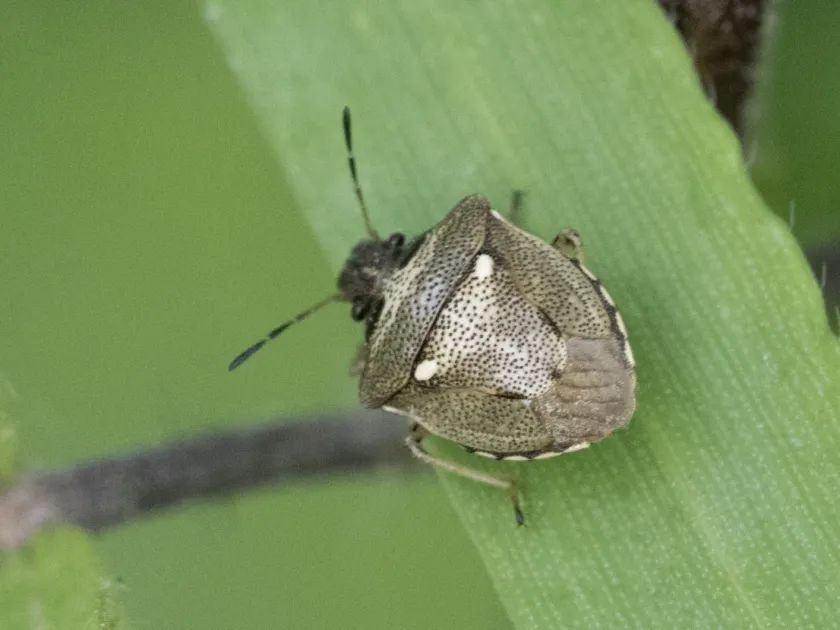
The pearl bug (scientific name: Eysarcoris perlatus) is a species of stink bug belonging to the family Pentatomidae. These insects have an oval, shield-shaped body typically measuring between 6 to 8 millimeters in length.
The coloration of the adult bug ranges from brownish-grey to yellow-brown. The body is heavily punctuated, giving it a rough texture, with distinctive light markings on the pronotum that resemble pearls, hence the common name.
They possess a piercing-sucking proboscis adapted for feeding on plant tissues. The antennae and legs are usually reddish or ochre, which serves as a helpful diagnostic feature for field identification.
The nymph stages undergo five molts, gradually increasing in size and changing their appearance to match the adults. Nymphs are generally smaller and lack fully developed wings compared to the mature insects.
Adults overwinter in leaf litter, debris, or upper soil layers. They emerge in early spring as temperatures rise to feed and search for suitable host plants for reproduction.
What it damages
The pearl bug is a polyphagous pest that primarily damages generative parts of plants. They feed on the cell sap of various crops, with a strong preference for cereals such as wheat, barley, and oats.
In addition to cereals, they can be found on legumes and various wild grasses. They use their proboscis to puncture stems, leaves, and developing seeds, injecting digestive enzymes that disrupt plant physiology.
Feeding on developing kernels causes them to become shriveled, deformed, or sterile. This leads to a significant decrease in grain weight and a decline in overall crop quality and marketability.
The punctures made by the bugs provide entry points for secondary fungal and bacterial infections. This can lead to local tissue necrosis, causing plants to weaken and sometimes die prematurely.
Severe infestations can lead to substantial yield losses across entire fields. The damage is particularly critical during the milky-wax ripeness stage of cereals when the grain is soft and nutrient-rich.
When it appears
The activity of the pearl bug begins in spring when average daily temperatures reach +10-12 degrees Celsius. They start feeding on emerging wild grasses before migrating to crops.
Egg laying usually takes place in late spring and early summer. Females lay batches of eggs on the undersides of leaves, ensuring that the emerging nymphs have immediate access to food.
Nymphs develop rapidly throughout the summer months. This period coincides with the most sensitive growth stages of cereal crops, leading to the highest potential for agricultural damage.
There is typically one generation per year, although exceptionally warm summers can facilitate the development of a partial second generation. Weather patterns greatly influence their annual population density.
As autumn approaches and temperatures drop, adults stop feeding and seek sheltered locations to enter diapause. They remain in these overwintering sites until the next spring season.
Signs of infestation
Initial signs of infestation include tiny discolored spots or punctures on the stems and developing heads of cereal crops. These spots are the direct result of the bug's piercing-sucking feeding method.
Visually, the presence of these bugs is often marked by a characteristic foul odor emitted when they are disturbed. This scent is a result of secretions from their defense glands.
Heads of grain may exhibit partial sterility, becoming light and turning white prematurely. Upon inspection, the kernels inside these heads will appear shriveled and may show signs of discoloration or rot.
The plants may exhibit signs of overall stress, such as yellowing leaves or stunted growth. In dense populations, the bugs can be seen crawling on the stalks or congregating near the bases of plants.
During field scouting, using an entomological net is the best way to confirm the presence and density of the pearl bug. Observing the crop for these early signs is crucial for timely intervention.
Control measures
Effective control of the pearl bug requires an integrated pest management (IPM) approach. The first line of defense is field sanitation to remove weeds that harbor the pests during the early season.
Deep autumn plowing is highly recommended to disrupt the overwintering sites and reduce the number of bugs emerging the following spring. Crop rotation helps to break their life cycle.
Chemical control should be implemented only when the population reaches or exceeds the economic threshold. Applying contact or systemic insecticides can significantly reduce pest pressure during critical growth stages.
- Consistent monitoring of fields using standard sweep-netting techniques.
- Application of selective insecticides during the nymphal development period.
- Adherence to safety intervals between treatment and harvesting.
Taxonomy
- Latin name
- Eysarcoris perlatus
- Order
- Hemiptera (bugs, aphids, leafhoppers)
- Family
- Pentatomidae
- EPPO code
- EUSAPE
Discussion
No discussions yet — be the first.