
Small shield bug
Eysarcoris parvus
Description
How to identify
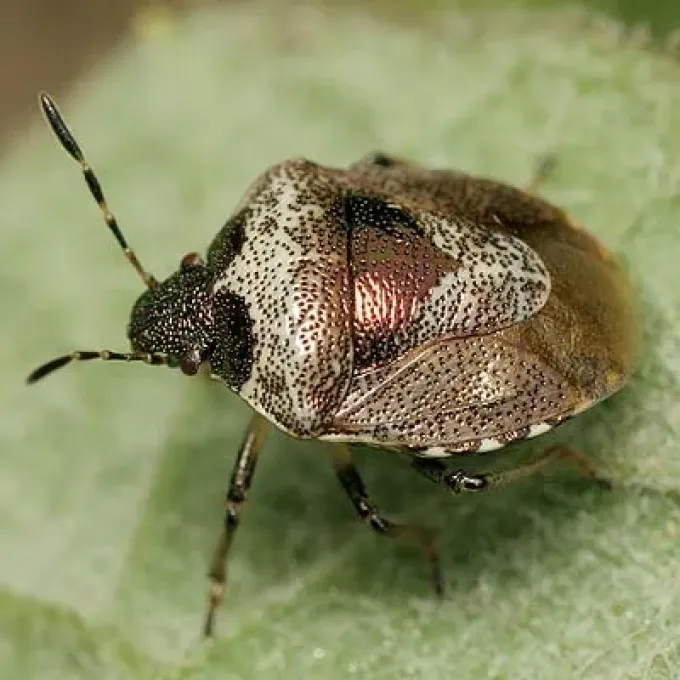
The small shield bug (Eysarcoris parvus) is a member of the Hemiptera order and the Pentatomidae family. Adult specimens typically measure 5–7 mm in length and possess an oval-shaped body with a brownish or reddish-gray coloration characterized by fine punctures.
Identification can be confirmed by the rounded projections of the head and the specific structure of the pronotum. The scutellum, which extends to the middle of the abdomen, covers most of the wings, serving as a primary taxonomic feature for this species within the shield bug family.
What it damages
This pest is known to cause significant agricultural damage across a variety of cereal crops, including wheat, barley, and rice. The bugs feed by piercing the plant tissue and extracting nutrients from developing grains and vegetative parts.
In addition to cereals, Eysarcoris parvus frequently affects legumes, such as soybeans. Feeding by this insect often results in reduced plant vigor and lower grain quality, significantly impacting the overall yield potential of infested fields.
When it appears
The development of the small shield bug is highly dependent on environmental temperature and host plant availability. Hibernation typically occurs in leaf litter or crop residues, with adults emerging in the spring as temperatures begin to rise consistently.
- Overwintering survival depends on climate conditions.
- Spring emergence coincides with initial crop growth.
- Summer peak corresponds with the grain-filling stage of cereals.
- Multiple generations can occur in warmer regions.
- Adults seek shelter as autumn temperatures drop.
Signs of infestation
The most reliable sign of an infestation is the presence of shriveled or underdeveloped grains, commonly referred to as "empty" kernels. These result from the bug's enzymatic saliva injected into the plant during the feeding process, causing localized tissue damage.
Heavy infestations are indicated by the visible presence of adults and nymphs on stems, leaves, and panicles. If left unchecked, the damage manifests as yellowing, tip necrosis, and stunted growth of the plant's reproductive structures, which are easily visible upon close inspection.
Control measures
Effective management requires an integrated approach starting with proper field sanitation. Deep autumn plowing is highly recommended to disrupt overwintering sites, while controlling weeds in and around the fields reduces alternative food sources for the bugs.
When pest populations exceed economic thresholds, the use of chemical insecticides, such as pyrethroids, becomes necessary. It is essential to apply these treatments during the most susceptible growth stages, specifically the flowering and milk-ripening phases of the crops, to ensure optimal protection.
Taxonomy
- Latin name
- Eysarcoris parvus
- Order
- Hemiptera (bugs, aphids, leafhoppers)
- Family
- Pentatomidae
- EPPO code
- EUSAPA
Discussion
No discussions yet — be the first.