
Pointed shield bug
Eysarcoris guttiger
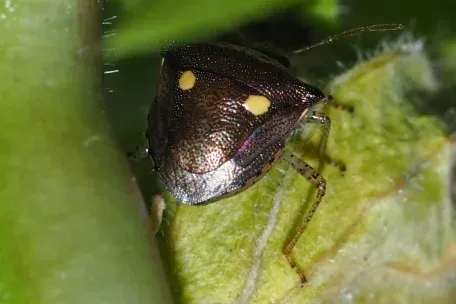
Description
How to identify
The pointed shield bug (Eysarcoris guttiger) is a member of the Pentatomidae family within the order Hemiptera. These insects are characterized by their distinctively shaped body, usually ranging between 5 to 7 mm in length.
The body is relatively flat and oval-shaped, displaying a brownish or yellowish-gray coloration with dense, small dark punctures scattered across the dorsal surface, providing a cryptic appearance.
The head is broad with well-developed antennae. Like other members of its family, it possesses a rostrum (a beak-like mouthpart) adapted for piercing and sucking plant fluids, which is folded under the body when not in use.
The life cycle involves incomplete metamorphosis, moving through five nymphal stages before reaching adulthood. Nymphs resemble miniature adults but lack fully developed wings and reproductive organs.
Adults overwinter in protected areas such as leaf litter, bark crevices, or soil debris. As temperatures rise in spring, they emerge to feed on wild hosts before migrating to cultivated crops.
What it damages
This bug is considered a polyphagous pest, meaning it attacks various crops, including cereals like rice, wheat, and barley, as well as various legumes and vegetable species.
The primary damage occurs when both nymphs and adults feed on the plant sap. They specifically target reproductive parts such as flowers, developing pods, and maturing grain heads.
Feeding on seeds at the developmental stage often results in shriveled, malformed, or underdeveloped grain. This drastically lowers both the yield quantity and the overall quality of the harvested produce.
Vegetable crops can suffer from surface lesions and deformation of fruits, which significantly reduces the market value and cosmetic appeal of the agricultural output.
The feeding process also introduces plant pathogens through the bug's saliva, which can trigger secondary infections, leading to rot or necrotic tissue development around the puncture sites.
Signs of infestation
One of the earliest indicators of an infestation is the presence of adults on the plants, particularly on the underside of leaves or within the canopy during the cooler parts of the day.
Visual symptoms on leaves include small chlorotic (yellowish) spots where the insect has inserted its rostrum. Over time, these spots can enlarge and result in the browning of leaf tissues.
Egg masses, typically laid in clusters on the undersides of leaves, are a clear sign that a local population is established and actively reproducing in the field.
Damaged grain heads often display a characteristic "whitehead" appearance or show uneven grain development, where specific sections of the spike fail to fill properly.
The presence of dark excrement droplets on stems or leaves, along with visible adult insects, provides strong evidence of significant bug activity within the crop area.
Control measures
Effective management begins with cultural practices, such as deep plowing in autumn, which destroys the overwintering sites for adults and reduces the initial pest population in the field.
Sanitation is crucial; removing weeds around the field margins, particularly grasses and legumes, helps eliminate alternative host plants and reduces the migration of bugs into the crop.
In cases of high infestation, chemical control using systemic or contact insecticides may be necessary. Applications should be timed carefully to match the susceptible stages of the pest.
Biological control, including the encouragement of natural predators and parasitoids such as egg-parasitizing wasps, can play a significant role in keeping populations below economic injury levels.
- Monitor fields during early flowering stages for bug presence.
- Rotate crops to disrupt the pest's life cycle.
- Use pheromone-based monitoring to track population density.
Taxonomy
- Latin name
- Eysarcoris guttiger
- Order
- Hemiptera (bugs, aphids, leafhoppers)
- Family
- Pentatomidae
- EPPO code
- EUSAGU
Discussion
No discussions yet — be the first.