
Eysarcoris fabricii
Eysarcoris fabricii
Description
How to identify
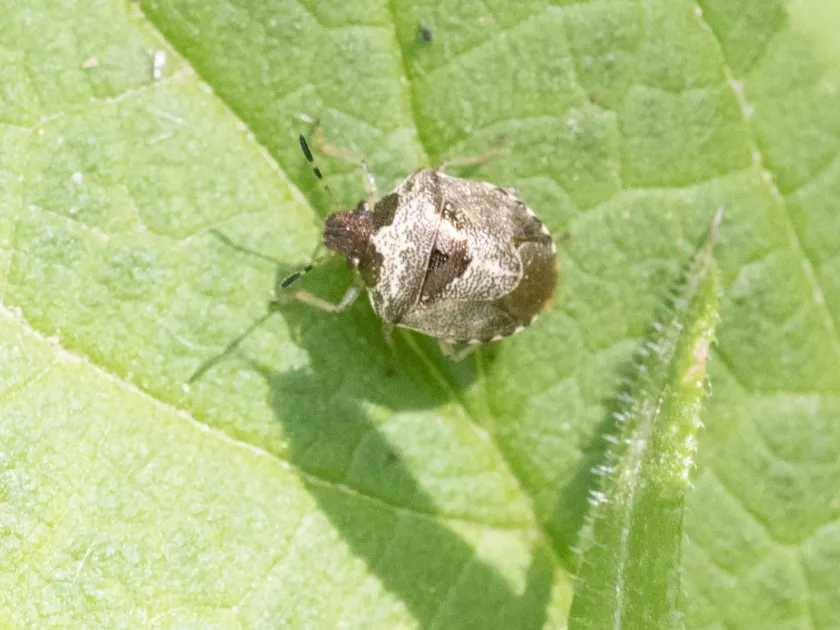
Eysarcoris fabricii is a member of the Pentatomidae family, belonging to the order Hemiptera. The adult insect features a characteristic shield-shaped body, typically measuring between 6 and 8 mm in length, with a coloration ranging from grayish-brown to yellowish-brown, covered in numerous dark dots.
The head and pronotum of this bug exhibit distinct light spots, while the scutellum is broadened, covering a large portion of the abdomen. Unlike many other shield bugs, this species has a unique camouflage that allows it to blend effectively into crop residues and stem bases.
The larvae go through five developmental instars, gradually acquiring the features of the adults. Early stages are more rounded and lighter in color, darkening as they mature, which makes early detection during field scouting a significant challenge.
Adult bugs overwinter in diapause, hiding beneath plant debris, fallen leaves, or within the topsoil layer in fields and forest margins. Once stable warm weather arrives, the insects emerge to begin feeding and subsequent reproduction cycles.
The life cycle typically includes one or two generations per year depending on regional climatic conditions. Females generally lay eggs in clusters on the underside of host plant leaves, providing the offspring with primary protection against direct sunlight and predators.
What it damages
Eysarcoris fabricii is a polyphagous pest that damages a wide range of crops. The primary damage is inflicted on cereal grains, including wheat and barley, as well as certain legumes and essential oil crops.
Beyond agricultural crops, the pest is frequently found on weeds, particularly those from the Lamiaceae family, which act as permanent reservoirs near agroecosystems. During periods of population outbreaks, the bugs migrate onto cereal fields.
Feeding occurs by piercing the plant tissue with a proboscis and injecting salivary secretions containing enzymes that liquefy the plant cells. This disrupts physiological processes and severely degrades the quality of the harvest.
Damage to generative organs in the early stages of development can lead to complete plant failure or stunted growth. Late-stage infestation causes significant grain weight loss, reducing both commercial and seed quality, as well as the baking properties of the grain.
Furthermore, the pest serves as a vector for phytopathogens, which enter plant tissues through proboscis punctures. This triggers secondary fungal and bacterial infections that accelerate the necrosis of the affected stems or ears.
When it appears
The activity of the bug begins in spring when average daily temperatures exceed 10–12 degrees Celsius. During this time, the insects migrate from their overwintering sites to young crops to feed intensively before egg-laying.
Population peaks typically occur during the summer months, coinciding with larval development and the emergence of the new generation. Regular crop monitoring is essential during this period, as the insects are at their most active and destructive.
Cereal crops are most vulnerable during the grain filling stage, when the bugs feed on the sap of immature grains. Infestation during this window can lead to a rapid increase in damaged kernels, necessitating immediate action.
Towards the end of summer, as temperatures drop, the adults enter diapause. They begin searching for hibernation sites, making autumn weed control and post-harvest field maintenance effective strategies for reducing the following year's population.
Consequently, the primary control window spans from the spring emergence through the milky-wax ripeness stage of the grain, when the crop is most attractive to the bugs.
Signs of infestation
Initial signs of infestation include the appearance of chlorotic spots on leaves and stems, which gradually turn yellow and die at the puncture sites. Field inspections should be conducted in the morning when the insects are most active.
The presence of excrement on leaves and shriveled or empty grains in the ear indicates an infestation. When an affected grain is broken open, dark spots caused by toxic salivary enzymes can be clearly seen inside.
In cases of early-stage damage to the stem or ear base, characteristic twisting or premature drying of the head occurs. This phenomenon, often called white-ear, happens because the upper part of the plant loses its nutrient supply and dehydrates rapidly.
Visual population monitoring is performed using an entomological net: sweeping 10–20 times over the crops allows for an estimate of pest density per square meter, helping to determine the necessity of insecticide application.
The presence of egg clusters on the underside of leaves is a clear signal to prepare protective measures. It is important to pay close attention to field edges, as pest migration often starts from weedy margins and boundaries.
Control measures
Agronomic control includes deep autumn plowing, which destroys overwintering sites and contributes to the mortality of a significant portion of the population. Timely weed control in fields and along boundaries is also critical.
Implementing crop rotation and maintaining spatial isolation from pest reservoirs (such as forest belts or abandoned land) helps reduce the migration pressure of the shield bug. Using resistant varieties can also mitigate the risk of mass infestation.
Chemical control involves the application of systemic or contact-stomach insecticides during periods of mass infestation. The economic threshold for action is typically 2–5 adults per square meter during the grain-filling stage.
Biological control methods emphasize preserving natural enemy populations, such as Telenomus egg parasitoids, which parasitize shield bug eggs. Limiting the use of broad-spectrum pesticides during periods of natural enemy activity is an essential part of an integrated pest management strategy.
In cases of high pest density, border spraying with insecticides is recommended to contain the spread of the bugs into the main crop area while minimizing the overall environmental impact on the agroecosystem.
Taxonomy
- Latin name
- Eysarcoris fabricii
- Order
- Hemiptera (bugs, aphids, leafhoppers)
- Family
- Pentatomidae
- EPPO code
- EUSAFA
Discussion
No discussions yet — be the first.