
Eysarcoris bug
Eysarcoris
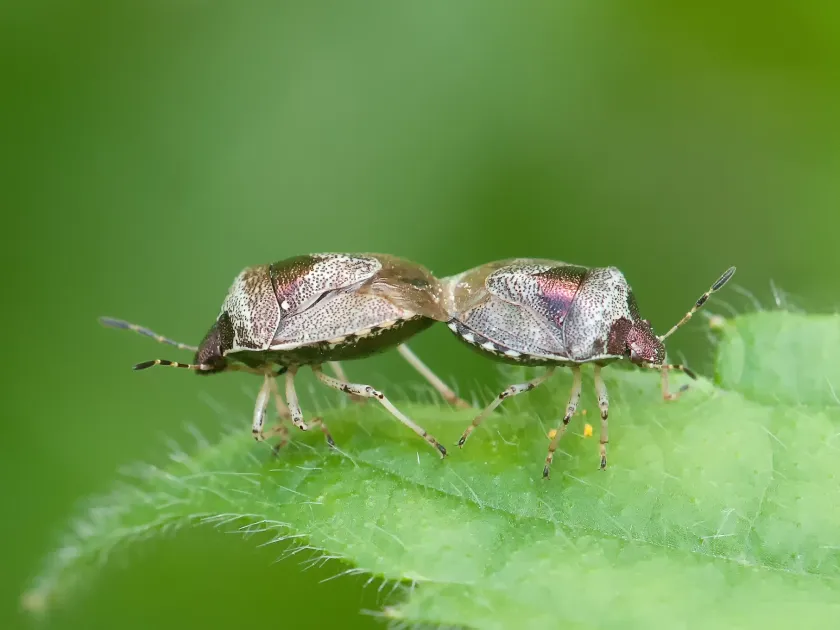
Description
How to identify
The Eysarcoris bug belongs to the Pentatomidae family, commonly known as shield bugs. These insects are characterized by a distinct shield-like body shape, typically measuring between 5 to 7 millimeters in length, making them relatively small among their relatives.
Adult bugs usually exhibit a color pattern ranging from gray-brown to yellowish-brown, often covered with fine punctate markings. Their head is typically somewhat blunt, and the pronotum often features lateral projections that are essential for accurate identification in the field.
Nymphs, or immature stages, go through several molts. They closely resemble adults but lack functional wings and possess less rigid cuticles. Their coloration can be quite variable, often appearing brighter than the adult stage to provide camouflage in the foliage.
Identification often requires close inspection of the scutellum (the triangular plate on the back). In the genus Eysarcoris, the scutellum is almost always longer than it is wide at its base, which is a reliable diagnostic feature for agronomists.
These bugs overwinter as adults in protected environments such as leaf litter, crop debris, or the top layer of soil. As temperatures rise in the spring, they emerge and begin searching for host plants to initiate their life cycle.
What it damages
Eysarcoris bugs are polyphagous, but they are most notorious for causing damage to cereal crops such as wheat, barley, and oats. They utilize their piercing-sucking mouthparts to feed on developing plant tissues, especially grain kernels.
During feeding, the insect injects saliva containing enzymes into the plant. These enzymes break down the structural proteins and carbohydrates, which can severely diminish the baking quality of wheat by degrading gluten structures.
The damage to cereal grains often results in shriveled, deformed kernels with distinct dark spots at the point of puncture. In severe cases, the grains may become entirely hollow, significantly reducing both the yield and the economic value of the harvest.
In addition to cereals, these bugs may attack vegetables and legumes. On these crops, the damage can lead to fruit deformation, stunted growth, and premature fruit drop, which is particularly detrimental for commercial produce quality.
The overall impact of an Eysarcoris infestation is directly proportional to the population density and the timing of the attack. Infestations occurring during the grain-filling stage are the most critical and can lead to substantial crop losses.
When it appears
The life cycle of the Eysarcoris bug is synchronized with the phenology of the host crops. After emerging from hibernation, they move to fields and start feeding on young plants as they reach the tillering and jointing stages.
Mating and egg-laying typically occur during the warmer months, often peaking during the heading and flowering stages of cereals. This timing ensures that the emerging nymphs have an abundant supply of nutrients from the developing grain.
Depending on the climatic zone, the species can produce one or two generations per year. Warmer summers accelerate the development of the second generation, which often poses a greater threat to late-season crops or neighboring vegetable plots.
Throughout the growing season, adults remain quite active and mobile, often migrating between fields or from weeds to crops. They are particularly active during sunny weather and tend to aggregate in areas with higher plant density.
As autumn approaches and temperatures begin to drop, the adults start looking for suitable locations for diapause. They leave the drying cereal fields and settle into field margins, hedgerows, or overgrown areas to survive the winter months.
Signs of infestation
Signs of infestation include the presence of discolored or shriveled grains with small necrotic spots. In severe cases, affected heads of wheat or barley may appear prematurely white, indicating that the vascular transport has been compromised.
On vegetable crops, visible signs include chlorotic spots on foliage and twisted or deformed fruit. If you look closely at the underside of leaves or within floral clusters, you may find the barrel-shaped eggs deposited by the female.
The presence of the bugs themselves is a major sign. They are often found on the stems and near the grain heads during early morning or late afternoon when they are most active. They typically drop to the ground when disturbed.
Dark fecal spots on the leaves or stems are another indication of a prolonged presence of the pests. These small specks are often overlooked but can serve as a warning sign during scouting missions for integrated pest management.
Patches of stunted or visually weaker plants within a field can suggest a concentrated infestation. These "hotspots" often form near the edges of fields adjacent to non-crop habitats where the population initially established itself.
Control measures
Cultural control is the first line of defense against Eysarcoris bugs. This includes diligent weed management in fields and along boundaries to remove alternative hosts, as well as proper crop rotation to disrupt the pest's reproductive cycle.
Maintaining spatial isolation between cereal fields and permanent grasslands can significantly reduce the pressure from migrating bugs. Proper tillage techniques can also help destroy overwintering sites, reducing the number of adults that emerge in the spring.
Chemical control should be employed based on economic thresholds determined by field scouting. Systemic or contact insecticides are effective, but they must be applied according to the specific labels and within the correct developmental stages of the insect.
Biological control methods, such as the release of egg parasitoids (e.g., Trichogramma species), can be effective in lowering the population size. These beneficial insects target the eggs of the shield bug, reducing the need for chemical intervention.
Regular monitoring using sweep nets is essential for making informed decisions regarding pesticide applications. By timing the interventions correctly, farmers can effectively protect their crops while minimizing the impact on non-target beneficial species.
Taxonomy
- Latin name
- Eysarcoris
- Order
- Hemiptera (bugs, aphids, leafhoppers)
- Family
- Pentatomidae
- EPPO code
- EUSASP
Discussion
No discussions yet — be the first.