
Eyprepocnemis plorans
Eyprepocnemis plorans
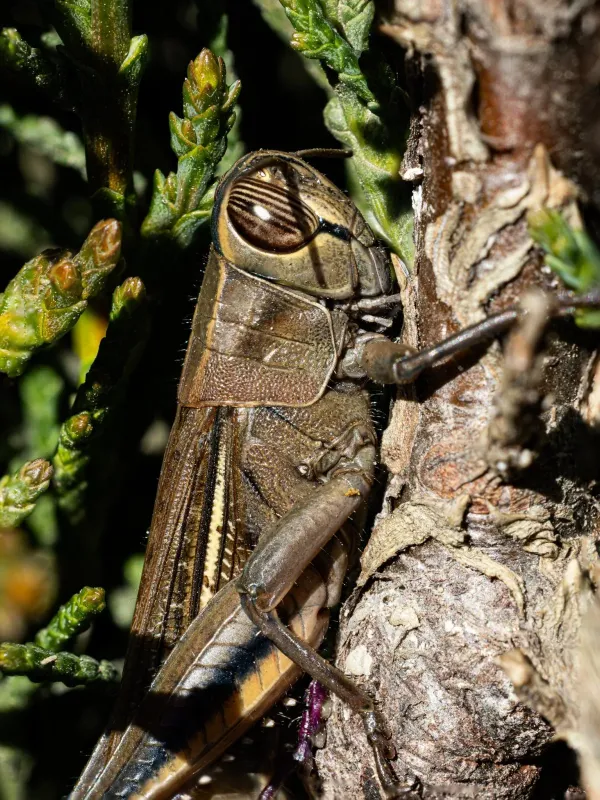
Description
How to identify
Eyprepocnemis plorans, commonly known as the sorrel grasshopper or simply by its scientific name, belongs to the family Acrididae within the order Orthoptera. It is a medium-sized grasshopper with a distinctive appearance.
The adults are characterized by a robust body and powerful hind legs, which enable them to jump significant distances. Their coloration often includes dark markings on the femurs, which helps them blend into their natural environment.
Nymphs, the immature stage of the insect, closely resemble adults but lack functional wings. Throughout their development, they undergo several molts, progressively increasing in size and developing wing pads.
This species is widely distributed in Mediterranean regions, Africa, and parts of Southern Europe. It thrives in humid habitats, such as wetlands, irrigation channels, and cultivated fields with dense vegetation.
The species is known for its acoustic signaling behavior. Although it is a classical grasshopper, its potential for population explosions makes it a significant concern for local agricultural systems.
What it damages
Eyprepocnemis plorans is a generalist herbivore, meaning it consumes a wide variety of plant species. This polyphagous behavior makes it a versatile and dangerous pest for many farming operations.
Cereal crops, including wheat, maize, and millet, are among its primary targets. In cases of high infestation, these insects can devour entire fields, leading to total crop failure.
Beyond cereal crops, this grasshopper poses a threat to legumes, vegetables, and various types of pasture grasses. During dry seasons, they often migrate from wild habitats to irrigated croplands in search of fresh food.
Young seedlings are particularly susceptible, as the grasshoppers can consume the foliage down to the base, effectively killing the plant before it has a chance to mature.
Furthermore, feeding damage to the plant's leaves and stems makes the crops more vulnerable to secondary infections, such as bacterial or fungal diseases, significantly reducing the final yield quality.
When it appears
The life cycle of this pest is strictly tied to temperature and environmental conditions. The insect overwinters in the egg stage, with the eggs buried in the soil to protect them from winter frost.
As soil temperatures rise in the spring, the eggs hatch, and the nymphs begin to feed immediately on available vegetation. This timing often overlaps with the germination of important spring crops.
Development from nymph to adult occurs over several months. During this time, they grow rapidly and become more mobile, especially as they reach the final adult stage and gain full flight capability.
In warmer climates, Eyprepocnemis plorans can complete multiple generations within a single season, significantly increasing the pressure on agricultural producers throughout the year.
The peak of adult activity is usually observed in mid-to-late summer, which is when the most severe damage to crop foliage typically occurs in infested areas.
Signs of infestation
One of the primary indicators of an infestation is the presence of irregular holes in leaf margins. As the population density increases, these small holes merge, leading to extensive tissue loss.
Observing the field in the early morning is the most effective way to identify the presence of these grasshoppers. They are less active in cooler morning temperatures and can be easily spotted among the stalks.
Accumulation of fecal pellets on the leaves and at the base of the plants is a clear sign that a colony has been established and is actively feeding on the crop canopy.
Visible damage to stems and the destruction of growing points in grain crops are signs of severe infestation that necessitate immediate management action to save the remaining harvest.
If you see rapid thinning of foliage in localized patches of the field, it is highly likely that a localized swarm of Eyprepocnemis plorans is active in that area.
Control measures
Successful management of this pest requires an integrated approach that focuses on prevention and timely intervention when thresholds are exceeded.
Deep plowing during the fall is highly effective, as it exposes the egg pods buried in the soil to environmental extremes, such as frost and dehydration, preventing hatching in the spring.
Maintaining clean borders by mowing weeds along roadsides and irrigation ditches is crucial. This limits the habitat availability for the grasshoppers and prevents them from moving into crop fields.
When population levels warrant chemical intervention, targeted application of approved insecticides should be used. Using systemic or contact-based products can provide rapid results.
- Monitoring fields regularly during the early growing season.
- Applying insecticides during the peak of nymphal activity.
- Rotating chemical classes to prevent the development of pesticide resistance.
Taxonomy
- Latin name
- Eyprepocnemis plorans
- Order
- Orthoptera (locusts)
- Family
- Acrididae
- EPPO code
- EYPCPO
Discussion
No discussions yet — be the first.