
Florida predatory stink bug
Euthyrhynchus floridanus
Description
How to identify
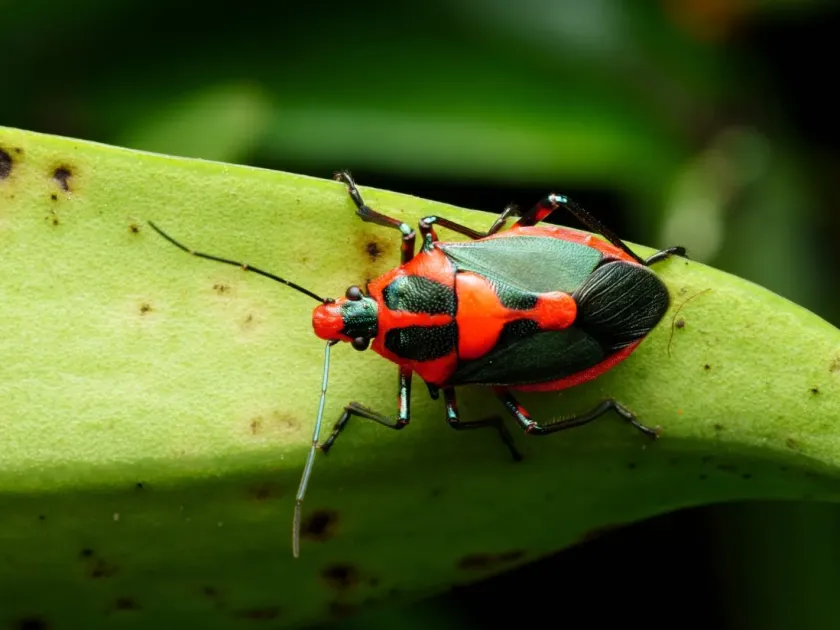
The Florida predatory stink bug (Euthyrhynchus floridanus) is a member of the Pentatomidae family. Adults typically measure 12–17 mm and exhibit a dark, metallic coloration with striking red or yellowish spots on the pronotum and scutellum.
Nymphs undergo several developmental stages, changing color as they grow. Early-stage nymphs are gregarious and often congregate on the undersides of leaves, which makes them easier to identify during inspections.
Their mouthparts are designed for piercing and sucking; although they are primarily predators, they possess the structural capacity to pierce plant tissues when searching for moisture or nutrients during resource scarcity.
Eggs are laid in neat, barrel-shaped clusters, usually creamy or white, which are often found on stems or leaf surfaces. Monitoring these clusters is vital for predicting outbreaks.
The species is highly adaptive, showing a preference for warm climates where it can sustain multiple generations throughout the year, especially in well-irrigated agricultural environments.
What it damages
Damage occurs when the bug uses its rostrum to pierce plant tissues. By injecting salivary enzymes into the plant, it breaks down cells, leading to necrotic spots and yellowing of the foliage.
Affected plant parts may show signs of wilting, premature drop, or physical deformation. In fruit-bearing crops, the damage manifests as indentations and localized tissue death, reducing shelf life.
Young seedlings are particularly vulnerable to the feeding activity of these bugs. Piercing the terminal bud can stunt growth or lead to the death of the entire plant if the infestation is severe.
Feeding sites frequently become entry points for secondary pathogens, such as fungi or bacteria, which can cause rotting of fruit and tissue necrosis across the plant.
Agricultural losses are most significant when populations reach high densities, as the cumulative impact of thousands of feeding punctures severely weakens the plant's metabolic capacity.
When it appears
The Florida predatory stink bug is most active during the warmer months. Temperature acts as the primary driver for its life cycle, with optimal development occurring between 20°C and 30°C.
In temperate zones, they begin to emerge from hibernation sites in early spring, seeking out fresh plant growth or prey. Activity usually peaks mid-summer when temperatures are consistent.
As autumn approaches and temperatures drop, adults seek overwintering sites, such as bark crevices, leaf litter, or debris, where they enter a state of reduced metabolic activity.
In greenhouses and indoor cultivation systems, the life cycle is not governed by seasonal changes. They can remain active and reproductive year-round, provided that food and moisture are available.
Understanding the seasonal progression is crucial for timing control measures. Proactive monitoring in early spring can help suppress populations before they hit their peak reproductive cycle.
Signs of infestation
The most visible signs of infestation are the necrotic spots or "stings" on leaves. These are often surrounded by a chlorotic halo, indicating the enzymatic reaction of the plant to the bug's saliva.
Clumps of barrel-shaped eggs on the leaves are a primary diagnostic sign. Finding these clusters requires careful inspection, particularly in the lower canopy of the plants.
Small, dark fecal spots on the stems and leaves serve as clear indicators of an active colony. These spots often cluster near where the bugs are feeding.
Visible nymphal clusters are a definitive sign of an established infestation. If found in groups, it suggests a local breeding population that needs immediate management.
Stunted growth or abnormal curvature of stems, often accompanied by the presence of adults on the plant, confirms that the stink bug is actively impacting plant health.
Control measures
Effective management begins with sanitation. Clearing weeds, debris, and fallen leaves removes the primary overwintering and sheltering sites for the stink bugs.
Mechanical control, such as manual collection of egg masses and adults, is highly effective for smaller plots or home gardens where chemical use is discouraged.
Biocontrol agents, including specific entomopathogenic fungi, can be deployed to reduce populations naturally. Maintaining a diverse ecosystem also encourages native predators to feed on the bugs.
For severe infestations, spot-treatment with registered insecticides may be necessary. It is essential to apply these during the early stages of infestation to achieve maximum efficacy.
- Use yellow sticky traps for monitoring populations.
- Implement physical barriers like protective nets for young crops.
- Practice crop rotation to disrupt the life cycle in open fields.
Taxonomy
- Latin name
- Euthyrhynchus floridanus
- Order
- Hemiptera (bugs, aphids, leafhoppers)
- Family
- Pentatomidae
- EPPO code
- EUTHFL
Discussion
No discussions yet — be the first.