
Euseius tularensis
Euseius tularensis
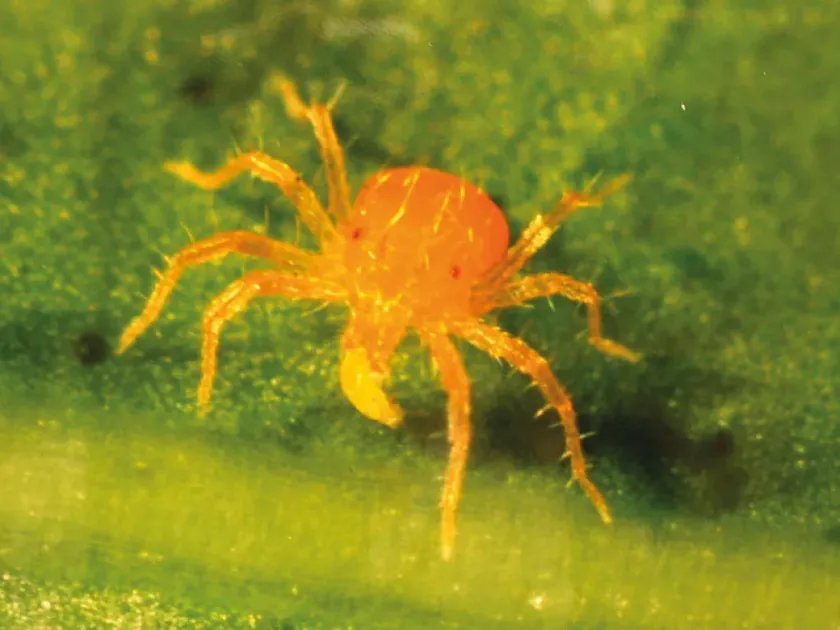
Description
How to identify
Euseius tularensis is a small mite belonging to the Phytoseiidae family. These mites are typically teardrop-shaped and range in color from pale white to yellowish-tan depending on their recent feeding.
They are characterized by high mobility. Unlike typical spider mites, they move actively across leaf surfaces, often making them difficult to capture or identify without laboratory magnification.
Taxonomically, they are classified under the order Mesostigmata. They possess specialized mouthparts that allow them to function as both predators and generalist feeders on plant materials like pollen.
Identifying the species accurately in the field is challenging for non-experts, as they share morphological traits with several other beneficial phytoseiid mites common in orchards.
Microscopic examination of the dorsal plates and specific seta patterns is essential for distinguishing E. tularensis from other related species in agricultural environments.
What it damages
The primary hosts for Euseius tularensis include various citrus species such as lemons, oranges, and grapefruits. They are usually found inhabiting the underside of foliage.
While often considered beneficial due to their predatory behavior against other mites, they can cause damage when their primary prey is scarce by feeding on plant cell contents.
Feeding is performed by piercing the plant epidermis and consuming the fluids within, which can lead to metabolic stress in the affected leaves and buds.
Heavy infestations can result in stunted growth of new shoots and, in severe cases, the premature drop of young fruit set, impacting overall crop yield.
The damage often manifests as minor chlorosis or pitting on the leaves, which can reduce the photosynthetic capacity of the canopy if the mite population density is high.
When it appears
The activity of these mites is heavily dependent on ambient temperature and humidity levels. Populations typically increase as spring temperatures become moderate to warm.
Optimal development occurs in the range of 20 to 28 degrees Celsius, where the life cycle can be completed relatively quickly, leading to multiple generations per season.
During peak summer months, when pollen is abundant, the mite population can expand rapidly. Humidity levels play a significant role in their survival and reproductive rate.
As temperatures decline in the autumn, the mites begin to seek shelter in crevices of the tree bark or within protected plant parts to endure colder conditions.
Overwintering occurs primarily at the adult stage, with these mites remaining in a state of reduced activity until favorable spring conditions return to the orchard.
Signs of infestation
Early signs of infestation include tiny, light-colored spots on the leaves where the mites have fed, which may eventually coalesce into larger chlorotic areas.
The presence of rapidly moving mites on the underside of leaves during inspection is a key indicator, especially when compared to the stationary nature of most herbivorous pests.
Exuviae (shed skins) and mite frass might be visible under high magnification, often contributing to a dirty appearance on the lower surface of the leaf.
Flower bud drop or curling of young, tender leaves can indicate localized high-density mite feeding, often confused with nutrient deficiencies by inexperienced growers.
Sooty mold growth may appear on the foliage as an indirect consequence, as the mites' secretions or the weakened state of the plant can facilitate fungal colonization.
Control measures
Effective management focuses on Integrated Pest Management (IPM) practices to maintain a balance that limits potential damage to citrus trees.
- Implement regular field scouting to monitor population trends.
- Maintain orchard sanitation by removing weeds that serve as alternate hosts.
- Use selective acaricides only when economic injury thresholds are exceeded.
- Encourage natural biological control by protecting indigenous predator populations.
- Ensure adequate tree hydration to improve plant resilience against mite feeding.
Taxonomy
- Latin name
- Euseius tularensis
- Order
- Mites
- Family
- Phytoseiidae
- EPPO code
- EUSITU
Discussion
No discussions yet — be the first.