
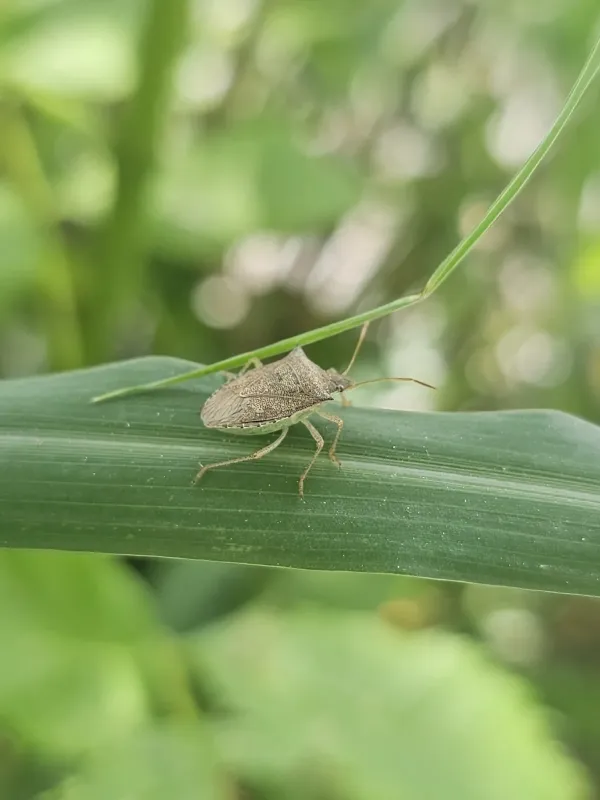
Brown stink bug Euschistus quadrator
Euschistus quadrator
Description
How to identify
The stink bug Euschistus quadrator belongs to the family Pentatomidae, order Hemiptera. These insects possess a characteristic shield-shaped body, which is typical for the family, with well-defined humeral angles on the pronotum.
The coloration of the adults generally ranges from grayish-brown to yellowish-brown, which provides excellent camouflage against vegetation and crop residues. The average body length of an adult is about 10–12 mm.
The head is of a typical shape, equipped with piercing-sucking mouthparts adapted for puncturing plant tissues and extracting cell sap. A specific feature of this species includes the shape of the pronotum and the pattern on the ventral side of the body.
Nymphs look like smaller versions of the adults but lack fully developed wings and have a more rounded body. As they go through several instars, the nymphs gradually increase in size and change their coloration patterns.
Identifying this species often requires a careful examination of morphological traits, as it visually resembles many other members of the genus Euschistus that are common in their native ranges.
What it damages
This pest is a polyphage, meaning it can feed on a wide variety of cultivated and wild plants. The primary damage is caused by sucking fluids from various parts of the plant, disrupting physiological processes.
Euschistus quadrator causes significant damage to cereal crops, legumes, and vegetable plants. The damage occurs on both vegetative parts and reproductive organs, including flowers and developing seeds or fruits.
When ears or pods are damaged, the seeds inside often become shriveled and underdeveloped, leading to substantial yield losses in both quantity and quality. The puncture sites often become entry points for secondary pathogens.
The impact is more severe during drought periods when plants are water-stressed and the bugs actively seek nutrient-rich fluids. Massive outbreaks of this pest can lead to the destruction of a significant portion of the harvest.
Damaged plant tissues often become deformed, and plant growth is stunted, making the crop more susceptible to secondary infections or fungal diseases introduced by the insects during feeding.
When it appears
The life cycle of Euschistus quadrator is closely tied to the climatic conditions of the region. Generally, adults overwinter in diapause in sheltered areas to survive cold periods.
In spring, as temperatures rise, the overwintered adults emerge from their hibernation sites and begin searching for host plants. Initially, they are often found on weeds and wild grasses.
As agricultural crops grow, the bugs migrate to these fields. The population peak often coincides with the flowering and fruit-setting stages of the most common agricultural crops.
The development of one generation takes a specific amount of time, depending on the cumulative degree-days. Under favorable conditions, several generations may occur within a single growing season.
In autumn, as temperatures drop and day length shortens, the bugs prepare for winter by moving into field borders, forest edges, or underneath plant debris and leaf litter.
Signs of infestation
The first sign of the pest's presence is observing the bugs themselves on leaves and stems, especially during the early morning or evening hours. They often sit still, mimicking the color of the foliage.
On leaves, small light-colored spots appear at the puncture sites, which may eventually turn necrotic. Leaf blades can sometimes curl or show deformities due to metabolic disturbances caused by the bugs' saliva.
When fruits or seeds are attacked, one can observe indentations, spots, and overall deformation of the produce. In cereals, empty husks or whiteheads may indicate the presence of infestation.
A characteristic sign is the presence of fecal droplets on leaves and stems, accompanied by a specific unpleasant odor emitted by the bugs' scent glands when they are disturbed or threatened.
When inspecting fields, it is crucial to check the undersides of leaves and the leaf axils, where these insects frequently seek refuge from direct sunlight during the hottest parts of the day.
Control measures
Cultural control methods include weed management, as weeds serve as primary breeding grounds before the bugs move to crops. Deep autumn plowing is effective for destroying overwintering sites.
Crop rotation and maintaining spatial isolation between susceptible crops and fields with high bug populations can significantly reduce the risk of massive infestations.
Biological control involves the preservation and augmentation of natural enemies, particularly parasitic wasps that prey on the bug's egg masses, keeping populations in check.
Chemical control is implemented when thresholds of economic damage are exceeded. Systemic and contact insecticides from the pyrethroid, organophosphate, or neonicotinoid groups are commonly used.
- Monitoring population density using yellow sticky traps
- Timely application of insecticides during critical crop development stages
- Harvesting crops promptly to reduce damage to grain seeds
- Using entomopathogenic fungi as part of integrated management programs
Taxonomy
- Latin name
- Euschistus quadrator
- Order
- Hemiptera (bugs, aphids, leafhoppers)
- Family
- Pentatomidae
- EPPO code
- EUSCQU
Discussion
No discussions yet — be the first.