
Brown stink bug
Euschistus picticornis
Description
How to identify
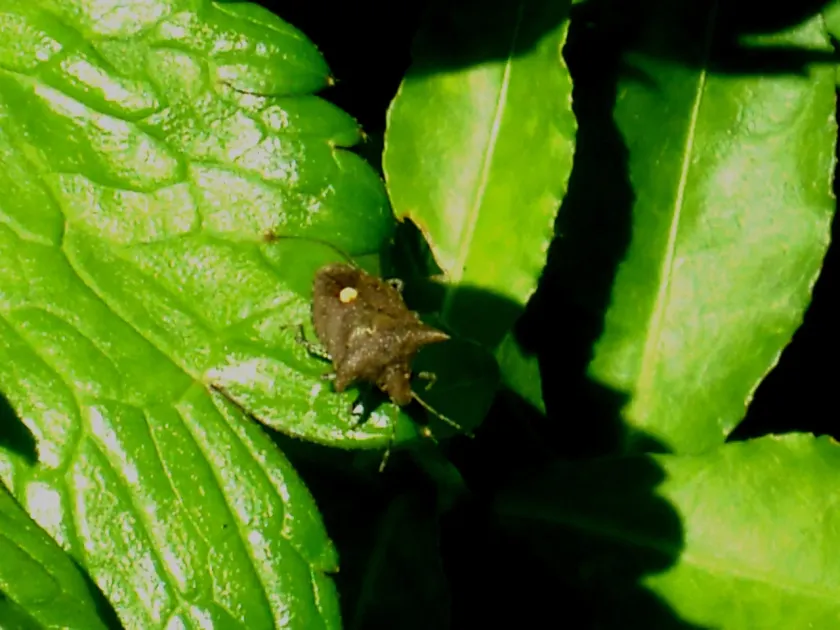
The brown stink bug (Euschistus picticornis) is a member of the order Hemiptera and the family Pentatomidae. These insects are easily recognized by their shield-shaped bodies and the prominent spines on their shoulders.
Their color ranges from light yellowish-brown to dark brown, providing excellent camouflage against soil and dry plant debris. The surface of their wings is typically covered in small, dense punctures that give them a textured appearance.
Nymphs resemble smaller, wingless versions of the adults. Throughout their development, they go through five instar stages, during which their size increases significantly until they reach maturity.
Like other pentatomids, they possess a piercing-sucking mouthpart called a rostrum. This organ is folded under the body when not in use and is extended to pierce plant tissues for feeding.
The species prefers warm climates, which dictates its distribution and seasonal activity. Females lay their eggs in clusters, typically on the underside of leaves, ensuring the safety of the next generation.
What it damages
This species is a known polyphagous pest, meaning it attacks a wide variety of economically important crops. Common hosts include soybeans, beans, corn, tomatoes, cotton, and various other vegetable crops.
The damage is primarily caused by both nymphs and adults feeding on developing fruits, seeds, and pods. They inject saliva containing enzymes into the plant tissue, which breaks down cells and facilitates the extraction of nutrients.
Feeding on young fruits often leads to severe deformation, tissue necrosis, and reduced market quality. In crops like beans, it results in shriveled seeds and pod abortion, significantly lowering the overall yield.
Secondary infections are a major concern, as the feeding punctures serve as entry points for various bacterial and fungal pathogens. This can lead to rot and further degradation of the harvested produce.
High population densities can lead to significant economic losses if not managed properly. The pest is especially problematic because it is highly mobile and can easily move between different host plants during the season.
When it appears
The life cycle and activity of Euschistus picticornis are highly dependent on seasonal temperature fluctuations. Adults typically enter a state of diapause to survive the winter months in protected sites.
Spring marks the end of dormancy, as adults emerge to feed on wild hosts and weeds. As temperatures rise, they shift their attention to emerging agricultural crops, starting the process of infestation.
The peak activity and reproductive phase occur during the summer months when food resources are most abundant. Multiple generations can be produced in a single growing season under favorable conditions.
As autumn approaches and temperatures begin to drop, the bugs prepare for hibernation. They seek out sheltered areas, such as leaf litter or crevices in bark, to wait out the cold weather until the next spring.
Monitoring the seasonal emergence is crucial for effective pest management. By timing interventions correctly, farmers can significantly reduce the potential impact on their crop production.
Signs of infestation
The most evident signs of infestation are the physical defects on the crops. Fruits often exhibit small, discolored depressions where the bugs have pierced the skin and sucked the sap.
Inside pods, seeds may appear underdeveloped, pitted, or darkened. Such damage is frequently hidden from exterior inspection, requiring researchers to open the pods to assess the level of infestation.
Chlorotic spots on leaves and stems are another common indicator. These spots can eventually merge, leading to tissue death and a decline in the plant's overall photosynthetic efficiency and vigor.
Observing the presence of egg masses on the lower leaf surfaces is a clear sign of an active infestation. The eggs are usually arranged in neat, tight clusters that are characteristic of this genus.
Farmers can also detect the presence of these insects by using sweep nets or pheromone traps. Seeing the bugs themselves, especially in their early nymphal stages, should be treated as a warning to take immediate action.
Control measures
An effective control program for Euschistus picticornis requires an integrated approach that minimizes reliance on single-method solutions while maximizing sustainability.
Cultural practices are the first line of defense. This includes maintaining clean field borders, eliminating host weeds, and managing crop residues to reduce the number of favorable wintering sites.
Chemical control is utilized when population levels exceed the economic threshold. Applying insecticides should be done carefully to avoid killing beneficial predatory insects that naturally control pest populations.
Biological control remains a vital component, as several natural enemies, such as parasitic wasps, help regulate the population density of these stink bugs throughout the growing season.
- Use pheromone traps for regular monitoring of bug populations in the field.
- Practice crop rotation to disturb the pest's cycle and break reliance on specific hosts.
- Remove plant debris and weeds around field edges to limit overwintering sites.
- Apply insecticides only when necessary, using products that are selective and safe for beneficials.
Taxonomy
- Latin name
- Euschistus picticornis
- Order
- Hemiptera (bugs, aphids, leafhoppers)
- Family
- Pentatomidae
- EPPO code
- EUSCPI
Discussion
No discussions yet — be the first.