
Brown stink bug
Euschistus impictiventris
Description
How to identify
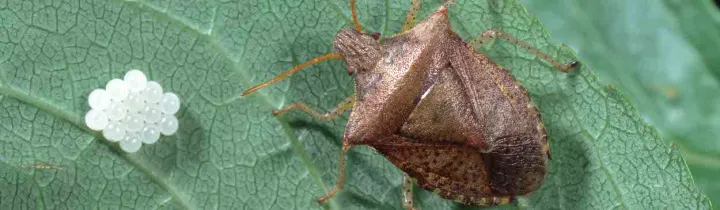
The brown stink bug, Euschistus impictiventris, belongs to the Pentatomidae family within the order Hemiptera. These insects typically have an oval, flattened body shape ranging from 10 to 12 mm in length.
The adult insect is usually brownish or tan, with a distinctive shape of the head and sharp "shoulders" or pronotal angles that help differentiate it from other species.
The underside of the abdomen is typically pale, lacking the dark spots often found in related species, which is reflected in its specific name impictiventris.
The nymphs go through five developmental stages (instars). As they grow, their color and body proportions change, but they generally retain the characteristic stink bug appearance.
Eggs are barrel-shaped and typically laid in clusters on the undersides of leaves, often showing a light color that helps them blend with the vegetation.
What it damages
Euschistus impictiventris is a well-known polyphagous pest, with a particularly high economic impact on cotton crops in agricultural regions.
Beyond cotton, the bug feeds on a variety of vegetable crops, including tomatoes, peppers, beans, and other legumes, causing structural and aesthetic damage.
Feeding occurs by piercing the plant tissue with a stylet and injecting saliva containing digestive enzymes, which breaks down the cell contents for ingestion.
Damage to cotton bolls includes internal decay, fiber staining, and boll abortion, which directly reduces both yield and quality of the fiber harvest.
In vegetables, feeding results in pitted or deformed fruit, often leading to the spread of secondary pathogens that cause the fruit to rot prematurely.
When it appears
The life cycle and activity of this bug are heavily dependent on climatic conditions, with rapid reproduction occurring during warmer summer months.
Adults overwinter in protected sites, such as leaf litter, debris, or underneath vegetation, emerging when temperatures rise in the spring.
Once active, the bugs move to available weeds or early-season hosts before migrating into primary agricultural crops to feed and reproduce.
Depending on the region, the insect may complete several generations in a single growing season, leading to peak populations in mid-to-late summer.
The most critical period for crop damage occurs during the fruit-set and maturation phases, when the insects are most active in searching for food.
Signs of infestation
The primary sign of infestation is the appearance of dark, sunken spots on the fruit, which indicate the exact location of the bug's previous feeding attempt.
Deformed or bumpy fruit, specifically in crops like tomatoes or cotton bolls, often indicates severe piercing and salivary enzyme damage.
Visual observation of the bugs, particularly on the underside of leaves or within developing flower buds, is the most accurate way to detect an active colony.
The presence of egg clusters on leaf surfaces is a clear indicator of a developing population that may soon lead to significant damage.
- Dark necrotic spots on fruit skin.
- Deformities in developing bolls or vegetables.
- Premature fruit or bud drop.
- Evidence of eggs or active adults on host plants.
Control measures
Cultural control, such as strict weed management around the perimeter of fields, is the first line of defense to reduce the initial source of bugs.
When infestation levels exceed the economic threshold, the application of effective contact-type insecticides is necessary to protect the harvest.
Ongoing field monitoring, including the use of pheromone traps or visual scouting, allows farmers to make data-driven decisions for treatment.
Biological control, including the protection of native parasitoid wasps that target stink bug eggs, can provide significant long-term population suppression.
Post-harvest field sanitation and deep plowing help destroy overwintering sites, significantly reducing the population pressure for the following season.
Taxonomy
- Latin name
- Euschistus impictiventris
- Order
- Hemiptera (bugs, aphids, leafhoppers)
- Family
- Pentatomidae
- EPPO code
- EUSCIM
Discussion
No discussions yet — be the first.