
Brown stink bug
Euschistus heros
Description
How to identify
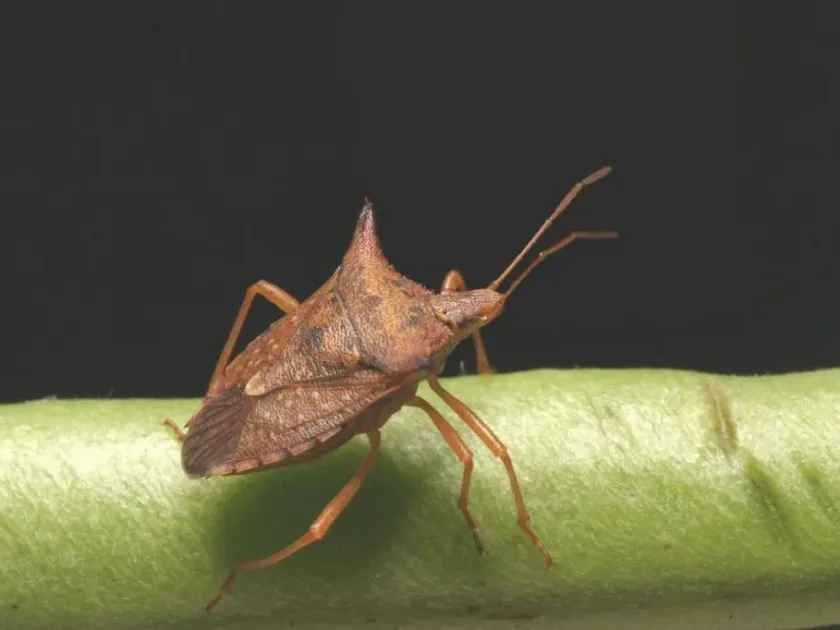
The brown stink bug belongs to the Pentatomidae family within the order Hemiptera. Adult insects are characterized by a shield-like body shape and a brownish or yellowish-brown coloration.
Adults typically measure between 10 and 12 millimeters in length. A definitive identification trait is the presence of sharp, thorn-like projections on the sides of the pronotum, which distinguishes this species from others.
The eggs are barrel-shaped and are usually deposited in compact clusters on the underside of plant leaves. Nymphs pass through five distinct instars, gradually developing into adults through a series of molts.
This species is highly adaptable to tropical and subtropical climates and thrives in agricultural settings with high plant density. It prefers open environments where vegetation is abundant.
Agronomists often use sweep nets or direct field counts during routine scouting to monitor the population density of this pest on vulnerable crops.
What it damages
The primary host for the brown stink bug is the soybean plant, where the insect severely damages reproductive tissues. In the absence of soybean, it can survive on various other legumes and cereals.
Both adults and older nymphs cause damage by piercing the plant with their straw-like proboscis. They inject digestive enzymes into the seeds, which liquefy the plant tissue for consumption.
This feeding activity causes the seeds to shrivel, discolor, and lose their germination capacity, leading to a significant reduction in grain quality and market value for the producer.
The feeding punctures also serve as entry points for secondary pathogens, including various fungal and bacterial rots, which often cause pods to drop prematurely.
In cases of severe infestation, the cumulative impact of these feeding behaviors can result in crop losses reaching 30 to 50 percent if left untreated.
##season##The life cycle of the brown stink bug is closely synchronized with the phenological development of its host plants. Activity peaks during the pod-filling and grain-ripening stages.
Adults overwinter in plant debris, under leaf litter, or in the upper soil profile, emerging from these shelters once temperatures consistently rise in the spring.
Initially, they colonize various weeds and wild hosts, which serve as nutritional reserves before moving into commercial crop fields as they become available.
The number of generations per year is heavily dependent on regional temperatures; in warm years, the bug can produce multiple generations, complicating pest management programs.
The highest population levels are typically reached in late summer, when the abundance of maturing seeds provides optimal conditions for rapid reproduction and larval development.
Signs of infestation
Visual confirmation of an infestation often includes the appearance of small, dark spots on pod surfaces, marking the sites where the insect has fed.
Inside the pods, damaged seeds appear deformed, shrunken, or exhibit necrotic tissue, indicating a loss of structural integrity due to the injected enzymes.
- Premature pod drop and abortion of young embryos.
- Presence of insect waste (excrement) on leaves and stems.
- Observation of nymphs on the underside of leaves during crop scouting.
Plants often display delayed development or abnormal green-stem symptoms, where the plant remains green long after it should have naturally matured due to internal damage.
Finding the insects during standard field inspection protocols, such as shake-cloth sampling, serves as a clear indication that protective measures must be initiated.
Control measures
Managing the brown stink bug requires an integrated strategy that combines cultural practices with targeted chemical applications to effectively reduce population numbers.
Cultural control methods include the removal of weed hosts surrounding field edges, timely harvesting to break the reproductive cycle, and deep tillage to disrupt overwintering sites.
When the economic threshold for damage is reached, systemic and contact insecticides are deployed to suppress populations before they cause irreversible harm to the developing grain.
Utilizing resistant crop varieties that feature thicker pod walls can create a physical barrier that makes it significantly harder for the bugs to feed effectively.
Biological control initiatives, such as the augmentation of natural egg parasitoids like Trissolcus basalis, are becoming increasingly important for sustainable pest management solutions.
Taxonomy
- Latin name
- Euschistus heros
- Order
- Hemiptera (bugs, aphids, leafhoppers)
- Family
- Pentatomidae
- EPPO code
- EUSCHE
Discussion
No discussions yet — be the first.