
Austrian shield bug
Eurygaster testudinaria
Description
How to identify
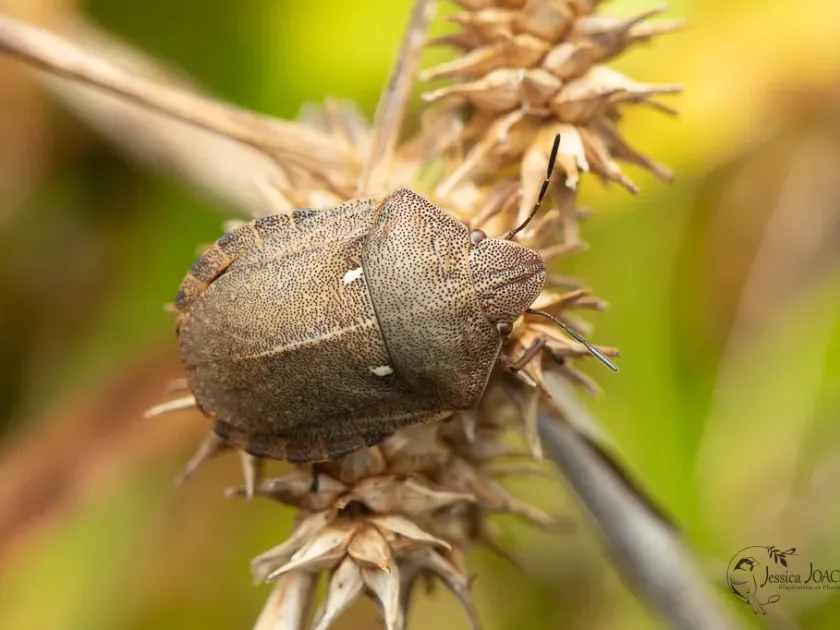
The Austrian shield bug (Eurygaster testudinaria) belongs to the order Hemiptera and the family Scutelleridae. It is a shield-shaped insect, typically reaching 10–12 mm in length, with a characteristic brownish or grayish-yellow coloration.
Unlike other species in the genus, this bug features a more pronounced wedge-shaped head and a specific pattern on the pronotum. The body is protected by a dense chitinous shell, which shields it from environmental stress and natural predators.
The nymphs go through several developmental stages, gradually increasing in size and acquiring coloration similar to the adults. They feed actively on plant sap, which supports their rapid development during the summer season.
Adults overwinter in forest litter, under fallen leaves, or in dry grass within field margins. Once consistent warm temperatures arrive, they migrate to cereal crops to feed and breed.
In field conditions, agronomists identify this pest using sweep nets. Accurate identification relies on examining the pronotum structure and head shape, as many Eurygaster species are morphologically similar.
What it damages
This pest primarily targets cereal crops, including winter and spring wheat, barley, rye, and oats. It can also be found on wild grasses, which serve as alternative hosts during the season.
The bugs extract sap from leaves, stems, and glumes, leading to stunted growth and development. The most critical period of damage occurs during the stem elongation and grain-filling stages.
Damage involves piercing the stems, which often causes whitehead symptoms or shriveled grains. The bug’s saliva contains enzymes that break down gluten, rendering the harvested grain unsuitable for milling and baking purposes.
Damaged grains become shriveled and lose their viability, significantly reducing overall yields. Even low population densities can severely downgrade the quality of an entire grain harvest.
Mass outbreaks are often correlated with mild winters and dry springs. Damage is usually localized but can spread across large fields when population densities are high.
When it appears
The emergence of the bugs from overwintering sites begins when soil temperatures reach 12–15 degrees Celsius. This timing usually coincides with the tillering stage of cereal crops.
After feeding, the bugs lay their eggs on the underside of cereal leaves. Females deposit eggs in clusters, ensuring the successful development of the next generation.
Nymphs hatch within 1–2 weeks and begin feeding on plant sap. The development from nymph to adult stage takes approximately one month, depending on regional climatic conditions.
A new generation of adults emerges in mid-summer, continuing to feed on the ripening grain until autumn. This period is the most critical as the bugs cause direct damage to the crop's economic value.
With the first cold snaps, the adults migrate to their hibernation sites. The entire lifecycle is strictly synchronized with the phenological stages of cereal crops.
Signs of infestation
The first sign of infestation is the appearance of puncture marks on the stems below the ear, often leading to premature plant death. Yellowing and curling of leaf tips are also common indicators.
Inspection of the ears reveals characteristic grain damage, appearing as dark spots with sunken tissue. When broken, these grains show internal damage caused by the bug's feeding enzymes.
Excrement deposits on leaves and glumes are another clear sign of activity. These marks are easily visible upon close inspection of the underside of the foliage.
In cases of severe infestation, the crops appear generally depressed, showing signs of wilting, while the ears may be empty or contain "bitten" and shriveled grains.
The presence of adults and nymphs is easily confirmed through standard sweep-net sampling. Population counts help determine if intervention with control measures is necessary.
Control measures
The primary control strategy involves crop rotation to prevent the continuous cultivation of susceptible cereals. Controlling weeds in and around fields is essential as they serve as secondary hosts.
Chemical control involves the application of contact and systemic insecticides once the economic threshold is exceeded. Applications are most effective during the mass emergence of nymphs.
Biological control methods include the preservation and augmentation of natural enemies, such as egg parasitoids (e.g., Telenomus species). These parasitoids can effectively suppress pest populations naturally.
Good agricultural practices such as stubble cultivation, deep autumn plowing, and early harvesting contribute to reducing the survival rate of the pest heading into winter.
- Application of approved systemic insecticides.
- Timely monitoring of pest population density.
- Encouraging natural entomophages to manage numbers.
Taxonomy
- Latin name
- Eurygaster testudinaria
- Order
- Hemiptera (bugs, aphids, leafhoppers)
- Family
- Scutelleridae
- EPPO code
- EURYTE
Discussion
No discussions yet — be the first.