
Moorish bug
Eurygaster maura
Description
How to identify
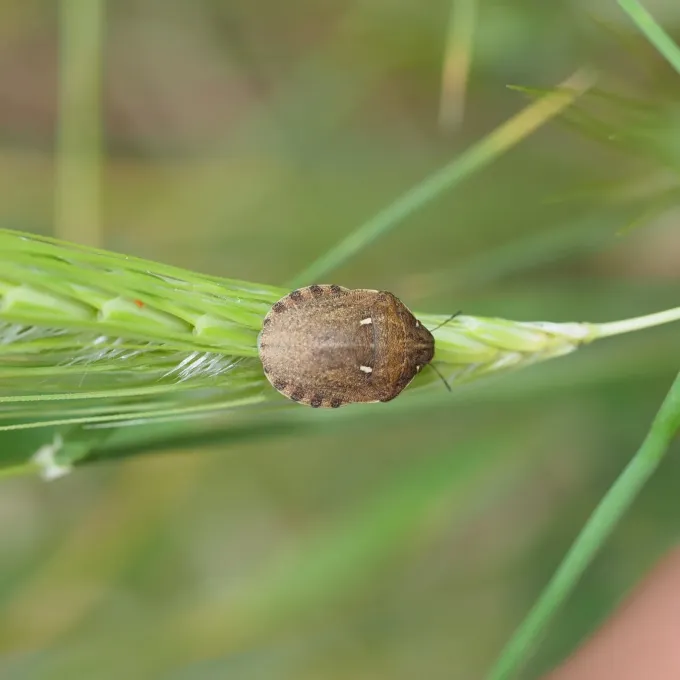
The Moorish bug Eurygaster maura belongs to the order Hemiptera and the family Scutelleridae. It is an oval-shaped insect measuring between 8 and 11 mm in length, with a coloration ranging from grayish-yellow to dark brown.
A distinctive feature of this species is a visible projection on the pronotum located before the scutellum. This characteristic helps to distinguish it from closely related species, such as the more common Sunn pest.
Adult bugs overwinter primarily in forest litter, under fallen leaves, and in dry grass. As spring approaches and soil temperatures reach 12-15 degrees Celsius, the bugs emerge and migrate to cereal fields.
The life cycle includes the egg stage, five nymphal instars, and the adult stage. Usually, there is one generation per year, although favorable climatic conditions and high humidity can accelerate the development process.
Adult bugs possess well-developed wings, allowing them to perform active flights over significant distances in search of food. This mobility complicates the localization of pest outbreaks within agricultural fields.
What it damages
The primary food sources for the Moorish bug are cereal crops, including both wild grasses and agricultural crops. It causes significant damage to wheat, barley, oats, rye, as well as millet and corn.
The pest attacks plants throughout all growth stages, from seedling emergence to grain maturation. Adults and nymphs pierce stems and leaves, feeding on the plant's cell sap.
The most critical period is the grain-filling phase, when insects suck nutrients from the milk and dough stages of the grain, leading to a sharp decrease in yield weight.
Damage to the grain is accompanied by the injection of salivary enzymes that degrade gluten. Even a small number of punctures can render the flour unsuitable for baking purposes.
Severe stem damage can lead to wilting and death of the ear, resulting in empty spikes and substantial losses in the total harvest of cereal crops in infested areas.
When it appears
The spring migration of bugs from overwintering sites coincides with the tillering phase of spring cereals and the jointing phase of winter crops. Mass arrival in fields typically occurs in late April or early May.
Egg-laying begins two to three weeks after feeding commences. Females lay eggs on the underside of plant leaves in neat rows, with 10–14 eggs per cluster.
First-instar nymphs do not feed, remaining near the egg cluster, but starting from the second instar, they begin to actively suck juices from young tissues, gradually moving toward the developing ears.
The second half of summer, July and August, is characterized by the mass emergence of new-generation adults. During this period, the pests feed intensively on cereal crops before migrating to overwintering sites.
With the onset of autumn cold, adults migrate to permanent habitats, such as forest belts, shrubs, and woodlands, where they enter diapause until the following spring.
Signs of infestation
The main sign of the Moorish bug's presence is the appearance of small punctures on leaves and stems, which eventually develop into discolored or necrotic spots.
The presence of the pest is indicated by damaged ears that turn white prematurely and become stunted. During field inspections, one can find egg clusters on the underside of leaves.
On the grain, characteristic dark-haloed spots appear where the bug has pierced the hull. The grain in these areas becomes shriveled, wrinkled, and takes on a dull or grayish hue.
In fields, it is common to find adult bugs or nymphs of various ages, which may drop to the ground or hide in leaf sheaths when approached or disturbed by noise.
Significant infestations can lead to widespread plant mortality, lodging of the crop, and a severe reduction in the baking quality of the grain, which is confirmed during laboratory analysis.
Control measures
Agronomic control methods include early sowing of spring crops and harvesting as quickly as possible. It is essential to minimize grain losses during harvest, as leftover grain attracts bugs.
Controlling weed vegetation during the off-season and managing cereal regrowth significantly reduces the pest's food supply and lowers population numbers during the spring.
Chemical protection involves the application of systemic and contact-stomach insecticides during the periods of peak damage: when nymphs emerge and during grain formation.
- Application of insecticides based on pyrethroids and organophosphorus compounds.
- Adherence to application regulations to prevent harm to beneficial insects.
- Monitoring pest density using yellow sticky traps or visual field inspections.
The biological control method involves preserving and attracting natural enemies of the bug, such as Telenomus egg parasitoids, which are capable of significantly reducing pest populations in the natural environment.
Taxonomy
- Latin name
- Eurygaster maura
- Order
- Hemiptera (bugs, aphids, leafhoppers)
- Family
- Scutelleridae
- EPPO code
- EURYMA
Discussion
No discussions yet — be the first.