
Austrian shield bug
Eurygaster austriaca
Description
How to identify
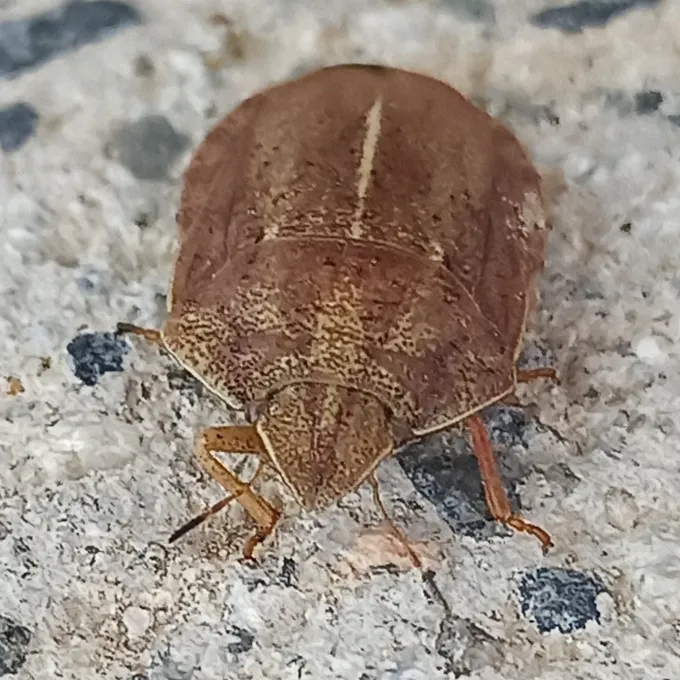
The Austrian shield bug (Eurygaster austriaca) is a large insect belonging to the Scutelleridae family, known for its significant impact on grain crops.
Adult insects have an oval-shaped body, reaching up to 13 mm in length, with coloration ranging from yellowish-grey to deep dark brown tones.
The most distinctive feature of this species is the slightly raised and rounded anterior edge of the head, which helps differentiate it from other related bugs.
Nymphs of this species resemble adults but are smaller, lack fully developed wings, and transition through several growth stages before reaching maturity.
They are primarily found in steppe and forest-steppe ecosystems, where they thrive among wild grasses and cultivated cereal fields.
What it damages
The species primarily feeds on cereal crops, including winter wheat, spring wheat, barley, and rye, causing severe physiological stress to the plants.
Both adults and nymphs feed by piercing the plant tissues and sucking out plant juices from leaves, stems, and developing grain kernels.
Damage to the stems during the booting stage often leads to "white ear" symptoms, where the ear fails to fill and eventually dies completely.
When feeding on grain, the bugs inject enzymes that degrade gluten proteins, rendering the resulting flour unsuitable for high-quality baking.
Heavy infestations can result in significant yield losses, potentially reducing total harvest productivity by up to half if left unmanaged.
When it appears
The Austrian shield bug overwinters as an adult, finding shelter in leaf litter, debris, or dense clumps of perennial grasses in protected areas.
Emergence from hibernation occurs in spring when temperatures rise to approximately 10-12 degrees Celsius, leading to migration toward winter cereal fields.
Mating and oviposition typically happen during the wheat tillering and shooting phases, ensuring nymphs have immediate access to food upon hatching.
The lifecycle consists of five nymphal instars, with development usually completed over several weeks throughout the late spring and summer months.
By late summer, the newly emerged adults feed briefly before migrating to their overwintering sites, where they remain dormant until the following year.
Signs of infestation
Initial signs of infestation include the presence of egg clusters on the undersides of leaves and small whitish spots on leaves where feeding occurred.
Stunted growth or wilting of the central leaf in the vegetative stage is a clear indicator of stem-base damage caused by the bug's feeding activities.
In the field, one may observe empty or shriveled grains in the ears, often marked by tiny dark puncture wounds left by the bug's mouthparts.
A distinctive, unpleasant odor is often detectable in fields with high population densities, as the bugs release chemicals when threatened or disturbed.
Regular visual inspections of the crop canopy during the boot and heading stages are essential to identify the presence of this pest early.
Control measures
Effective management includes cultural practices such as timely harvesting and deep autumn plowing to destroy the bugs' overwintering habitats.
Crop rotation and weed management are vital to reduce the suitability of the field environment for the pest's reproduction and survival.
Chemical control involving systemic or contact insecticides is recommended when population levels reach the economic injury threshold.
Biological control methods, such as the use of natural egg parasitoids (Telenomus species), can significantly help maintain bug populations at low levels.
Integrated Pest Management (IPM) programs emphasize scouting and monitoring to ensure that insecticide applications are targeted and ecologically responsible.
Taxonomy
- Latin name
- Eurygaster austriaca
- Order
- Hemiptera (bugs, aphids, leafhoppers)
- Family
- Scutelleridae
- EPPO code
- EURYAU
Discussion
No discussions yet — be the first.