
Austrian sunn pest
Eurygaster alternata
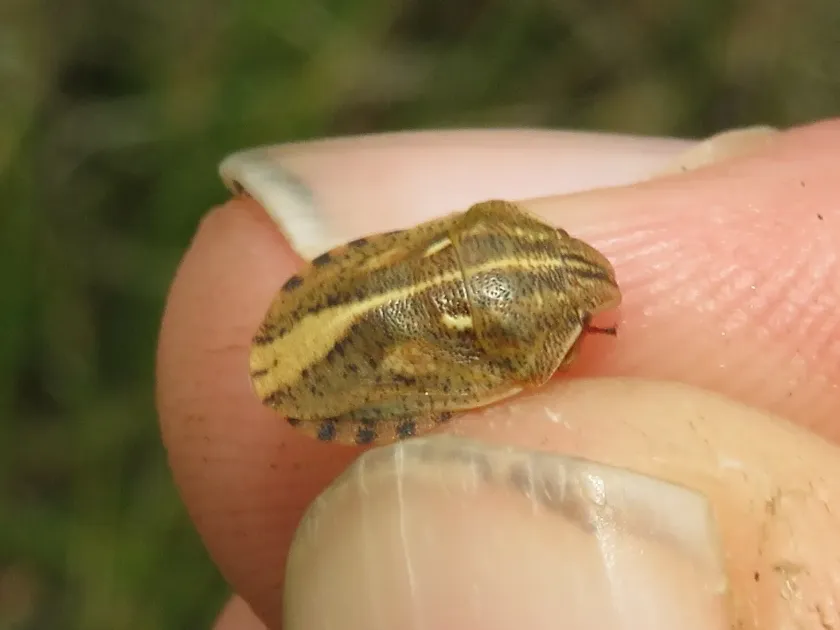
Description
How to identify
The Austrian sunn pest (Eurygaster alternata) belongs to the order Hemiptera and the family Scutelleridae. Adult bugs are typically 10–12 mm long, characterized by a large scutellum that covers most of the abdomen and wings.
The coloration of these insects ranges from light gray to brown, often featuring a mottled pattern on the pronotum and scutellum. The head is triangular, and the antennae consist of five segments, which serves as a key diagnostic feature for species identification.
Larvae undergo five developmental stages (instars), gradually increasing in size and morphologically resembling the adults. This species can be distinguished from other Eurygaster members by specific markings on the head and the structure of the pronotum.
The biological cycle includes one generation per year. Adults hibernate mainly in forest edges, windbreaks, or under plant debris, becoming active again when stable spring temperatures arrive.
After hibernation, the bugs migrate to grain fields for feeding, mating, and egg-laying. Eggs are deposited in groups on the undersides of cereal leaves, making them difficult to detect during standard field inspections.
What it damages
The pest primarily infests cereal crops such as wheat, barley, and rye. It may also feed on various wild grasses that serve as alternative hosts during the spring and autumn periods.
Significant damage is caused by both adults and larvae of all stages, which suck nutrients from the stems, leaves, and developing grains within the ear.
Damage to stems during early growth stages leads to the death of the central leaf, stunted growth, or complete plant loss, which considerably reduces crop density.
The most critical damage occurs during the grain-filling stage. Bugs pierce the grain coat and inject enzymes that degrade gluten, rendering the grain unsuitable for flour production and baking.
Flour produced from damaged grains exhibits poor baking qualities: the dough becomes sticky, loses elasticity, and the resulting bread has low volume and poor porosity.
Signs of infestation
The first indicator of an infestation is the presence of adult bugs in the field during the stem elongation phase. Careful inspection reveals puncture marks on leaves and whitening of the ear tips.
Visual symptoms in the field include damaged shoots that lag behind in growth and exhibit twisted or yellowing leaves, often mistaken for nutrient deficiencies.
The presence of egg clusters on the underside of leaves in late spring signals an impending surge in the larval population. These egg clusters are barrel-shaped and usually laid in two distinct rows.
During grain maturation, signs of infestation include a small black spot at the puncture site on the kernel. A discolored or shriveled patch often surrounds this puncture mark.
Large aggregations of larvae within the ears during the milk stage of grain development constitute a critical warning that requires immediate control interventions.
Control measures
Agrotechnical measures include harvesting the crop in a timely manner, which prevents the mass migration of the pest to hibernation sites and reduces the population for the following season.
Stubble cultivation and deep plowing after harvest help destroy larvae and eggs while creating unfavorable conditions for adults preparing for overwintering.
Crop rotation and maintaining adequate spatial separation between grain fields and forest belts, where bugs prefer to hibernate, are essential preventative strategies.
Chemical control is the primary method when the economic threshold of damage is reached. Insecticides from groups like organophosphates, pyrethroids, or neonicotinoids are commonly applied.
- Regular monitoring of pest density using an entomological sweep net.
- Timely field treatment during the grain formation stage.
- Use of insecticides with high residual activity.
- Application of tank mixes to control a broad complex of grain pests simultaneously.
Taxonomy
- Latin name
- Eurygaster alternata
- Order
- Hemiptera (bugs, aphids, leafhoppers)
- Family
- Scutelleridae
- EPPO code
- EURYAL
Discussion
No discussions yet — be the first.