
Fieber's shield bug
Eurydema fieberi
Description
How to identify
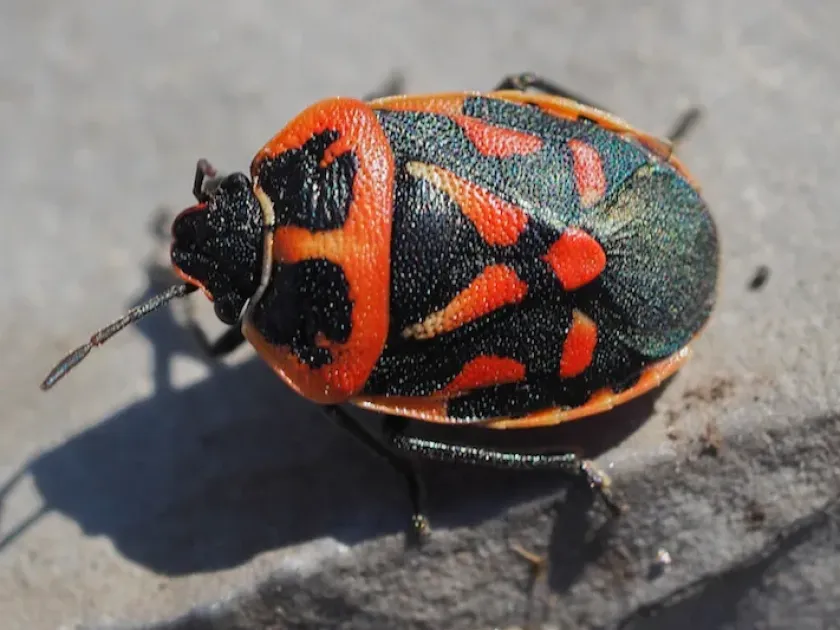
Fieber's shield bug (Eurydema fieberi) is a member of the order Hemiptera and the family Pentatomidae. These insects are easily recognized by their bright, distinctive coloration, featuring black markings on a red or yellow background.
Adults typically measure between 7 and 9 millimeters in length. Their body has a characteristic shield-like shape, which is a common feature among many species in the Pentatomidae family.
The nymphs undergo five stages of development before reaching the adult stage. Their coloration is generally more muted than that of adults, often appearing as a yellowish-gray with dark spots.
These bugs overwinter as adults in plant debris, under leaf litter, in hedgerows, or within the top layer of soil. Once temperatures rise in the spring, they emerge to colonize available host plants.
The life cycle typically includes one or two generations per year, depending on the local climate and the length of the growing season of the host crops.
What it damages
The primary food source for Fieber's shield bug consists of plants in the Brassicaceae family. The pest targets both wild weeds and various agricultural crops with equal intensity.
Major crops affected include cabbage, radish, rapeseed, mustard, and turnip. Beyond affecting foliage, the bugs frequently attack seed pods, leading to significant yield losses and reduced seed quality.
The insect feeds by piercing the plant tissue with its mouthparts and sucking out cellular juices. Enzymes present in the bug's saliva cause localized necrosis in the affected plant tissue.
Symptoms of damage include the appearance of white or yellowish spots on leaves, which subsequently darken and die. Severe infestations can cause wilting and systemic deformation of the plant.
Young seedlings are particularly vulnerable to attacks, which can lead to complete plant death, significantly reducing crop density and necessitating replanting in some instances.
When it appears
The bugs typically appear in fields in the spring when average daily temperatures reach 12–15 degrees Celsius. This timing aligns with the early stages of crop development.
Activity usually peaks in early summer when adults begin laying eggs on the undersides of host plant leaves. Egg clusters are typically laid in orderly, closely packed rows.
Summer generations develop rapidly, particularly during hot and dry weather conditions, which favor population growth and rapid migration across agricultural fields.
As the season nears its end and crops mature, the bugs migrate to late-season weeds or neighboring Brassicaceae fields to seek food before entering their overwintering phase.
With the onset of autumn temperatures, the adults seek protected overwintering sites, where they remain dormant until the following spring season.
Signs of infestation
Early signs of infestation include tiny, pale spots on the leaf surface. Upon close inspection, one may find traces of salivary secretions left by the feeding insects.
Their bright, contrastive coloration makes them quite easy to spot when they congregate on stems, flowers, or seed pods during the day.
Egg clusters appearing as small, barrel-shaped structures on the underside of leaves serve as a clear indicator of a new generation being established.
Distorted flower stalks and stunted growth are classic symptoms of prolonged feeding. Such plants often fail to reach their full potential, resulting in lower harvest quality.
The presence of young nymphs clustered within the leaf rosettes is a definitive sign of an active, growing colony that requires prompt management intervention.
Control measures
Cultural control methods such as deep autumn plowing are effective in destroying overwintering sites and reducing the initial population size for the upcoming season.
Maintaining fields free of Brassicaceae weeds is a crucial preventative measure, as these weeds act as secondary hosts for the bugs throughout the growing season.
Chemical control, when necessary, should be applied during the early nymph stages, which are the most susceptible to contact and systemic insecticides. Always follow local label regulations.
Biological control agents, including various egg parasitoids, play a significant role in naturally suppressing bug populations and should be preserved in integrated pest management programs.
- Regular scouting of fields during the early growing season.
- Effective weed management in and around production areas.
- Strategic application of insecticides at economic threshold levels.
Taxonomy
- Latin name
- Eurydema fieberi
- Order
- Hemiptera (bugs, aphids, leafhoppers)
- Family
- Pentatomidae
- EPPO code
- EURDFI
Discussion
No discussions yet — be the first.