
Red-legged shield bug
Eurydema dominulum
Description
How to identify
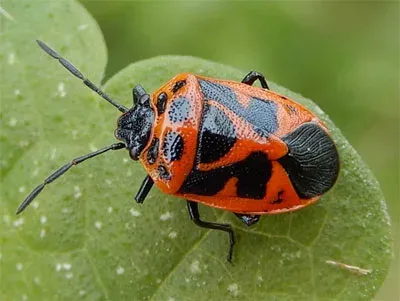
The red-legged shield bug (Latin: Eurydema dominulum) is a member of the Pentatomidae family, order Hemiptera. These insects are easily recognizable by their vibrant, warning coloration: a black body with a metallic sheen, adorned with distinct red, orange, or white patterns on the pronotum and scutellum.
Adult specimens typically range from 7 to 10 millimeters in length. Their most prominent feature, as the name implies, is their reddish legs, which set them apart from other related shield bug species found in agricultural landscapes.
The insect undergoes hemimetabolous development. Adults hibernate through the winter in leaf litter, dense vegetation, or debris, emerging in early spring as temperatures rise to begin their life cycle.
Once active, they initially colonize weeds before migrating to preferred cultivated crops. Mating occurs shortly after emergence, followed by the female laying eggs in small, organized batches.
The eggs are laid in two rows, typically in clusters of 12, on the undersides of leaves. This placement makes the eggs somewhat shielded from direct sun and potential predators, ensuring higher survival rates for the nymphs.
What it damages
These bugs are specialized pests of the Brassicaceae family. They primarily attack crops such as cabbage, radish, turnip, mustard, and horseradish, causing significant physiological stress to the plants.
They use their piercing-sucking mouthparts to penetrate plant tissues, extracting sap. As they feed, they inject toxic saliva that contains enzymes, which cause the surrounding tissue to break down and necrotize.
Seedlings and young plants are the most vulnerable; heavy infestation can result in stunted growth, leaf deformation, and, in severe cases, the complete death of the crop.
Damage to flowering stalks and seedpods is particularly detrimental for seed producers, as it directly impacts the yield and quality of the seeds being harvested for the following season.
Lesions left by the feeding process serve as entry points for various secondary infections, including fungal pathogens and bacteria, which can accelerate the decay of the foliage.
Signs of infestation
The first indicator of an infestation is the appearance of small white or pale yellow spots on the leaves, which gradually turn into irregular holes as the tissue dies and falls away.
Insects are often visible during the day, resting on the upper or lower surfaces of leaves. Because of their bright markings, they are relatively easy to spot if you inspect the plants carefully.
Searching for egg clutches on the undersides of leaves is a proactive way to detect the presence of the pest early. The eggs appear as neat, barrel-shaped structures with small dark dots.
General wilting or yellowing of the foliage during dry, hot weather—despite adequate watering—often indicates that the plant is being drained of sap by a cluster of shield bugs.
Tiny black spots on the leaves, which are the excrement of the bugs, provide clear evidence that a colony is currently active and feeding on that specific part of the crop.
Control measures
Effective management begins with strict weed control, specifically targeting Brassicaceae weeds like shepherd's purse and wild mustard, which act as early-season host plants for the bugs.
Tilling the soil deeply after the harvest helps to bury or destroy overwintering sites, significantly reducing the population of adult bugs that would otherwise emerge the following spring.
For smaller garden plots, manual collection of the adults and the physical removal of leaves containing egg clutches are highly effective and environmentally friendly control measures.
Utilizing row covers or fine mesh netting during the early growth stages prevents adult bugs from accessing the plants, effectively stopping egg-laying cycles without the need for chemicals.
When populations reach economic damage thresholds, the application of registered insecticides is recommended, ensuring that all safety instructions and pre-harvest intervals are strictly followed.
Taxonomy
- Latin name
- Eurydema dominulum
- Order
- Hemiptera (bugs, aphids, leafhoppers)
- Family
- Pentatomidae
- EPPO code
- EURDDO
Discussion
No discussions yet — be the first.