
Steppe grasshopper
Euchorthippus pulvinatus
Description
How to identify
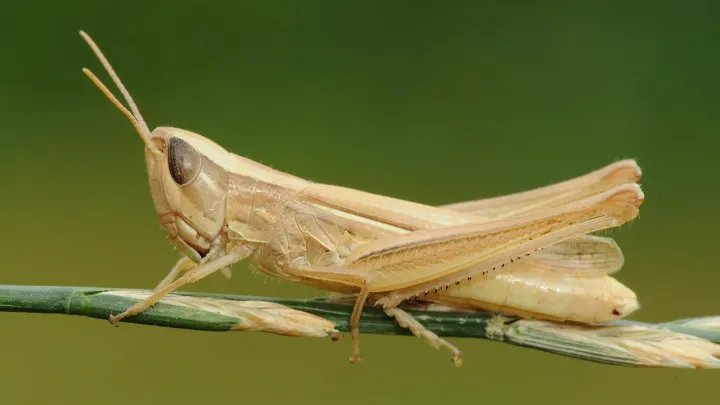
The steppe grasshopper (Euchorthippus pulvinatus) belongs to the order Orthoptera and the family Acrididae. This small insect has a slender body ranging from 15 to 25 mm in length, typically displaying yellowish-brown or light green coloration for effective camouflage.
Adults possess well-developed wings that often reach or slightly exceed the end of the abdomen. The head is conical, a characteristic feature of the Gomphocerinae subfamily, and the antennae are clearly visible to the naked eye.
A diagnostic feature of this species is the presence of specific light-colored longitudinal stripes along the sides of the pronotum. These signs are essential for agronomists to correctly identify the pest during field scouting in the spring and summer.
Sexual dimorphism is moderate, with females usually being larger than males and possessing a more robust abdomen designed for laying eggs in the soil. Nymphs resemble adults but are smaller in size and lack fully developed wings.
Reproduction occurs through mating, after which the female deposits eggs into the soil within protective capsules called egg pods, which safeguard the offspring from harsh environmental conditions during the winter months.
What it damages
This species is a polyphagous pest, feeding primarily on cereal crops. The list of vulnerable plants includes wheat, barley, oats, millet, and maize, particularly during the early stages of plant development.
Beyond agricultural fields, the steppe grasshopper actively colonizes natural pastures, meadows, and grasslands. These areas serve as natural reservoirs from which the pests migrate into adjacent crop fields.
During years of massive outbreaks, these insects can completely destroy cereal seedlings by consuming leaves down to the base. This results in thinned plant stands and significant reductions in potential crop yield.
Damage is particularly severe during dry and hot seasons, as natural vegetation withers, forcing the grasshoppers to concentrate on irrigated or lush crop fields, where they cause the most substantial economic damage.
Beyond direct foliage loss, the feeding damage weakens the plants, making them more susceptible to secondary diseases and physiological stress, which further diminishes the quality of the grain harvest.
When it appears
The lifecycle of this species is univoltine (one generation per year). Eggs overwinter inside egg pods at a shallow depth in the soil. In spring, as temperatures rise, the nymphs emerge to begin their feeding cycle.
The nymphal stage lasts for approximately 30 to 40 days, during which the pest undergoes five instars. This period is marked by high feeding activity, as the nymphs require constant access to succulent cereal foliage.
Fledging occurs in early summer, usually around June. At this stage, the insects become highly mobile and capable of migrating over long distances in search of better food sources and breeding grounds.
The period of mass flight and mating occurs mid-summer. Agronomists must conduct intensive monitoring during this time to assess population density and the necessity for insecticide applications.
The lifecycle concludes in the autumn when adults die due to the onset of frost. Before perishing, females ensure the survival of the population for the next season by laying eggs in the soil.
Signs of infestation
The first sign of infestation is the presence of characteristic "ragged" edges on the leaves of young crops. Unlike caterpillars, grasshoppers start feeding from the leaf margin, creating distinct, irregular bite marks.
The pest is most active during the morning hours, making it the ideal time to detect them by observing the sudden jumping of insects when walking through the field.
Affected field areas often appear as patches of thinned vegetation or completely bare spots. If left unmanaged, these spots expand rapidly, potentially covering large sections of the crop area.
During the hottest part of the day, grasshoppers seek refuge near the base of stems or in the lower canopy, so entomological sweeping nets should be used for accurate population counting.
The gathering of birds in the fields can also serve as an indirect indicator that a large population of grasshoppers is present, as they constitute a major food source for local bird species.
Control measures
The primary control measure is agronomic, involving deep autumn tillage. This practice destroys the egg pods, exposing the eggs to the surface where they perish from desiccation or bird predation.
Effective management requires the control of weeds along field borders, forest strips, and roadsides, as these zones act as primary breeding grounds for the steppe grasshopper before they move into crops.
When the economic threshold is exceeded (usually 2–5 individuals per square meter), chemical insecticides are required. These are typically chosen from registered organophosphate or pyrethroid groups.
- Optimal timing: Apply during the early nymphal stages when pests are most vulnerable to chemical agents.
- Use aerial spraying for large-scale infestations or ground sprayers for localized hotspots.
- Adhere strictly to safety protocols to protect beneficial insects and local pollinators.
Biological control methods involve the use of entomopathogenic fungi or microbes, which can suppress pest populations without environmental harm, though they require specific environmental conditions to be effective.
Taxonomy
- Latin name
- Euchorthippus pulvinatus
- Order
- Orthoptera (locusts)
- Family
- Acrididae
- EPPO code
- CHOHPU
Discussion
No discussions yet — be the first.