
Yellow-spotted stink bug
Erthesina acuminata
Description
How to identify
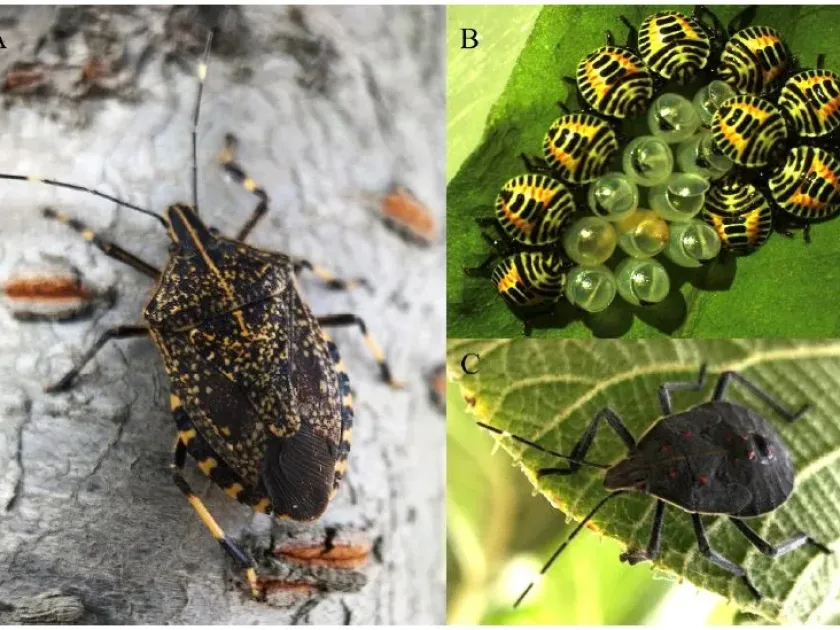
The yellow-spotted stink bug (Erthesina acuminata) belongs to the Pentatomidae family, order Hemiptera. Adult insects have a typical shield-like body shape, usually measuring between 17 mm and 23 mm in length.
Their base color ranges from brown to gray, characterized by dense, small dark punctations. A key diagnostic feature is the presence of yellowish or orange spots along the margins of the pronotum, scutellum, and abdomen.
Nymphs undergo five developmental instars, displaying a color transition from vibrant red with black patterns in early stages to darker, more dull shades in the final nymphal stages.
The insect possesses a piercing-sucking mouthpart, which allows it to penetrate plant epidermis and fruit skins to access nutrient-rich plant sap.
Although they may be confused with other shield bug species, the distinct arrangement of the pale spots on the pronotum provides a reliable marker for field identification.
What it damages
This species is a highly polyphagous pest, known to feed on over 100 different plant species, including apples, pears, peaches, citrus fruits, kiwis, and grapes.
Beyond orchards, it frequently attacks vegetable crops such as tomatoes and peppers, as well as various ornamental trees and shrubs in urban and rural environments.
Damage is caused by both adults and nymphs, which drain plant sap from leaves, stems, and fruits, leading to reduced vigor and stunted growth.
Fruit damage is the most economically significant, as feeding punctures result in necroses, deformations, and localized rotting, rendering the produce unmarketable.
Feeding sites often become entry points for secondary fungal and bacterial pathogens, which significantly increases the total volume of crop loss during storage.
When it appears
The yellow-spotted stink bug overwinters as an adult, seeking shelter under loose bark, in leaf litter, or within cracks and crevices of agricultural or residential structures.
As temperatures rise in the spring, the overwintered adults emerge and begin feeding on newly emerging buds and tender shoots of host plants.
The egg-laying period typically spans late spring to mid-summer, with females depositing clusters of eggs on the undersides of leaves to ensure survival.
Depending on regional climatic conditions, the bug can produce two generations per year, leading to exponential population growth towards late summer.
The peak activity and the most intense damage to fruits are usually observed during the late summer months as the insects congregate on ripening produce.
Signs of infestation
Visual identification of the bug on leaves or fruit is a primary sign, especially during the cool early morning hours when the insects are less mobile.
Initial feeding damage appears as small, depressed dots on the fruit surface, which eventually turn dark and necrotic, indicating tissue collapse beneath the skin.
Affected plants often show systemic stress, including leaf yellowing, curling, and premature abscission of buds or fruit due to massive fluid loss.
Accumulation of black excrement droplets on leaves and fruit surfaces is a common sign of infestation, which may lead to the development of sooty mold.
A foul-smelling, pungent odor is often emitted by the insects when they are disturbed or crushed, which can serve as a detectable sign of their presence in the canopy.
Control measures
Management heavily relies on the timely application of systemic or contact insecticides, such as neonicotinoids or pyrethroids, based on established economic thresholds.
Cultural practices, including the removal of weeds and debris in orchards, are essential to eliminate favorable overwintering sites for the adult population.
Pheromone traps are highly effective for monitoring the arrival and population density of the bugs, allowing for precise timing of integrated pest management interventions.
Biological control using natural egg parasitoids (such as Trissolcus spp.) has demonstrated success in reducing population outbreaks in sustainable farming systems.
- Regular inspection of fruit trees during the sensitive maturation stage.
- Mechanical exclusion using protective orchard netting.
- Hand-picking and destruction of insects in small-scale plantings.
Taxonomy
- Latin name
- Erthesina acuminata
- Order
- Hemiptera (bugs, aphids, leafhoppers)
- Family
- Pentatomidae
- EPPO code
- ERTNAC
Discussion
No discussions yet — be the first.