
Lappet moth
Eriogaster
Description
How to identify
The genus Eriogaster belongs to the order Lepidoptera and the family Lasiocampidae, commonly known as Lappet moths. Adult moths are medium-sized with robust, hairy bodies that provide insulation against cooler temperatures.
The larvae, or caterpillars, are characterized by dense hairs covering their bodies, which can cause irritation to human skin upon contact. Their coloration is generally cryptic, serving as camouflage against the twigs and leaves of host plants.
Their life cycle involves complete metamorphosis, consisting of four stages: egg, larva (caterpillar), pupa, and adult (moth). Most species in this genus are univoltine, meaning they complete one generation per year, typically overwintering in the egg stage.
Pupation occurs within firm, silken cocoons often attached to twigs or hidden in the leaf litter. These cocoons are highly protective, ensuring the survival of the pupa throughout the dormant season.
Adult moths are primarily nocturnal and are rarely seen during the day. They focus on reproduction, with females depositing their eggs in clusters on the stems of suitable host trees and shrubs.
What it damages
Lappet moths are primarily pests of trees and shrubs, showing a preference for deciduous species. In agricultural settings, they can cause significant damage to fruit trees such as apple, pear, plum, and cherry.
Beyond orchards, they frequently infest forest trees including oak, birch, willow, and poplar. In years of outbreak, their feeding can lead to severe defoliation, stressing the health of the entire canopy.
The larvae are voracious feeders. In early stages, they feed gregariously, skeletonizing the leaves, while older caterpillars consume the entire leaf blade, leaving only the main veins.
Heavy infestation weakens trees, making them susceptible to secondary pests and fungal infections. The loss of leaf area reduces the tree's photosynthetic capacity, which directly affects fruit quality and yield.
In cases of severe outbreaks, trees may suffer from repeated defoliation in a single season, which can eventually lead to stunted growth or even the death of younger or weaker specimens.
When it appears
Spring is a critical time for pest management, as larvae emerge from overwintered eggs just as buds begin to burst. This is when they are most vulnerable to initial control measures.
The peak feeding activity occurs during May and June. During this window, regular scouting of the orchard or garden is essential to prevent the spread of the caterpillar population.
Adult moth activity typically peaks in late summer or autumn. After mating, females lay their eggs on twigs, where they remain dormant throughout the winter until the next spring.
Winter is the most effective time for mechanical control, as the egg clusters are visible on dormant branches and can be easily removed by pruning and burning.
Climatic factors play a major role in population dynamics. Mild winters often lead to higher survival rates for eggs, resulting in increased caterpillar pressure in the following season.
Signs of infestation
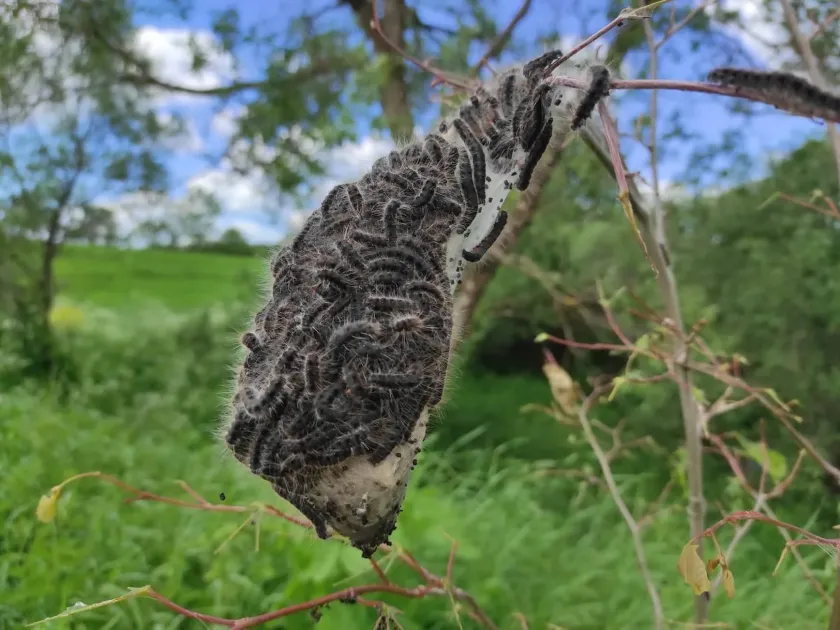
One of the most noticeable signs of a Lappet moth infestation is the presence of webbed nests on branches. These nests serve as communal shelters for the larvae during the day.
Frass (larval droppings) found on leaves or the ground beneath the tree canopy is a clear indicator of feeding activity occurring in the upper branches.
Defoliated leaves, showing either partial skeletonization or complete loss of the leaf blade, are classic symptoms of caterpillar feeding. The damage usually begins at the edges of the leaves.
Egg clusters appear as collar-like growths around thin twigs, often covered with hairs from the female's abdomen. These are often overlooked until the leaves drop in autumn.
Clusters of larvae found on the bark or branches are a direct sign that immediate control measures are required to protect the tree from further damage.
Control measures
Mechanical removal is the most environmentally friendly control method. By cutting out and destroying the silken nests and pruning branches with egg clusters during winter, you can drastically reduce local populations.
Biological control using microbial insecticides based on Bacillus thuringiensis is highly effective against young larvae. This approach minimizes harm to beneficial insects and pollinators.
Chemical intervention should be reserved for periods of high population density when economic thresholds are exceeded. Use selective insecticides to minimize impact on non-target species.
Maintaining a healthy garden ecosystem by encouraging birds and parasitic wasps provides a natural check on Lappet moth numbers. These natural predators are often sufficient to keep populations below damaging levels.
- Perform regular garden monitoring.
- Mechanically remove nests and egg clusters.
- Use biological insecticides like Bt.
- Apply chemical sprays only when necessary.
- Promote biodiversity to support natural predators.
Taxonomy
- Latin name
- Eriogaster
- Order
- Lepidoptera (butterflies)
- Family
- Lasiocampidae
- EPPO code
- ERIGSP
Discussion
No discussions yet — be the first.