
Lappet moth (Epicnaptera ilicifolia)
Epicnaptera ilicifolia
Description
How to identify
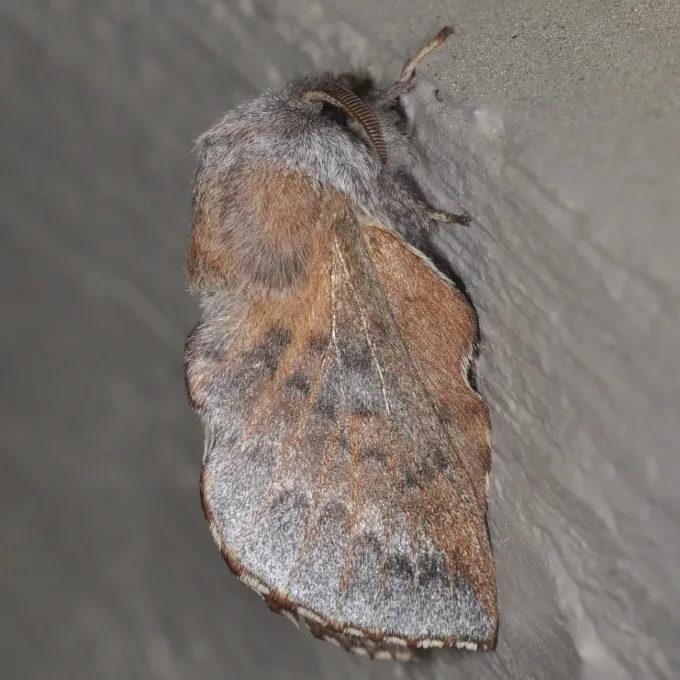
The Lappet moth (Epicnaptera ilicifolia) belongs to the Lasiocampidae family within the order Lepidoptera. The adult moth is characterized by a wingspan ranging from 40 to 55 mm, with brownish-grey forewings featuring intricate, wave-like patterns that provide perfect camouflage against tree bark.
The larvae, commonly known as caterpillars, can reach lengths of up to 70 mm. They are covered in dense hairs and display grey or brownish coloration. When threatened, they reveal distinct orange or red transverse stripes hidden between their segments.
This species is widely distributed across the forest zones of Eurasia. They are relatively rare compared to other moths in the Lasiocampidae family, which often makes their presence in garden environments go unnoticed for an extended period.
The pupal stage occurs within a sturdy, greyish-brown cocoon. These cocoons are skilfully attached to twigs or hidden within bark crevices, resembling dry leaves or lichen, which makes them very difficult to spot during routine inspections.
The life cycle consists of the egg, larval (caterpillar), pupal, and adult stages. In most climates, the species produces one generation per year, typically overwintering as a young larva firmly attached to the host tree's twigs.
What it damages
The primary host plants for Epicnaptera ilicifolia are members of the Salicaceae family, specifically poplars (Populus) and willows (Salix). In some cases, the larvae may migrate to fruit trees if their preferred hosts are scarce.
Damage is caused exclusively by the caterpillars. Due to their large size and high metabolic rate, they are capable of consuming significant amounts of foliage, which leads to severe defoliation of the infested trees.
When mass outbreaks occur, the loss of foliage severely hampers the tree's ability to photosynthesize. This results in weakened growth, reduced nutrient storage, and a decreased ability of the tree to develop healthy buds for the following year.
In young trees or saplings, such damage can be fatal. The loss of leaves leaves the bark exposed to sunscald, and the tree becomes significantly more susceptible to secondary fungal infections or attacks by wood-boring insects.
The feeding pattern usually starts from the edges of the leaf, leading to skeletalization, where only the toughest veins remain. This visual sign is the most reliable indicator of an infestation in progress.
When it appears
Adult moths are typically active during the spring, usually between April and May. Following emergence, they mate and lay eggs directly onto the bark or near the developing buds of the host plant.
Larvae hatch in late spring. The peak feeding period occurs throughout June and July, when the foliage is at its most nutritious stage. This is the time when the caterpillars are most visible and vulnerable to management.
Pupation occurs in the summer months, usually by August. The pupa remains in its protective cocoon throughout the autumn and winter, waiting for the return of favorable spring conditions to begin the next cycle.
Climatic factors, such as unusually warm and dry springs, can accelerate larval development. This can lead to larger, more robust caterpillars that consume foliage more rapidly, increasing the overall severity of the damage.
Regular monitoring should begin as soon as the buds burst in the spring. Observing the early development of larvae is key to preventing the spread of the population across the entire garden or forest patch.
Signs of infestation
The most prominent sign of an infestation is the presence of eaten leaves with jagged edges. While many insects feed on leaves, the combination of skeletalization and large size makes this caterpillar quite distinct.
The presence of cocoons on the branches is a primary indicator. They look like small, elongated grey swellings or bark abnormalities, often overlooked by inexperienced observers during winter pruning.
Frass (caterpillar droppings) accumulating on the lower leaves or on the ground beneath the tree canopy is a strong indicator that a colony is present and actively feeding in the upper branches.
Sometimes, the bark around the site where the cocoon is attached may show minor scarring. Additionally, the presence of specific bird species feeding within the canopy can often reveal the location of a caterpillar colony.
- Jagged, uneven leaf edges.
- Skeletalized foliage with central veins left intact.
- Small, grey, leaf-like cocoons attached to twigs.
- Dark frass granules found on the ground or leaves.
Control measures
Manual removal is a highly effective control method for small-scale infestations. Collecting caterpillars or carefully pruning away branches containing cocoons during winter is both environmentally friendly and efficient.
Biological control using formulations based on Bacillus thuringiensis is recommended for larger areas. This bacterium is highly specific to moth larvae and does not harm beneficial insects or pollinators.
In cases of severe outbreak, contact or systemic insecticides may be necessary. These should be applied early in the season when larvae are in their initial stages to prevent the worst of the damage.
Good silvicultural practices, including maintaining tree vigor through appropriate irrigation and nutrient management, help trees recover faster from damage and increase their natural resistance to pest attacks.
Encouraging insectivorous birds, such as tits or warblers, into your garden provides natural predation pressure on the larvae, which can keep the population levels below the economic threshold of damage.
Taxonomy
- Latin name
- Epicnaptera ilicifolia
- Order
- Lepidoptera (butterflies)
- Family
- Lasiocampidae
- EPPO code
- EPIPIL
Discussion
No discussions yet — be the first.