
American lappet moth
Epicnaptera americana
Description
How to identify
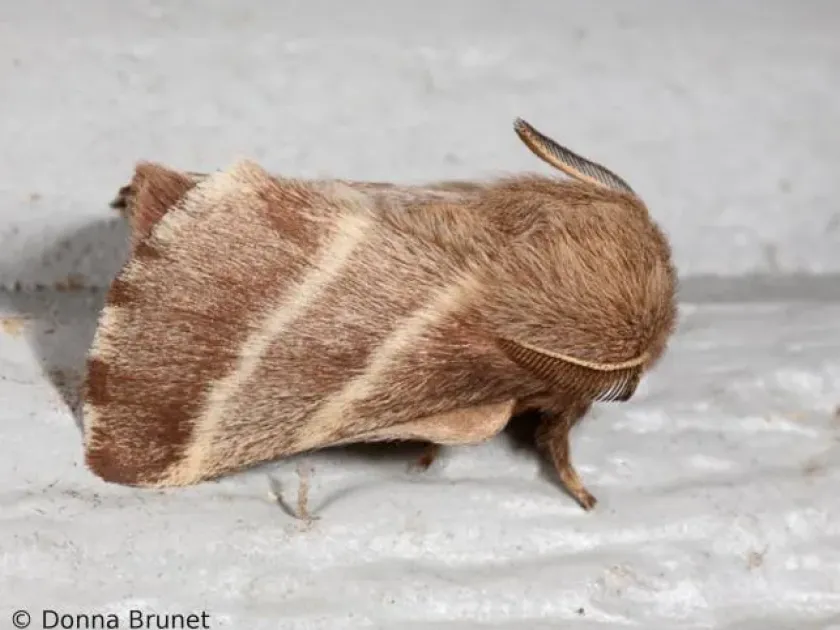
The American lappet moth (Epicnaptera americana) is a member of the Lasiocampidae family within the order Lepidoptera. Adult moths are large, nocturnal insects with distinctive jagged wing edges that mimic dry leaves, providing excellent camouflage.
The larvae are notably large and covered in dense setae, or hairs. Their coloration is variable, ranging from shades of grey and brown to reddish tones, which allows them to blend in with bark and branches seamlessly.
Females are generally larger than males, featuring broader wings and a heavier body. A characteristic visual feature of the moths is the finger-like projections along the margins of the forewings.
Their lifecycle progresses through the egg, larva, pupa, and imago stages. In most parts of their range, they produce one generation per year, though warmer climates may allow for partial second generations.
These moths overwinter as late-stage larvae, hiding within bark crevices or leaf litter, which provides significant protection against harsh winter conditions.
What it damages
The American lappet moth primarily targets various deciduous trees and shrubs. In agricultural settings, it is recognized as a potential pest of fruit-bearing species.
Common hosts include apple, pear, plum, cherry, and other stone fruit trees. Beyond orchards, they are known to thrive on forest species such as oak, birch, and alder.
Larvae feed on foliage, starting at the leaf edges and consuming the entire leaf blade. In cases of outbreaks, they can cause near-total defoliation of the host plant.
This loss of leaf surface reduces the photosynthetic capacity of the tree, negatively impacting fruit production and overall tree vigor.
Stressed trees become increasingly susceptible to secondary pests and various diseases, which can lead to significant branch dieback or tree mortality if attacks are repeated.
When it appears
Adult moths typically fly during the summer months, spanning from June to August, during which time egg-laying occurs.
Young larvae emerge in late summer and feed actively through the autumn, building up reserves for the winter diapause.
With the arrival of warmer temperatures in the spring, the overwintered larvae resume feeding, growing rapidly before they prepare for pupation.
Pupation occurs within dense, camouflaged cocoons attached to branches or tree trunks. This stage persists for several weeks before the next generation of moths emerges.
The spring period is particularly critical for orchard management, as post-winter larvae feed voraciously on developing buds and emerging foliage.
Signs of infestation
One of the primary indicators of a lappet moth presence is the appearance of skeletonized or raggedly consumed leaves throughout the canopy.
Cocoon clusters attached to branches are major diagnostic features. While they are adapted to look like bark, a thorough inspection can reveal their presence.
The accumulation of frass (larval excrement) on leaves or the ground beneath the tree serves as a clear sign of active larval feeding.
Larvae are often spotted while they remain motionless on twigs, as they are expert mimics of dry branches or bark nodes.
During significant infestations, the audible sound of falling leaf fragments and the presence of thinning foliage are clear indicators that the trees are under heavy pressure.
Control measures
Mechanical control involves the hand-collection and destruction of eggs and cocoons, which is viable for smaller trees or home orchard setups.
Biological control using formulations of Bacillus thuringiensis is an effective way to target young larvae while protecting beneficial predatory insects.
When populations exceed economic thresholds in commercial orchards, registered contact or systemic insecticides may be necessary during the active larval feeding phases.
Encouraging the presence of natural enemies, such as parasitic wasps and predatory beetles, is a cornerstone of an integrated pest management strategy.
- Pruning trees regularly to improve visibility and pest access.
- Removing loose, old bark during the dormant season to eliminate hiding spots.
- Utilizing sticky barriers on trunks to prevent larval movement.
Taxonomy
- Latin name
- Epicnaptera americana
- Order
- Lepidoptera (butterflies)
- Family
- Lasiocampidae
- EPPO code
- EPIPAM
Discussion
No discussions yet — be the first.