
Lappet moth
Epicnaptera
Description
How to identify
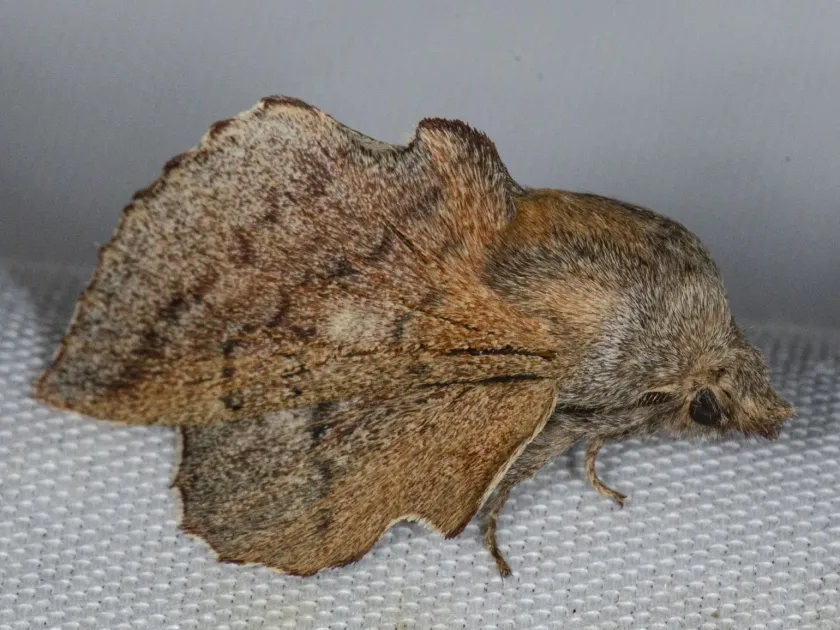
The Lappet moth (Gastropacha quercifolia) is a member of the Lasiocampidae family. It is a large moth known for its remarkable ability to mimic a dry, crumpled leaf while at rest, which provides excellent camouflage.
The moth's wings are reddish-brown with dark, jagged patterns. When the insect lands, it folds its wings in a "tent" shape, making it almost indistinguishable from surrounding debris or tree bark.
Larvae of the Lappet moth are equally impressive, growing up to 10 cm in length. Their appearance is generally greyish-brown, and they possess a distinctive blue or black band on the third thoracic segment, revealed only when the larva is disturbed.
Pupation occurs within a firm, elongated cocoon, which the larvae attach to the bark or branches of host trees. These cocoons are often greyish in color, matching the texture of the tree trunk.
This species is found throughout Europe and Asia, preferring habitats such as woodlands, hedgerows, and neglected orchards where its host plants are abundant.
What it damages
As a polyphagous insect, the Lappet moth feeds on a wide variety of woody plants. It causes significant economic damage to fruit-bearing trees and ornamental species alike.
Primary host plants include apple, pear, plum, cherry, and apricot trees. In addition to fruit crops, the caterpillars are frequently found on oak, willow, birch, and hawthorn trees.
Young larvae feed initially by skeletonizing the leaves, removing the soft tissue while leaving the veins intact. Mature larvae are capable of consuming entire leaves, severely reducing the plant's foliage.
Heavy infestations result in widespread defoliation. This process deprives the tree of its ability to photosynthesize, leading to stunted growth, reduced fruit yields, and a weakened overall condition.
Repeated defoliation by this pest leaves the trees susceptible to secondary pathogens and wood-boring insects, which can eventually lead to the premature death of the tree.
When it appears
The Lappet moth typically completes one generation per year. Adult moths are on the wing during the summer months, primarily between June and August.
Females deposit their eggs in small clusters on the underside of leaves or directly onto twigs. The eggs hatch after about two weeks, and the young caterpillars begin feeding immediately.
The species overwinters as mid-stage larvae. During the cold months, they hide in crevices within the tree bark or near the forks of branches, where they remain dormant until the following spring.
As soon as buds begin to open and foliage emerges, the caterpillars resume feeding. This spring feeding phase is when they do the most visible damage before they reach maturity.
Once fully grown, the larvae spin their cocoons and pupate. After a few weeks, the adult moth emerges to start the reproductive cycle again.
Control measures
Controlling the Lappet moth requires a proactive approach centered on monitoring and timely intervention to prevent large-scale population build-up.
Mechanical control is effective in smaller settings, involving the manual removal of cocoons and wintering larvae from tree trunks during the dormant season.
Chemical control should be targeted at the early larval stages in the spring when they are most vulnerable to contact or systemic insecticides.
Biological control methods are highly encouraged, particularly the use of specialized bacterial formulations that target lepidopteran larvae while sparing beneficial insects.
- Promoting biodiversity in the garden to attract natural predators such as birds and parasitoid wasps.
- Monitoring the adult population using pheromone traps to time treatments accurately.
- Maintaining tree health through proper fertilization and pruning to help them recover from defoliation.
Taxonomy
- Latin name
- Epicnaptera
- Order
- Lepidoptera (butterflies)
- Family
- Lasiocampidae
- EPPO code
- EPIPSP
Discussion
No discussions yet — be the first.